Introduction
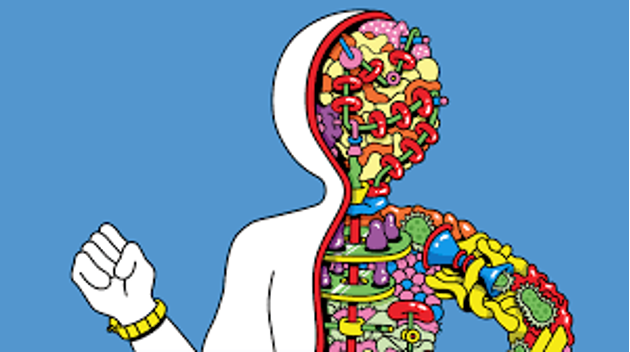
We often think of ourselves as individuals, but inside each of us lives a vibrant community of trillions of tiny organisms: bacteria, fungi, viruses and other microbes. Known collectively as the gut microbiota, these microscopic companions play an extraordinary role in our daily lives. They help us digest food, train our immune system, produce essential vitamins, and even influence our mood and brain function.
The human gut microbiome has been called a ‘forgotten organ’ because, although invisible to the naked eye, it works alongside our cells to maintain balance and health. Understanding how gut microbes work opens new doors to medicine, nutrition and even mental wellbeing. This unit takes students on a journey into the hidden world within them, using interactive activities and augmented reality (AR) to bring this microscopic universe to life.
The word ‘microbe’ comes from the Greek mikros (small) and bios (life). Microbes include bacteria, archaea, fungi, protozoa and viruses. Some live in the soil, others in water, and billions live inside our bodies, silently influencing our health every day.
The existence of microbes was unknown until the invention of the microscope in the 17th century. Dutch scientist Antonie van Leeuwenhoek was the first to observe them around 1674, using lenses he had made himself. He called these tiny creatures ‘animalcules’ when he saw them wriggling in a drop of pond water. This was a turning point in science: for the first time, humanity realised that there was a whole invisible world coexisting with us.
Later, in the 19th century, scientists such as Louis Pasteur and Robert Koch demonstrated that microbes could cause disease, giving rise to the “germ theory”. Pasteur showed that microorganisms were responsible for food fermentation and spoilage and developed the pasteurisation process to make milk safe. Koch, meanwhile, identified the specific microbes responsible for tuberculosis and cholera, laying the foundations of modern microbiology.
But microbes are not just pathogens. Modern research has revealed their essential role in health and ecology. In our intestines, microbes help digest complex plant fibres, produce vitamins, train our immune system and protect against harmful invaders. Today, scientists use advanced DNA sequencing to study the microbiome, discovering connections between microbes and conditions such as obesity, depression, and autoimmune diseases
To make this complex world more accessible, students can watch animations showing bacteria breaking down food molecules or microscope images of microbial colonies growing on a Petri dish. Teachers can guide discussions with questions such as,
If microbes are invisible to the eye, how do we know they exist?
or
Why do some microbes make us sick while others keep us alive?
By the end of this phase, students understand that microbes are not only the oldest and most abundant life forms on Earth, but also our constant companions. They are both friends and foes, shaping ecosystems, human history, and our health in ways we are still discovering.