Introduction
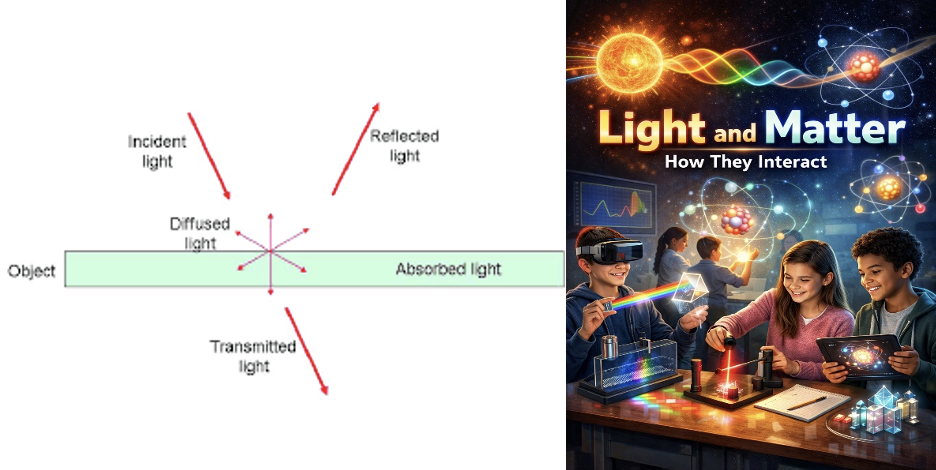
Light is one of the most fundamental phenomena in nature and plays a crucial role in how humans perceive and understand the world. Every day we encounter light interacting with different forms of matter: mirrors reflect our image, lenses refract light to focus images in cameras and glasses, surfaces absorb light and appear with different colors, and some materials emit light through fluorescence or phosphorescence. These phenomena are not only central to physics but also to modern technologies such as lasers, fiber optics, optical sensors, solar panels, and digital displays.
Understanding the interaction between light and matter allows students to explore fundamental physical concepts while developing analytical thinking and observation skills. This learning unit focuses on the main mechanisms of light-matter interaction: reflection, refraction, absorption, and emission. Through a combination of observation, experimental activities, and digital simulations, students will investigate how light behaves when it encounters different materials.
In addition to traditional hands-on laboratory activities, this unit integrates Augmented Reality (AR) technologies to enhance the learning experience. AR allows students to visualize processes that are normally invisible to the naked eye, such as the behavior of photons or the microscopic interactions between light and atoms. By manipulating virtual environments and observing real-time changes in physical phenomena, learners can develop a deeper conceptual understanding of how light behaves.
The structure of the learning unit is organized into three main phases: Explore, Execute, and Enhance. In the Explore phase, students are introduced to the key concepts through observation and guided discussion. In the Execute phase, they apply these concepts through structured experiments and collaborative activities. In the Enhance phase, AR tools are used to extend and deepen understanding by allowing immersive visualization and interactive exploration of physical phenomena.
The integration of experimental activities and AR-based simulations promotes inquiry-based learning, encourages collaboration among students, and fosters critical thinking. By connecting theoretical knowledge with practical observation and digital exploration, this learning unit aims to create a comprehensive and engaging learning experience.
Ultimately, students will gain a deeper understanding of how light interacts with matter and how these interactions are applied in everyday technologies and natural phenomena.