1. Explore
Silent Mutations
If a mutation does not change the organism’s visible traits, also called the phenotype, it is known as a silent mutation. In many cases, silent mutations do not cause noticeable effects, but the difference between silent and synonymous mutations is not always clear (Griffiths et al., 2019). Although synonymous mutations do not change the amino acid sequence of a protein, they can still have small effects. For example, different codons that code for the same amino acid may use different amounts of matching tRNA molecules. This can influence how fast a protein is produced, which may slightly affect cell function (Alberts et al., 2015). In most cases, silent and synonymous mutations have very little impact on the organism. These mutations demonstrate that genetic systems are flexible and can tolerate small changes without losing their function. This flexibility is important for evolution and long-term adaptation (Strachan & Read, 2018).
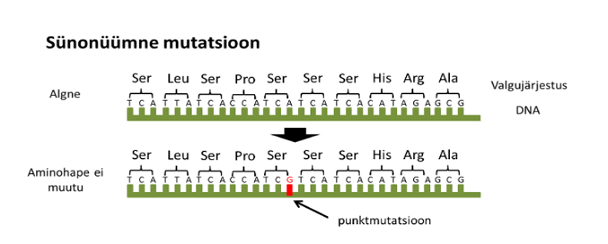
Figure 1 illustrates a synonymous mutation, where a change in the DNA sequence does not alter the amino acid sequence of the resulting protein.