Brainstorming activities in the classroom
Basic Level
The genesis of the nerve stimulus
How do neurons communicate?
All signals from the outside are picked up by the dendrites and transferred to the nucleus. If a stimulus arrives at the nucleus of a neuron that can modify the resting potential up to a threshold value (about -50 mV), an action potential or nerve impulse is generated that propagates along the axon.
The genesis of the action potential is linked to the exchange of ions through some voltage-gated channels of sodium Na+ and potassium K+. Sodium channels open first, when the potential reaches the threshold value, pushing ions inside the cell that is negative and rapidly depolarizing the membrane. The flow of sodium ions inside the membrane causes a polarity reversal: inside the membrane there is now an excess of positive charge, and outside a lack of positive charge. In this way, the membrane depolarizes, until it assumes a potential of +50mV, the maximum value of the action potential.
The depolarisation condition, however, lasts from 1 to 2 milliseconds.
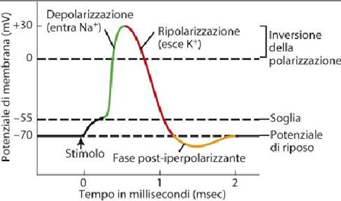
After this Over time, the voltage-gated sodium channels close and the voltage-gated potassium channels open. The latter open more slowly and remain open longer: the K+ ions flow to the outside of the membrane which begins to repolarize, bringing the potential back to a negative value. The flow of K+ persists generating a phase of hyperpolarization and the potential becomes more negative than the resting potential. Finally, all voltage-gated channels close and the activity of the sodium-potassium pump resumes, which restores the resting potential of the plasma membrane. The amplitude (about + 50 mV) and the duration (about 2 milliseconds) of the action potential are fixed, i.e. they do not depend on the amount of excitation.
How does the action potential propagate along the axon?
The electrical signal that propagates through the neuron and is then transmitted to subsequent neurons performs the following sequence of extremely rapid events:
- the electrical stimulus processed by the nucleus causes the opening of voltage-gated sodium channels in a segment near the nucleus; When the threshold value is reached, the first action potential is generated.
- depolarization propagates along the axon causing the channels to open voltage-gated sodium found in adjacent membrane zones; consequently, a second action potential is generated, which in turn will generate a third and so on.
- At the same time, in the area that had depolarized first, voltage-gated potassium channels opened, bringing the membrane back to the resting potential.
- potentials propagate only in one direction because, after closing, voltage-gated sodium channels undergo a refractory period during which they do not can open again.
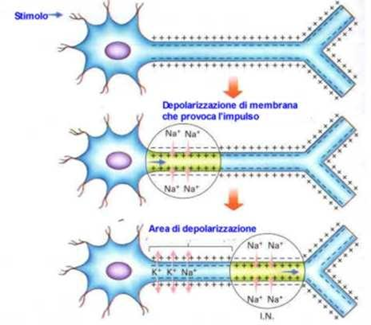
Propagation of action potential along an unmyelinated axon: video at: Propagation of action potential in an unmyelinated axon - Animated medical physiology - YouTube
What role does the myelin sheath play?
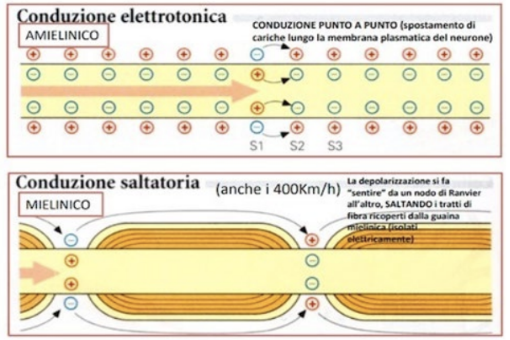
Nerve fibres coated with myelin sheath are more waterproof, as the sheath acts as an electrical insulator: consequently, the depolarization and propagation of the action potential occurs only in the sections where it is not present, called Ranvier's nodes. The nerve signal "jumps" from one node to the next with a higher speed than unmyelinated fibres.
 |
Let's think about it together: The transmission of the electrical signal in a neuron first and to other neurons later, is fast and precise. The speed of transmission and the accuracy of information are decisive factors in carrying out all human activities correctly. When something in this wonderful mechanism jams or stops, causing a neurological disease, the impact on the quality of life of affected individuals is devastating. Research on the operating principles of signal transmission neuronal stimulation is the basis of the most advanced neuro-technologies, which exploit electrical stimulation as a therapy. Have you ever heard of electrodes being applied to paralyzed patients who have walked again? |