1. Explore
Atoms
What is the structure of the atom?
The atom is the smallest part of the matter which has chemical properties. In 1 gram of Hydrogen there are 6,022⋅10^23 atoms. It contains the three type of elementary particles which constitutes the matter. The protons (positively electrically charged particles) and the neutrons (neutral positively electrically charged particles) are packed in the nucleus while the smaller electrons (negatively charged partices). The mass of the atom is the sum of the masses of these particles but because the eletrons are lighter only the 0,06% of the mass of the atom is electronic.
However the electrons gives the atom all its chemical properties. The number of electrons is the Atomic Number of the element. The Quantum Mechanics tells us that the electrons in the atom may have only some energies in a discrete way.
The energy of the n-th level is given by the formula
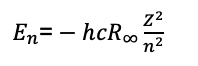
where h is the Planck constant, c is the speed of light, R∞ is the Rydberg formula and Z is the Atomic Number of the atom.
When an electron goes from a higher level of energy to a lower level it emits a quantum of electromagnetic energy (a foton). The energy is the difference of the energies of the levels involved and it is emitted with a frequency f given by the formula
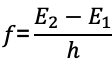
being E2 the energy of the higher level (i.e. the starting level of the electron) and E1 the energy of the lower level (i.e. the destination level).
This kind of emission is called spontaneous or radiative emission.
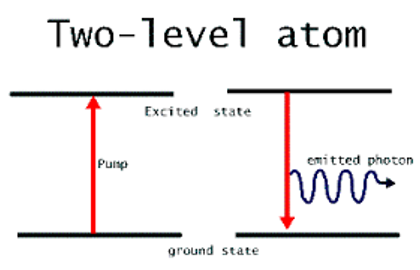
In order to fully understand the of the dynamics of this kind of emission is important to recall some characteristics of the constitution of the atom.
The electrons obey to the laws of Quantum Mechanics that tell us that
- we can’t find the position and the momentum of the particles with an infinite precision (Heisenberg Uncertainty Principle)
- we can only know the probability of finding a particle in a certain position in space through the use of the Schroedinger equation. The solutions of the this equation give us the probability as function of the space coordinates. As a result we can visualize the zone of the space where the probability of interaction with a partice is non negligible.
In the case of the electrons in the atom the solutions of the Schroedinger equation are called orbitals.
The Pauli Exclusion Principle allows only two electrons (one for each direction of the electronic property called spin) to occupy one orbital i.e. to satisfy the conditions of the Schroedinger equation.
The energy level structure of the atom and the transitions between them are depending on these rules.