Explore Module
Basic Level
Physics of Solar Energy Conversion
Light, absorption, and photon energy
Solar energy conversion begins when photons from sunlight strike the surface of a photovoltaic cell. Sunlight is a mixture of electromagnetic waves spanning ultraviolet, visible, and infrared wavelengths. Each photon carries a discrete packet of energy determined by its wavelength: shorter wavelengths (blue light) carry more energy than longer wavelengths (red light).
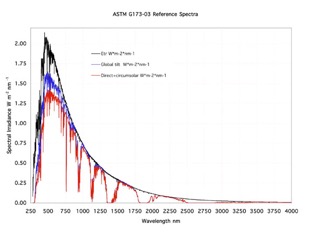
Figure 2. Solar spectral irradiance (ASTM G173-03 reference spectra) showing the distribution of photon energy across wavelengths. Silicon solar cells with a bandgap of ~1.1 eV (corresponding to ~1100 nm wavelength) can only convert visible and near-infrared photons. (Source: NREL)
When a photon enters a semiconductor material like silicon, it may be absorbed, reflected, or transmitted.
Absorption is key: if the photon's energy equals or exceeds the material's bandgap energy (the minimum energy required to free an electron from its atomic bond), the electron is promoted from the valence band to the conduction band.
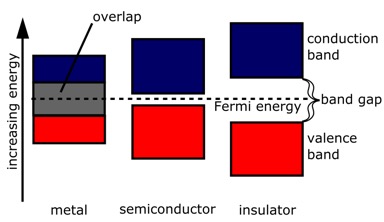
Figure 3. Comparison of energy band structures in metals, semiconductors, and insulators. In semiconductors like silicon, the band gap (Eg ≈ 1.1 eV) is small enough that photons can excite electrons from the valence band (red) to the conduction band (blue), enabling photovoltaic energy conversion. (Source: Wikimedia Commons, Public Domain)
This creates an electron-hole pair-a mobile negative charge (electron) and a corresponding positive vacancy (hole).
What determines whether a photon is absorbed or passes through?
The relationship between photon energy and the semiconductor's bandgap. Silicon's bandgap is ~1.1 eV, corresponding to infrared light at ~1100 nm. Photons with less energy pass through; photons with much more energy generate heat after freeing electrons.