Explore Module
Basic Level
From photons to electrons: the P-N junction
The absorbed photon creates an electron-hole pair, but without an internal electric field, these charges would quickly recombine, releasing energy as heat rather than electricity. This is where the P-N junction becomes essential.
Silicon is "doped" with impurities to create two distinct regions:
- N-type silicon: doped with phosphorus (extra electrons → negative charge carriers)
- P-type silicon: doped with boron (deficit of electrons → positive "holes")
At the boundary between N-type and P-type regions, a depletion zone forms naturally. Electrons from the N-side diffuse across to fill holes on the P-side, leaving behind positively charged atoms on the N-side and negatively charged atoms on the P-side. This charge separation creates a built-in electric field pointing from N to P.
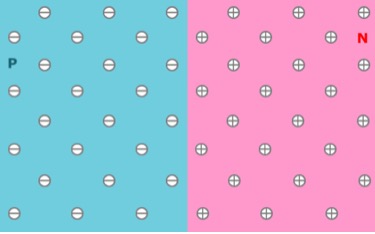
Figure 4. Schematic representation of a P-N junction before equilibrium. The P-type region (left, cyan) contains excess holes (positive charge carriers), while the N-type region (right, pink) contains excess electrons (negative charge carriers). When the two regions are brought into contact, charge carriers diffuse across the junction. (Source: PVEducation.org, educational use)
When a photon generates an electron-hole pair near the junction, the electric field sweeps the electron toward the N-side and the hole toward the P-side. This separation prevents recombination and drives charge carriers in opposite directions, creating a voltage difference between the two sides of the cell.
Because the electric field at the P-N junction provides a driving force stronger than random thermal motion, directing electrons and holes away from each other before they can recombine.
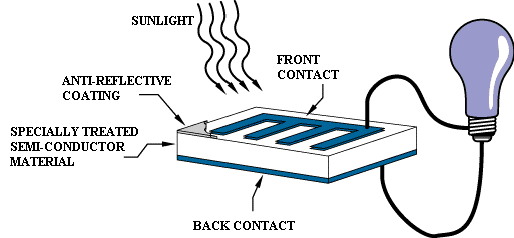
Figure 5. Complete solar cell operation showing the conversion of sunlight into electrical current. Photons strike the semiconductor material through the anti-reflective coating, generating electron-hole pairs that are separated by the internal electric field. The electrons flow through the external circuit (represented by the light bulb) before returning to recombine, creating usable electrical power. (Source: Wikimedia Commons, Public Domain)