Explore Module
Basic Level
Physics and Optics of Vision
Light, refraction, and image formation.
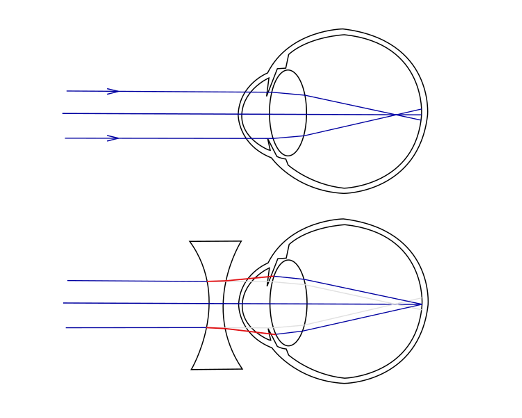
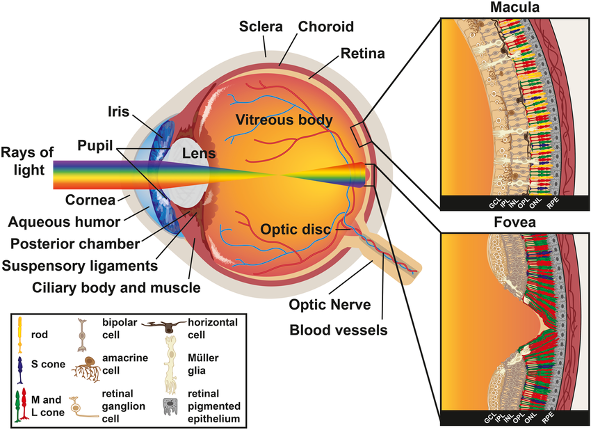
Vision begins when light reflected by objects enters the eye and passes through a natural optical system: cornea, aqueous humor, crystalline lens, and vitreous body. At each interface, light is refracted according to differences in refractive index. The result of this process is the focusing of the image on the retinal plane. The quality of the image depends on three main factors: surface geometry (curvature), refractive indices, and the pupil diameter controlling the depth of field. If light converges before the retina (myopia) or beyond it (hyperopia), the image appears blurred; the crystalline lens compensates through accommodation within physiological limits.
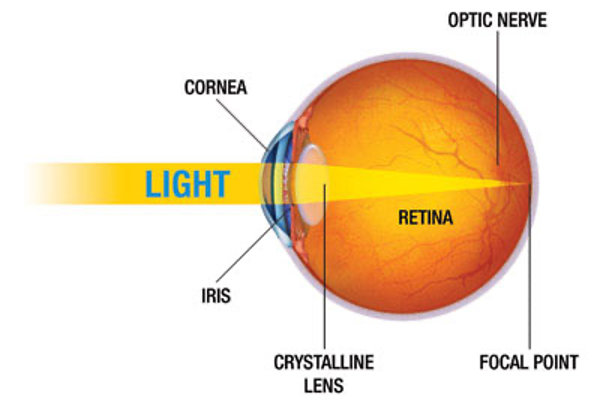
What determines where the focus will fall?
The balance between optical curvature and object distance: the closer the object, the greater the curvature required to maintain a sharp image on the retina.