Explore Module
Basic Level
From the retina to the brain: mandatory stages
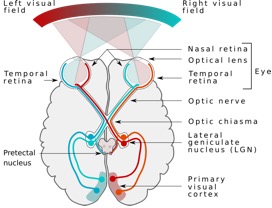
The signal leaves the eye through the optic nerve, passes through the optic chiasm (partial decussation), continues in the optic tract to the lateral geniculate nucleus (thalamus), and finally reaches the primary visual cortex (V1). Here—and in higher-order areas—the information is decomposed into features (orientation, spatial frequencies, motion, color) and then recomposed into a coherent perception. The brain does not “see” photons—it reconstructs meaning from neural activity patterns.
If the retina receives an upside-down image, why don’t we see the world upside down?
Because perception is generated in the brain: the cortex interprets and reconstructs information regardless of the initial optical orientation.
Because perception is generated in the brain: the cortex interprets and reconstructs information regardless of the initial optical orientation.