Operation Module
Advanced Level
The advanced level deepens the connection between retinal transduction and the propagation of the signal along the neural pathways to the visual cortex. Students observe how light energy is converted into electrical signals within photoreceptors and how these impulses are transmitted through bipolar and ganglion cells to the optic nerve.
To understand the sequence of events, the concept of phototransduction is introduced: the absorption of a photon by a rhodopsin molecule triggers a conformational change that activates a biochemical cascade. This cascade reduces cyclic GMP, closes ion channels, and consequently hyperpolarizes the cell. The outcome is the transformation of light energy into variations in electrical potential.
The propagation of the signal along the optic nerve and its route toward the visual cortex is illustrated through an Augmented Reality simulation developed with Delightex Studio – Spaces (Marker):
https://edu.delightex.com/Studio/Spaces
Using mobile devices, students explore a three-dimensional model of the human eye, observe photoreceptor activation, follow the signal along the optic nerve, visualize fibre crossing at the optic chiasm, and finally see the projection of signals to the lateral geniculate nucleus and the primary visual cortex.
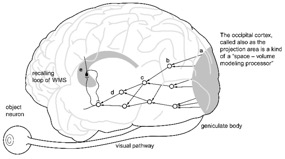
During the activity, guiding questions are proposed:
– At what point on the retina does light become an electrical impulse?
– Why do some fibres cross in the optic chiasm while others remain uncrossed?
– How does the visual cortex distinguish shape, colour, and motion?
Answers emerge through group discussion and comparison between anatomical models and physical processes.
The lesson ends with a reflection on the evolution of artificial vision systems. Students compare the functioning of the human eye with that of a digital camera, highlighting analogies and differences. While the camera captures images through a sensor, the brain reconstructs perception by integrating information from multiple sensory sources and correlating it with past experience.