Bio-inspired design process
| Sito: | Bios4You |
| Corso: | (2) Biomimicry: innovation and design inspired by Nature |
| Libro: | Bio-inspired design process |
| Stampato da: | Επισκέπτης (Guest user) |
| Data: | martedì, 25 agosto 2026, 06:42 |
Bio-inspired design process
Bio-inspired design examines the structure and work of organic frameworks as models and plans or builds modern materials and machines. It is broadly respected as synonymous with biomimicry, bio mimesis, and bio gnosis and comparable to biomimetics. The term biomimetics is inferred from the Greek word bios, “life,” and the addition mimetic, “having a fitness for mimicry.”

In general, design inspired from nature could be a strategy for making solutions to human challenges by imitating plans and concepts found in nature. It's utilized all over: buildings, vehicles, and indeed materials.
Bio-Inspired Design Process with Augmented Reality (AR)
The integration of Augmented Reality (AR) into the bio-inspired design process enhances interactivity, visualization, and accessibility. This approach aligns with the concept of "immersive design," which utilizes AR to create realistic digital environments for users. Additionally, the application of AR in design processes has been explored in various studies, highlighting its potential to revolutionize traditional methods
(https://journals.open.tudelft.nl/abe/article/view/3753).
Biomimetic Design Practice
Biologists are key players in the biomimicry design process because it relies heavily on biological knowledge; however, the role of the designer remains central. This orientation is particularly true regarding abstracting biological strategies into more broadly applicable design principles and implementing them to solve human challenges. The aim of biomimicry is not to create a replica of a natural form, process, or ecosystem; instead, it is to derive design principles from biology and use them as a stimulus for ideation. A final biomimetic solution should clearly evidence a transfer of functional or organizational principles from biology.
After all, the purpose of biomimicry is to tap the knowledge embodied by nature’s 3.8 billion years of research and development, and accomplishing this goal is impossible if the functional analogy between the natural model and the final design is lost in translation.
Biomimetic Design Practice Enhanced with AR
Integrating Augmented Reality (AR) into biomimetic design practices enhances the design process's visualization, simulation, and collaboration aspects, leading to more effective and innovative solutions.
Enhanced Visualization of Biological Models
AR enables designers to explore biological structures in three dimensions, facilitating a deeper understanding of form-to-function relationships. For instance, interactive AR models allow real-time manipulation, aiding in abstracting key principles such as energy efficiency, hydrophobicity, or adhesion. This capability aligns with findings that AR can significantly enhance the design process by providing intuitive and tangible interactions with virtual models (Shin et al.,2013).
Dynamic Simulations of Natural Processes
Through AR, designers can simulate natural processes like photosynthesis or fluid dynamics within biological structures, observing system functions under various conditions. This dynamic simulation offers insights into transferring biological principles to technical or architectural designs, as AR supports complex data visualization and interaction, crucial for collaborative design tasks (Nilsson et al.,2008).
Strengthened Collaboration and Ideation
AR provides a shared visual platform that enhances interdisciplinary collaboration among biologists, engineers, and designers. Real-time interactions and simulations help align perspectives and terminologies, ensuring a smoother transition from biological principles to technical applications. Research indicates that AR systems can create unique collaborative experiences by allowing users to interact with shared 3D virtual objects, thereby facilitating effective communication and idea exchange (Lukosch, 2015).
Interactive Prototyping and Feedback
Utilizing AR tools, designers can prototype bio-inspired solutions virtually and test them in simulated environments. This approach reduces the cost and time associated with physical prototyping and allows for iterative improvements based on immediate feedback. Studies have shown that AR can support collaborative design sessions effectively, enabling multiple participants to view and interact with AR-enhanced models concurrently (Giunta, 2022).
Investigating Spatial Augmented Reality for Collaborative Design Giunta, L. (Author). 22 Jun 2022.
Implementing AR in Biomimetic Solutions
Integrating Augmented Reality (AR) into biomimetic design practices enhances the process by facilitating the abstraction of biological principles, enabling virtual experimentation, and ensuring accurate functional translation into practical applications.
- Abstracting Principles: AR allows designers to interact with detailed 3D models of biological systems, aiding in the identification and extraction of functional principles. This immersive interaction enhances understanding and fosters innovation in design.
- Design Application: Through virtual experimentation and visualization, AR facilitates the application of abstracted biological principles in real-world scenarios. This approach allows designers to test and refine bio-inspired designs efficiently.
- Functional Translation: AR ensures the accurate translation of natural models into final designs by providing tools to dynamically compare and validate biological strategies. This dynamic validation process helps maintain the integrity of the bio-inspired solutions (Shin et al., 2013).
By leveraging AR technologies, the biomimicry design process becomes more robust and effective, aligning with modern, technology-driven approaches to innovation and sustainability.
Biology as a model and inventions
Nature has an enormous pool of inventions that passed the harsh test of practicality and durability in a changing environment. To harness the most from nature’s capabilities, it is critical to bridge between biology and engineering and see the cooperation of experts from both fields. This bridging effort can help turn nature’s capabilities into engineering capabilities, tools and mechanisms. To approach nature in engineering terms, it is necessary to sort biological capabilities along technological categories. Namely, one can take biologically identified characteristics and seek an analogy in terms of engineering, as shown in the table.
Table 2. Characteristic similarities of biology and engineering systems
| Characteristic similarities of biology and engineering systems | ||
| Biology | Engineering | Bioengineering, biomimetics, bionics and biomechanics |
| Body | System | System with multifunctional materials and structures are developed emulating the capability of biological systems |
| Skleton and bones | Structure and support struts | Support structures are part of every man-made system |
| Brain | Computer |
Advances in computers are being made emulating the operation of the human brain |
| Intelligence | Artificial intelligence | There are numerous aspects of artificial intelligence that have been inspired by biology including augmented reality, autonomous systems, computational intelligence, expert systems, fuzzy logic, etc. |
| Senses | Sensors | Computer vision, artificial vision, radar, and other proximity detectors all have direct biological analogies. However, at their best, the capability of the man-made sensors is nowhere near as good as biosensors |
| Muscles | Actuators |
Electroactive polymers are actuators with functional similarity to natural muscles |
| Electrochemical power generation | Rechargeable battries | The use of biological materials to produce power will offer mechanical systems enormous advantages. |
Nature capabilities
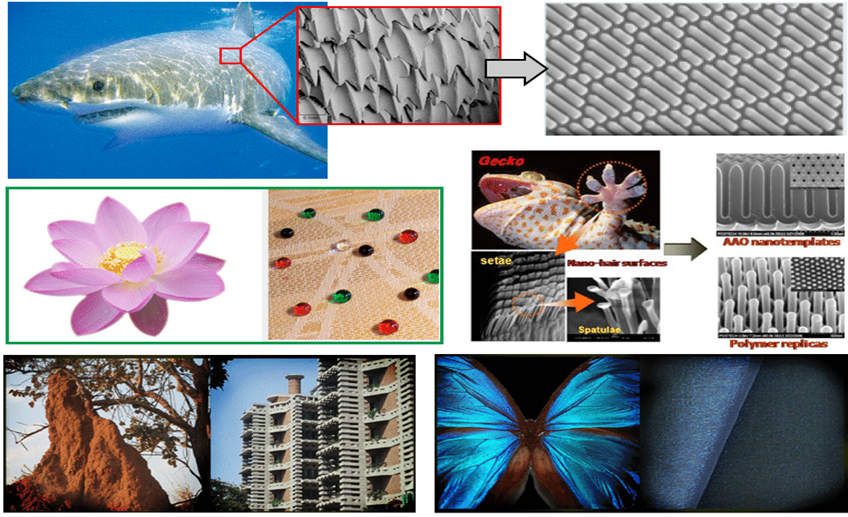
Some of nature’s capabilities can inspire new mechanisms, devices and robots. Examples may include the woodpecker’s ability to impact wood while suppressing the effect from damaging its brain. Another inspiring capability is the ability of numerous creatures to operate with multiple mobility options including flying, digging, swimming, walking, hopping, running, climbing, crawling. Increasingly, biologically inspired capabilities are becoming practical including collision avoidance using whiskers or sonar, controlled camouflage, and materials with self-healing. One of the challenging capabilities will be to create miniature devices that can:
- fly with enormous maneuverability like a dragonfly;
- adhere to smooth and rough walls like a gecko;
- adapt to the texture, patterns and shape of the surrounding environment like a chameleon, or reconfigure their body to travel through very narrow tubes like an octopus;
- process complex three-dimensional (3D) images in real time;
- recycle mobility power for highly efficient operation and locomotion;
- self-replicate, self-grow using resources from the surrounding;
- chemically generate and store energy; and many other capabilities for which biology offers a model for science and engineering inspiration.
While many aspects of biology are still beyond our understanding, significant progress has been made.