Physics and Chemistry activities
| Sito: | Bios4You |
| Corso: | (1) From waste to clean resources: a virtuous bio-cycle for the creation of an eco-habitat |
| Libro: | Physics and Chemistry activities |
| Stampato da: | Guest user |
| Data: | martedì, 25 agosto 2026, 05:56 |
Basic level
By replacing fossil fuels with renewable energy nations could achieve their emissions commitments without encroaching on vital natural land. Low-emission energy sources like wind and solar can have a larger geographical footprint than fossil-fuel plants of equivalent capacity. Even so, the renewable-energy potential of already developed land is more than enough to fulfill pledges made as part of the Paris Agreement and could satisfy the total energy demand projected for 2050. At the 21st Conference of the Parties (COP21) in Paris in 2015, 196 countries agreed to aim to limit warming to less than 2 °C above pre-industrial levels. The rapid cuts in greenhouse-gas emissions imply a large-scale shift away from fossil fuels.
Renewable-energy schemes are not without environmental impact themselves, however, so it’s important to choose locations and generation techniques that cause the least possible harm. Similar to conventional energy sources, we need to think beyond just the direct footprint of the wind turbine or solar panel and consider the associated structures and roads that renewable energy development brings with it.
The first step is the mapping of each country’s potential for wind and solar energy generation. We also should include the potential output from retrofitting existing hydroelectric plants – assuming their efficiency could be slightly improved – and repurposing non-hydroelectric dams to become power-generating.
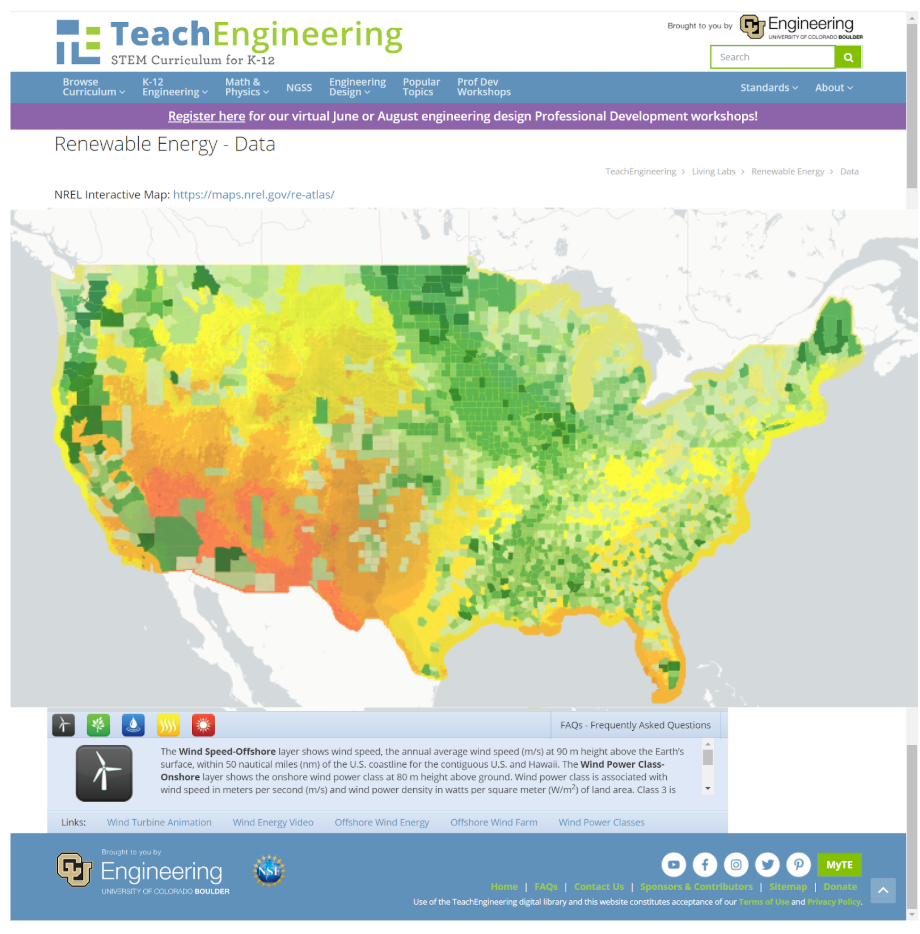
To achieve this task, we can exploit the potentialities of the
- Lab on Renewable Energy powered by Teach Engineering, University of Colorado, Boulder: https://www.teachengineering.org/livinglabs/renewableenergy912🔗
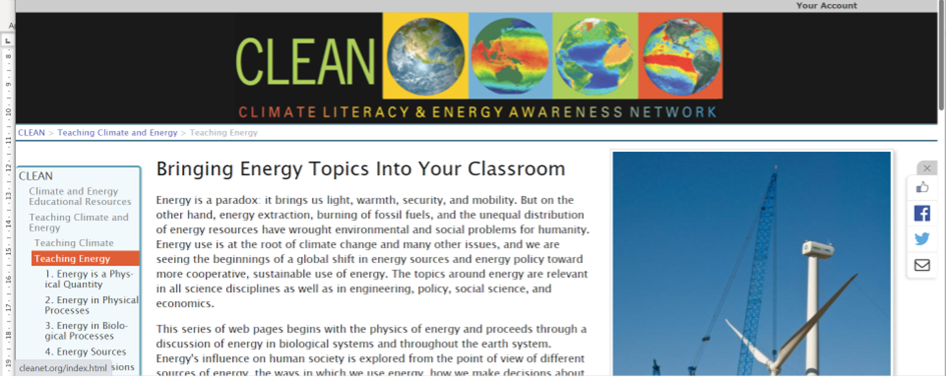
Or exploiting the
- CLEAN Collection of Climate and Energy Educational Resources, a collection of 700+ free, ready-to-use learning resources rigorously reviewed by educators and scientists suitable for secondary through higher education classrooms. https://cleanet.org/index.html🔗
Resources of the National Renewable Energy Laboratory (NREL) https://www.nrel.gov/index.html🔗
- Data and tools: Find NREL-developed data sets, maps, models, and tools used for the analysis of energy and energy efficiency technologies.
- Energy basics: Learn about the basics of research areas—bioenergy, geothermal, hydrogen, solar, transportation, wind, and water.

Design your own eco-city
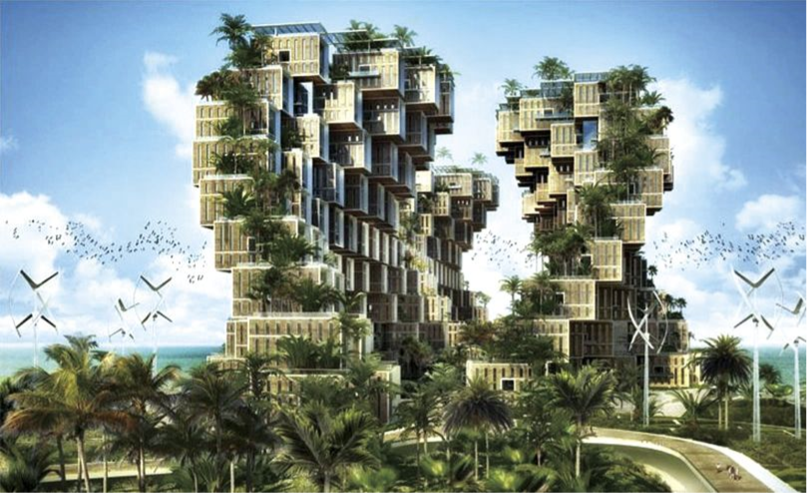
An eco-city is an ecologically healthy city. In the future, the cities in which we live must enable people to thrive in harmony with nature and achieve sustainable development. People oriented, eco-city development requires the comprehensive understanding of complex interactions between environmental, economic, political, and socio-cultural factors based on ecological principles. Cities, towns and villages should be designed to enhance the health and quality of life of their inhabitants and maintain the ecosystems on which they depend. Eco-city development integrates vision, citizen initiative, public administration, ecologically efficient industry, people's needs and aspirations, harmonious culture, and landscapes where nature, agriculture, and the built environment are functionally integrated in a healthy way.
EU Prototype Model of Smart Eco-Polis adopted the Smart Eco Polis Strategy and Implementation Plan where Eco-town and local communities are envisioned as smart and green, livable and creative, vibrant and attractive, climate-resilient places of the future and unique destination of excellence.
Web-based resources:
Advanced level
A big debate to reduce human’s environmental impact concerns the chose materials for buildings constructions. As shown in Figure, the building is a process that requires energy during the whole lifetime. Steve Howard, the corporate innovator of IKEA, resumes the compelling needs of sustainability considering that:
“we’re building cities like never before, bringing people out of poverty like never before and changing the climate like never before. Sustainability has gone from a nice-to-do to a must- to do”
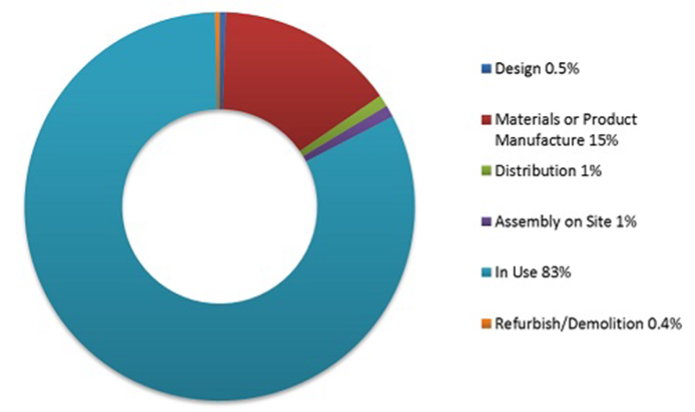
Current energy required for building constructions
In buildings, it is possible to save energy both in the used materials and in the improvement of the life cycle of the buildings.
Recalling the concept of circular economy, building materials that required less energy and come from recycled materials already exist. For example, the use of sedimentary rock or recycled glass particularly appreciated for their high mechanical resistance. But the new frontier of eco-building seems to be the cork.
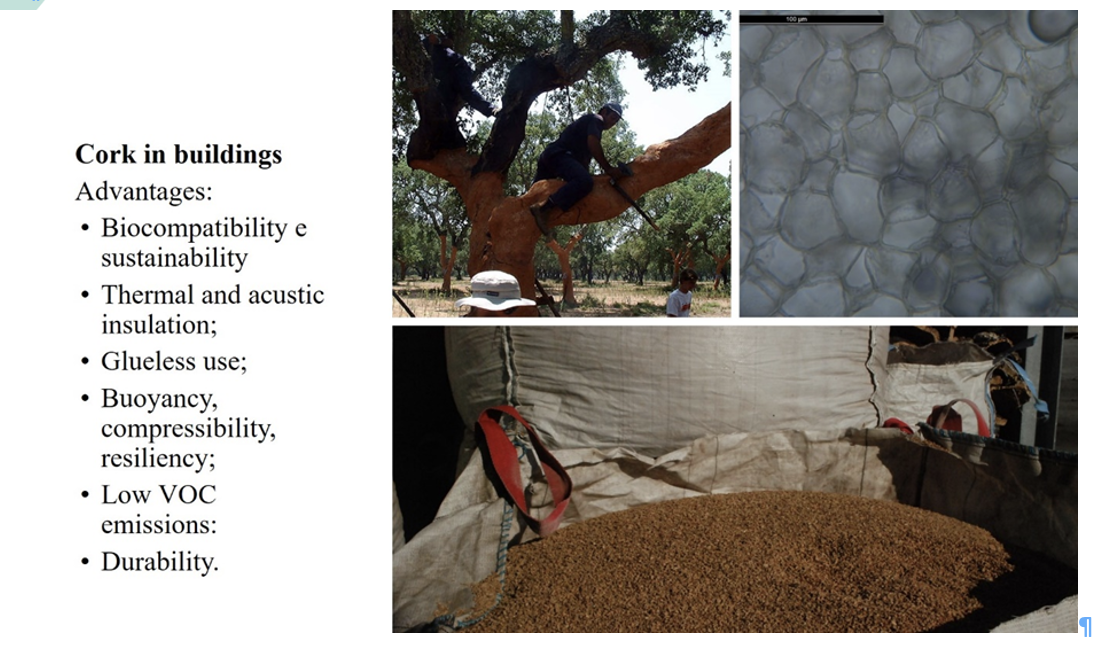
Due to the fact that more than 50% of the cell volume of a cork piece consists of air, cork is one of the lightest solid substances. Because heavy pressure does not break down or destroy the tiny air cells but compresses the air within the cells, the cork begins to spring back when the pressure is removed. A roll or sheet of composition cork can be compressed in one direction without losing its dimensions in the other direction. This is of great importance for many applications of composition cork. Moreover, cork is a highly frictional material, both in its natural form as well as in cork composition. Even when wet or coated with oil or grease, cork retains this quality which surpasses that of leather, rubber, and many other products used for frictional or non-skid purposes. The high degree of stability under varying conditions is paramount to the continuing success and use of cork in the world today.
Cork thermal insulation is primarily made from cork oak and can be produced as both a filler material or as boards. Typical thermal conductivity values for cork are between 40 and 50 mW/mK. Cork insulation products may be perforated and also cut and adjusted at the building site, without any loss of thermal resistance.
Some disadvantages in the use of cork are related to aesthetic issues as the limited color availability and the possibility to punctuate or damage if employed as a flooring surface.
In conclusion, biomaterials is a science about fifty years old. IUPAC's definition of this word is
“a material exploited in contact with living tissues, organisms or microorganisms”.
So, this term includes even the substances that, combined with a suitable polymeric substrate, are able to interact with biological systems and for that reason are employed also for a medical purpose.
From fashion to design, from building to constructions, biomaterials and their application are multiplying, changing the future of our life.
Advantages & Disadvantages Of Cork Flooring | The Flooring Group🔗
Activities
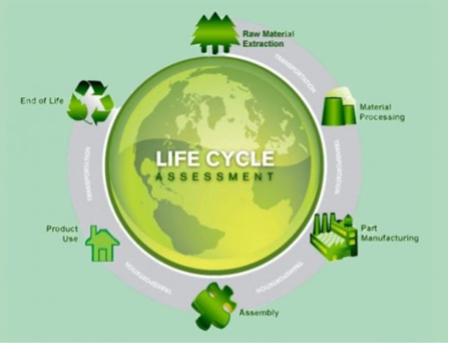
- Propose sustainability Frameworks in the Context of Waste Management: methods, indicators and eventual tools used.
- Propose solutions for an eco-sustainable home
-
Flipped learning: discover the Lifecab European project https://www.lifecab.eu/pages/home.aspx🔗