3. Enhance – AR for Deeper Learning and Engagement
| Õpikeskkond: | Bios4You |
| Kursus: | (18) Designing Cities for Coexistence: Wildlife and Urban Spaces |
| Raamat: | 3. Enhance – AR for Deeper Learning and Engagement |
| Printija: | Svečio paskyra |
| Kuupäev: | teisipäev, 25. august 2026, 05.56 AM |
Augmented Reality (AR) tools and application
Augmented Reality (AR) tools and applications are a powerful medium for environmental and urban education because they transform abstract concepts into tangible, interactive, and memorable experiences. For a topic as complex as "Designing Cities for Coexistence," where the goal is to integrate natural systems into the built environment, AR provides a unique ability to bridge the gap between theory and practice. It does this by:
- Deepening Understanding of Complex Concepts:
- Visualization of the Unseen: AR allows students to visualize abstract ecological processes (like water infiltration or air purification by plants) in real-time within their physical environment. Seeing a virtual overlay of roots absorbing water or pollutants being filtered makes the concept far more concrete and understandable than a diagram in a textbook.
- Making Complex Concepts Accessible:
- Bridging Theory and Reality: Concepts such as "habitat fragmentation" or "ecological corridors" can be abstract. AR can project virtual representations of these concepts onto a real landscape, allowing students to virtually "walk through" a fragmented habitat or "see" how a green bridge connects two previously isolated areas.
- Increasing Engagement and Motivation:
- Immersion: The immersive and interactive nature of AR captivates students' attention, making learning more exciting and memorable. It feels like "playing" while learning.
- Gamification: Integrating game-like elements (challenges, points, progress tracking) within AR experiences boosts motivation and encourages persistence.
3.1 Examples of Useful AR Apps and Tools
Various AR tools can significantly enhance the learning experience for ecosystem restoration by providing immersive and interactive ways to explore complex environmental concepts. Here is an example:
Delightex (CoSpaces Edu):
Delightex allows users to create interactive 3D virtual worlds and then experience them in augmented reality or virtual reality. It features a drag-and-drop interface and a visual block-based coding language (CoBlocks), making it highly accessible for students and teachers with no prior coding experience. It offers a free version with core functionalities. Students can design and build their own virtual ecosystems, simulate environmental changes, and visualize restoration efforts. Its creative freedom empowers students to become content creators, not just consumers.
3.2 Practical Suggestions for Integration into the Learning Experience
Gamified learning environments or interactive 3D virtual worlds can challenge students to explore green infrastructure like trees and green roofs in a city to mitigate the effects of climate change like flooding and heatwaves. This makes learning about urban design both fun and informative.
Exercise: "Eco-Visionary" AR App
"Eco-Visionary" AR app allows students to explore a real-world location, e.g. a city park, and then interact with virtual 3D models, like green infrastructure, wildlife habitats and info panels, directly onto that space. Each virtual object comes with an informational panel explaining its ecological purpose and how it contributes to a more biodiverse city. By physically walking through their augmented design, students gain a deeper, more intuitive understanding of how individual ecological elements can connect to create a cohesive and vibrant urban ecosystem.
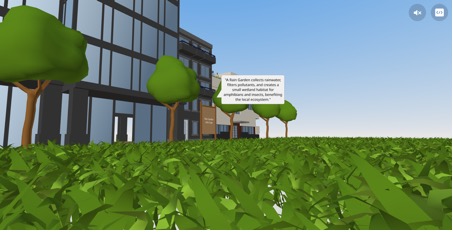
Image 2. "Eco-Visionary" AR App
By making learning more immersive, interactive, and directly relevant to the students' immediate environment, AR technology significantly strengthens their connection to urban ecosystems and promotes more effective knowledge building for future sustainable urban development.