3. Enhance – AR for Deeper Learning and Engagement
| Site: | Bios4You |
| Course: | (24) Innovative Water Recycling and Conservation Techniques in Urban Planning |
| Book: | 3. Enhance – AR for Deeper Learning and Engagement |
| Printed by: | Guest user |
| Date: | Tuesday, 25 August 2026, 5:56 AM |
3.1 Examples of Useful AR Apps and Tools
Various AR tools can significantly enhance the learning experience for ecosystem restoration by providing immersive and interactive ways to explore complex environmental concepts. Here is an example:
Delightex (CoSpaces Edu):
Delightex allows users to create interactive 3D virtual worlds and then experience them in augmented reality or virtual reality. It features a drag-and-drop interface and a visual block-based coding language (CoBlocks), making it highly accessible for students and teachers with no prior coding experience. It offers a free version with core functionalities. Students can design and build their own virtual ecosystems, simulate environmental changes, and visualize restoration efforts. Its creative freedom empowers students to become content creators, not just consumers.
3.2 Practical Suggestions for Integration into the Learning Experience
Gamified learning environments or interactive 3D virtual worlds can challenge students to explore
Exercise: “Rainwater Harvesting” AR App
“Rainwater Harvesting” AR App lets students explore a virtual house and learn how rainwater harvesting works in everyday spaces like the kitchen, bathroom, rooftop, and garden. As you move through each scene, you’ll see animations of how rain is collected, stored, and reused, along with quick facts about saving water. At the end of each area, a short quiz tests your knowledge. By the end, you’ll understand how simple actions at home can help conserve millions of liters of water and reduce our environmental footprint.
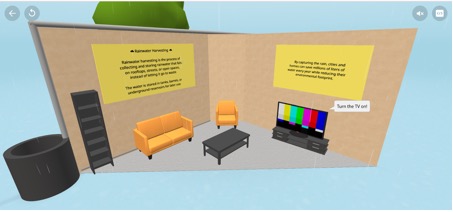
Image 2. “Rainwater Harvesting" AR App
By strategically integrating AR, educators can create dynamic, interactive, and highly effective learning environments that not only convey complex information about sustainable water management but also inspire students to become active participants and innovators in solving real-world environmental challenges.