1. Explore - Understanding GMOs and Their Impact
| Sito: | Bios4You |
| Corso: | (7) Modelling the impact of GMOs |
| Libro: | 1. Explore - Understanding GMOs and Their Impact |
| Stampato da: | Svečio paskyra |
| Data: | martedì, 25 agosto 2026, 05:56 |
Descrizione
In this section, students develop a foundational understanding of genetically modified organisms (GMOs), how they are created, and why their impact can be complex. The Explore phase introduces key biological and biotechnological concepts needed to understand genetic modification before engaging in modelling, AR-based analysis, and creative activities later in the unit.
1.1 What Are Genetically Modified Organisms (GMOs)?
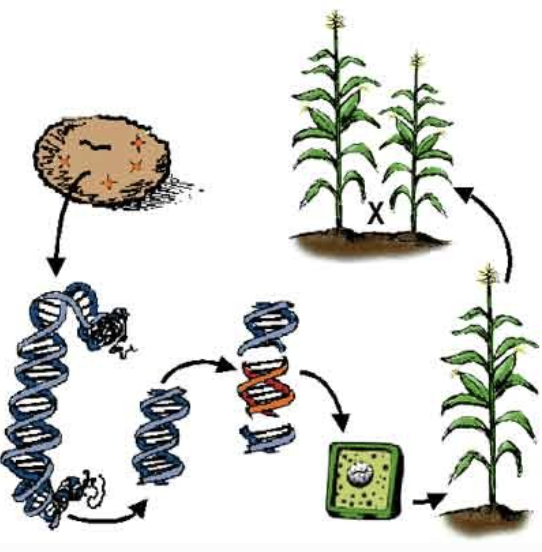
Figure 1. The Process of Plant Genetic Engineering. Source: https://passel2.unl.edu/view/lesson/7f79e74ec2cd/8
A genetically modified organism (GMO) is an organism whose genetic material has been deliberately altered using genetic engineering techniques. Unlike traditional breeding, which selects traits over many generations, genetic modification allows scientists to introduce specific genes directly into an organism's genome. (https://en.wikipedia.org/wiki/Genetically_modified_organism)
Example: Bt maize, engineered with a bacterial gene (Bacillus thuringiensis) for pest resistance. (https://en.wikipedia.org/wiki/Genetically_modified_organism)
GMOs can be plants, animals, or microorganisms. They are commonly used in agriculture to improve crop resistance, productivity, or nutritional value, and in biotechnology and medicine for research and production purposes.
To support students’ understanding of genetically modified organisms, learners are encouraged to watch a short introductory video explaining what GMOs are and how they are created. The video provides a clear, accessible overview of genetic modification processes and real-life examples, helping students build a common foundation before analysing GMO impacts through modelling and Augmented Reality activities.
Video: What Are Genetically Modified Organisms (GMOs)?
1.2 How Genetic Modification Works (Basic Principles)
Genetic modification involves identifying a gene with a desired trait and inserting it into another organism. This process typically includes:
- Isolating a specific gene from one organism (e.g., Bt toxin gene from bacteria).
Inserting the gene into a vector (often a plasmid). - Transferring the gene into the target organism (e.g., via Agrobacterium or gene gun).
- Ensuring the new gene is expressed correctly.
This allows organisms to gain new characteristics, such as resistance to pests, tolerance to herbicides, or the ability to produce useful substances like insulin.
1.3 Examples of GMOs in Real Life
GMOs are widely present in modern biotechnology and agriculture. Common examples include:
- Genetically modified crops, such as maize or soybeans, designed to resist pests or tolerate environmental stress. Bt maize or Roundup Ready soybeans, designed to resist pests or tolerate herbicides (MON810, approved 1990s). (https://en.wikipedia.org/wiki/Genetically_modified_maize)
- GMO microorganisms, used to produce medicines like insulin or vaccines. Example: E. coli engineered to produce human insulin (Humulin, FDA-approved 1982)
- Research organisms, modified to study gene function and disease mechanisms.
These examples show that GMOs are not limited to food production but play a broader role in science and medicine.
1.4 Potential Benefits of GMOs
Genetic modification offers several potential benefits, supported by rigorous meta-analyses:
- Increased crop yields (e.g., +22% for GM maize according to meta-analyses conducted 2014–2021. Source: https://pmc.ncbi.nlm.nih.gov/articles/PMC4218791/ ).
- Reduced pesticide use (-37% for herbicide-tolerant crops, 2014 meta-analysis).
- Improved nutritional content (e.g., Golden Rice with beta-carotene for vitamin A deficiency. Source: https://pmc.ncbi.nlm.nih.gov/articles/PMC4218791/).
- Enhanced resistance to environmental challenges (drought, salinity, soil stress). (Source: https://en.wikipedia.org/wiki/Genetically_modified_food).
These benefits address global challenges such as food security, reducing chemical inputs in agriculture, and building resilience to climate variability. (More: https://www.who.int/news-room/questions-and-answers/item/food-genetically-modified).
1.5 Potential Risks and Concerns
GMOs also raise valid concerns requiring careful evaluation, supported by ongoing ecological and social research:
- Effects on biodiversity (e.g., gene flow to wild relatives, herbicide-resistant "superweeds" documented since 2000s; non-target insect impacts under investigation) (source: https://www.science.org/doi/10.1126/science.ado9340).
- Potential gene transfer to non-target organisms (horizontal gene transfer; rare but documented in laboratory conditions).
- Long-term environmental impacts (soil microbial communities, effects on non-target insects such as monarch butterflies—debated since 1999 study, reassessed 2010–2020) (source: https://ecoservantsproject.org/genetically-modified-organisms-gmos-and-the-environment-impacts-benefits-and-concerns/).
- Ethical, social, and economic considerations:
- Farmer dependency on proprietary seeds and licensing agreements.
- Labeling regulations and consumer acceptance (varies by region).
- Equitable access to GM technologies in developing countries.
- Patent ownership and intellectual property concerns.
Understanding GMOs therefore requires systems thinking, where biological, environmental, and societal factors are considered together rather than in isolation.
Watch the video
To encourage critical thinking and discussion, students are invited to watch a short video presenting different perspectives on genetically modified organisms. The video highlights why the impact of GMOs can be complex and context-dependent, supporting informed analysis rather than simple “for or against” positions. This resource prepares learners for AR-based scenario analysis and decision-making activities in the following phases.
Video: Genetically Modified Organisms (GMOs) – Different Perspectives
1.6 Why Modelling and AR Are Useful for Understanding GMOs
The effects of genetic modification are often invisible and occur over time, making them difficult to understand through static images or text alone. Modelling and Augmented Reality (AR) help visualize processes such as gene insertion, trait expression, and potential environmental interactions.
By exploring GMO-related scenarios through AR-based tests and interactive models, students can better understand cause–effect relationships and evaluate different outcomes. This prepares learners to engage critically with the exercise activities and to reflect on how biotechnology decisions influence real-world systems.
Example: AR slider shows GMO maize yield vs. pesticide use changes. Students simulate scenarios, evaluate outcomes, and develop critical thinking for exercise activities. (https://bios4you.infoproject.eu/how-delightex-ar-is-transforming-stem-education-classroom-practices-and-teaching-tips/)
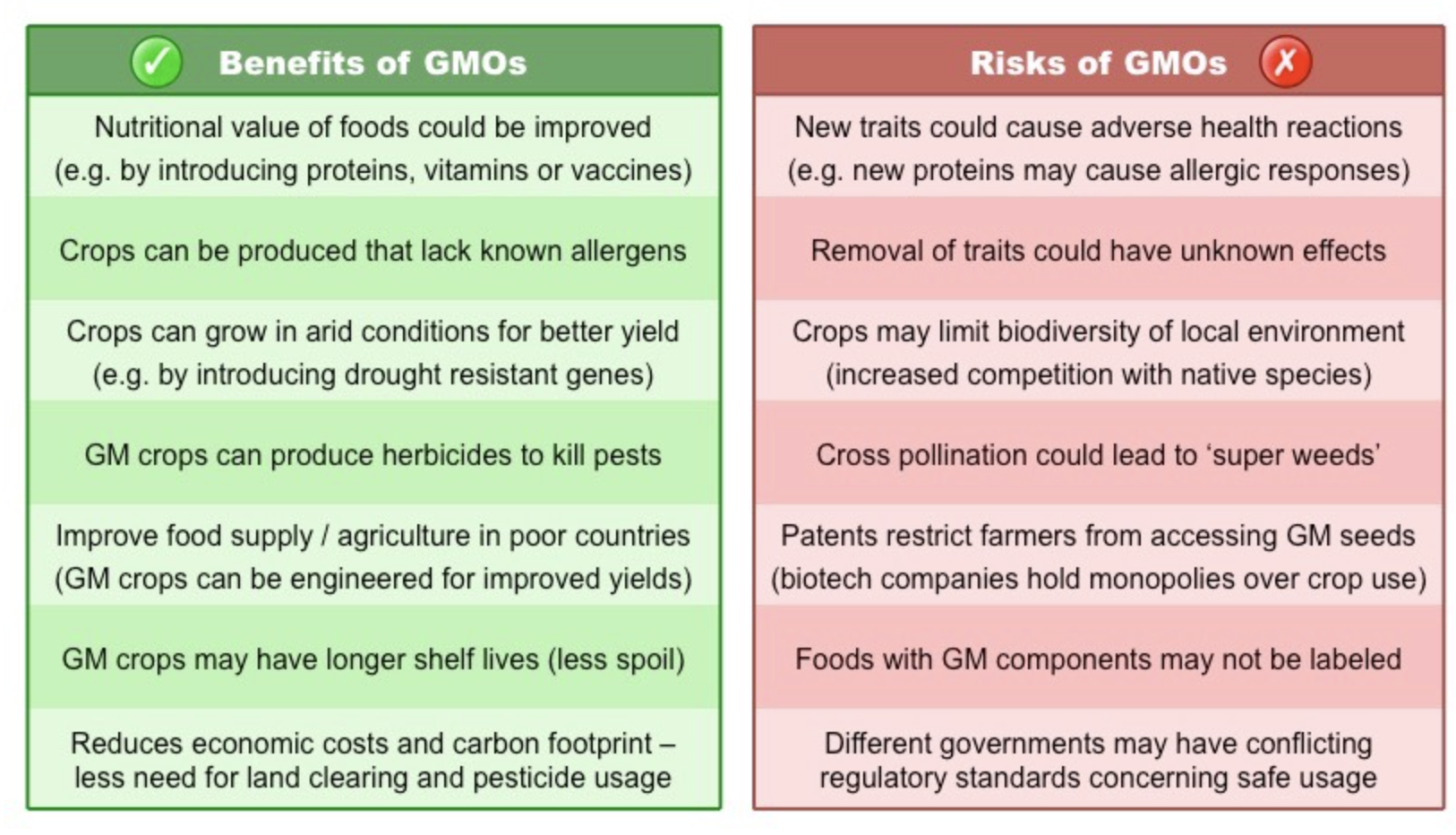
Visual summary: Benefits and risks of GMOs
The following visual summary presents commonly discussed potential benefits and risks of genetically modified organisms. It is used as a discussion and analysis tool to support systems thinking rather than to promote a specific viewpoint. Students are encouraged to compare points, identify trade-offs, and consider how different contexts (environmental, economic, and social) influence the evaluation of GMO use.
Questions for Reflection
- How do GMOs differ from organisms created through traditional breeding?
- Which benefits of GMOs seem most significant, and why?
- What potential risks require further investigation?
- Why is it important to consider environmental and societal impacts together?
- How might modelling and AR help explain complex biotechnology topics?