2. Execute - Applying Bio-Inspired Thinking through AR-Based Exploration
| Svetainė: | Bios4You |
| Kursas: | (16) Human Evolution: From Early Hominins to Modern Humans |
| Knyga: | 2. Execute - Applying Bio-Inspired Thinking through AR-Based Exploration |
| Spausdino: | Svečio paskyra |
| Data: | antradienis, 2026 rugpjūčio 25, 05:56 |
2.1 From Theory to Practice: Learning from Nature
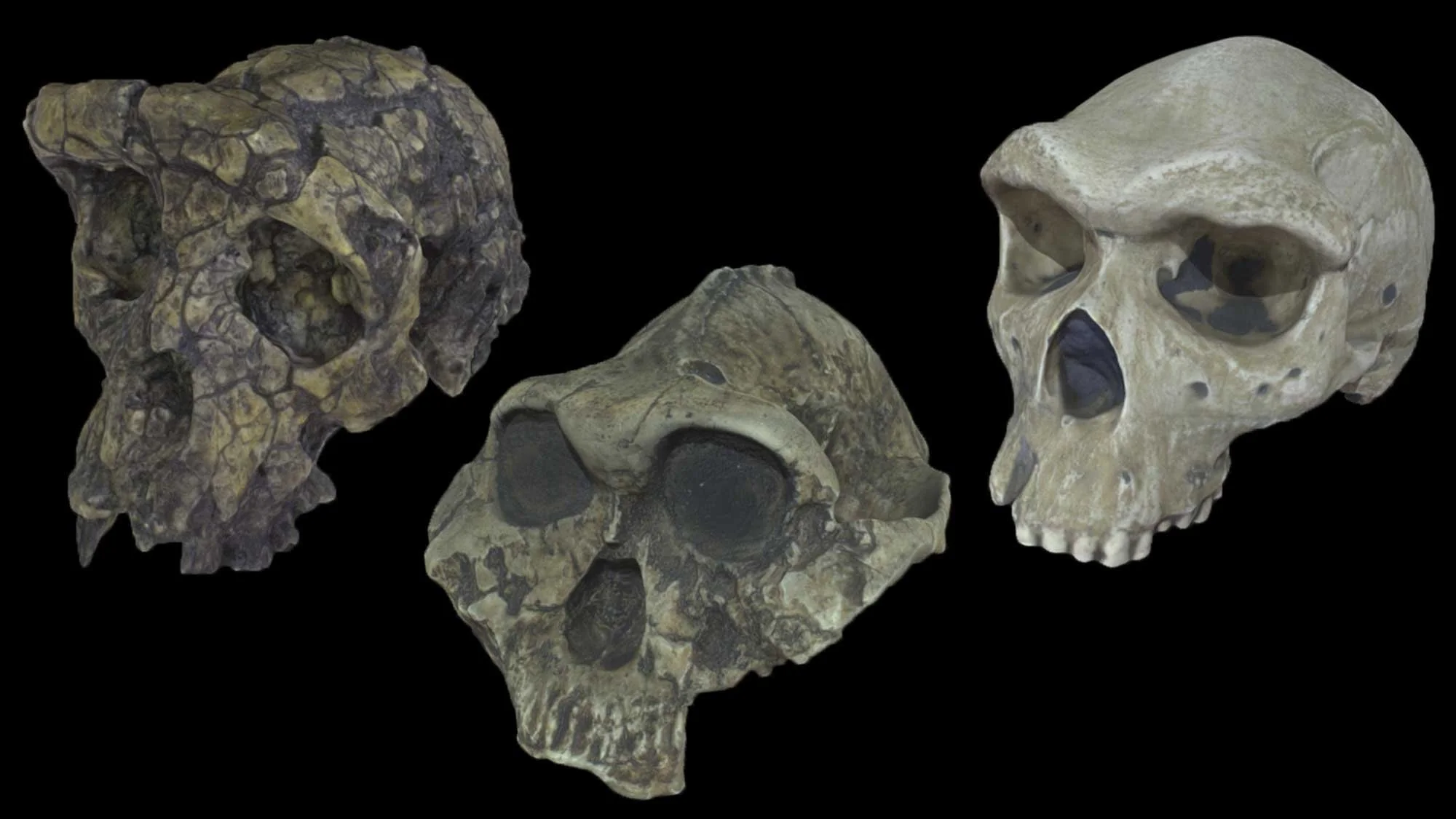
Human Origins: 3D Models (Source)
Human evolution is a powerful example of bio-inspiration in action. Over millions of years, natural selection shaped the human body, brain, and behavior as responses to environmental challenges. In this section, students move from theoretical understanding to practical exploration, analyzing how nature “designed” solutions for survival and adaptation.
Instead of learning evolution as a sequence of names and dates, learners investigate how natural constraints (climate, food availability, movement) influenced physical structures and behaviors — a mindset that mirrors how bio-inspired solutions are applied in modern engineering, architecture, and design.
2.2 How Augmented Reality Supports the Learning Objective
The main objective of this unit is to help students understand evolution as a dynamic, adaptive process, not a static historical list. Augmented Reality (AR) supports this goal by transforming abstract evolutionary changes into observable, comparable, and interactive elements.
Using an AR application, students:
- Explore a 3D evolutionary timeline from early hominins to Homo sapiens
- Observe and manipulate 3D skeletal and skull models
- Compare anatomical adaptations across species in real time
- Link environmental pressures to biological changes
Suggested AR features include:
- Interactive 3D models (skulls, skeletons, body proportions)
- Timeline-based navigation (scrolling through evolutionary stages)
- Hotspots revealing key adaptations (brain size, jaw shape, posture)
- Side-by-side comparison mode for different hominin species
These features allow students to actively construct understanding rather than passively receive information.
2.3 Practical AR Exercise: Exploring Evolution through Bio-Inspiration
Activity example: “Evolution as a Design Process”
Students use an AR scene containing a 3D human evolution model (such as the Sketchfab model provided) placed on a classroom table or floor. The model presents several hominin species arranged along a timeline.
Students are asked to:
- Select two different hominin species and compare their skeletal structures
- Identify at least three anatomical differences (e.g. skull shape, limb length, posture)
- Link each difference to an environmental or survival challenge
- Discuss how these natural adaptations inspired later human success
This exercise reinforces the idea that nature continuously tests and improves “designs”, a core principle of bio-inspired problem solving.
2.4 Bio-Inspired Learning Tasks Used Worldwide
Similar AR-based approaches are already used globally in science education, especially in:
- Virtual anthropology labs, where students explore fossil replicas without physical specimens (to see more: https://hominin.anthropology.wisc.edu/virtual-labs.html)
- Museum AR exhibits, allowing visitors to compare extinct and modern species (To see more: https://www.museumoftheearth.org/human-origins/3d-models)
- Biology and anatomy courses, using 3D models to understand structure–function relationships
In these contexts, AR has proven effective for:
- Visualizing large time scales
- Understanding gradual structural change
- Supporting inquiry-based and comparative learning
This unit adapts those proven practices to a school-friendly, classroom-based AR experience.
2.5 Collaborative and Inquiry-Based Learning
Students can work:
- Individually (guided exploration), or
- In small groups (comparison and discussion tasks)
Group activities may include:
- Debating which adaptation was most important for human survival
- Predicting how humans might evolve under future environmental pressures
- Reflecting on how natural evolution inspires modern technological solutions
These tasks encourage critical thinking, collaboration, and systems thinking, all core Bios4You competencies.
By completing the Execute phase, students gain hands-on experience with evolutionary evidence and bio-inspired reasoning. In the next section, Enhance, Augmented Reality will be examined as a pedagogical tool: how it deepens understanding, increases engagement, and supports long-term learning of complex biological processes.