3. Enhance - Deepening Evolutionary Understanding with Augmented Reality
| Svetainė: | Bios4You |
| Kursas: | (16) Human Evolution: From Early Hominins to Modern Humans |
| Knyga: | 3. Enhance - Deepening Evolutionary Understanding with Augmented Reality |
| Spausdino: | Επισκέπτης (Guest user) |
| Data: | antradienis, 2026 rugpjūčio 25, 06:42 |
Turinys
- 3. Human Evolution Timeline
- 3.1 Why Augmented Reality Enhances Learning about Human Evolution
- 3.2 Making Invisible Processes Visible
- 3.3 Enhancing Cognitive and Inquiry-Based Learning
- 3.4 AR as a Tool for Comparison and Critical Thinking
- 3.5 Increasing Engagement and Motivation
- 3.6 Supporting Inclusive and Multimodal Learning
- 3.7 Practical Suggestions for Classroom Integration
3. Human Evolution Timeline
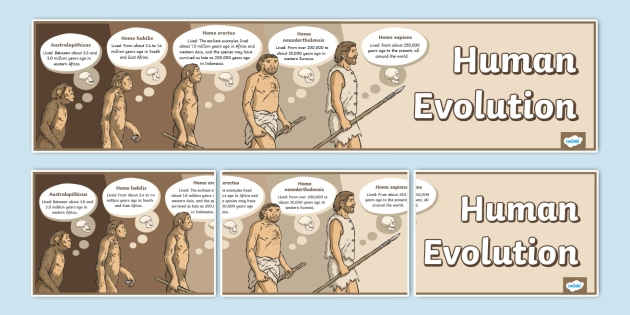
Human Evolution Timeline Source: https://www.twinkl.de/resource/t2-s-757-new-human-evolution-timeline
3.1 Why Augmented Reality Enhances Learning about Human Evolution
Human evolution involves complex concepts that are difficult to fully understand through text or static images alone. Changes in anatomy, posture, and brain structure occur gradually over vast time scales, making them abstract and challenging for learners to visualize. Augmented Reality (AR) enhances the learning process by transforming these abstract processes into concrete, observable experiences.
By overlaying interactive 3D models into the real learning environment, AR allows students to explore evolutionary changes spatially and dynamically, supporting deeper comprehension and long-term retention.
3.2 Making Invisible Processes Visible
AR enables learners to:
- Visualize anatomical changes that occurred over millions of years
- Observe differences in skull shape, posture, and body proportions in real scale
- Navigate evolutionary timelines in a non-linear and exploratory way
These capabilities help students move beyond memorization and toward conceptual understanding, where they can see how structure and function evolve together.
3.3 Enhancing Cognitive and Inquiry-Based Learning
Augmented Reality supports inquiry-based learning by encouraging students to:
- Ask questions while exploring models
- Form hypotheses about adaptation and survival
- Test ideas through comparison and observation
Instead of passively receiving information, students become active investigators, using AR tools to analyze evidence much like scientists do in real evolutionary research.
3.4 AR as a Tool for Comparison and Critical Thinking
One of the key strengths of AR in this unit is its ability to support side-by-side comparisons. Students can directly compare different hominin species, highlighting:
- Evolutionary trends in brain size and facial structure
- The relationship between anatomy and environment
- Multiple evolutionary solutions to similar survival challenges
This comparative approach strengthens critical thinking and systems thinking, essential skills in STEM education.
3.5 Increasing Engagement and Motivation
AR introduces a strong motivational component by making learning interactive and immersive. Features such as:
- 3D manipulation (rotation, zoom, scale)
- Interactive hotspots with explanatory content
- Gamified elements such as discovery tasks help sustain student attention and curiosity, particularly when dealing with complex scientific topics like evolution.
3.6 Supporting Inclusive and Multimodal Learning
AR supports diverse learning styles by combining:
- Visual learning (3D models, timelines)
- Kinesthetic interaction (manipulation of objects)
- Verbal and conceptual explanation
This multimodal approach makes evolutionary biology more accessible to a wider range of learners and supports inclusive education.
3.7 Practical Suggestions for Classroom Integration
To enhance learning outcomes, AR tools can be integrated into the classroom by:
- Using table-based AR exploration for small groups
- Allowing students to freely explore models before guided discussion
- Combining AR exploration with reflective questions or short debates
- Linking AR observations to real-world bio-inspired solutions
These strategies ensure that AR is used as a learning accelerator, not just a visual add-on.
Through Augmented Reality, human evolution becomes a tangible and meaningful learning experience. By enhancing visualization, interaction, and inquiry, AR deepens students’ understanding of evolutionary processes and strengthens their ability to connect biological adaptation with real-world bio-inspired thinking.