1. Explore - Understanding Evolutionary Relationships and Common Ancestry
| Website: | Bios4You |
| Kurs: | (17) Evolutionary Tree of Life: Building Phylogenetic Relationships |
| Buch: | 1. Explore - Understanding Evolutionary Relationships and Common Ancestry |
| Gedruckt von: | Utente ospite |
| Datum: | Dienstag, 25. August 2026, 07:22 |
1.1 What Is the Tree of Life?
The Tree of Life is a scientific model that represents the evolutionary relationships between organisms. Rather than ranking species as “more” or “less” evolved, it shows how all living beings are connected through common ancestors. Each branch represents evolutionary change over time.
1.2 What Is Phylogeny?
Phylogeny is the study of evolutionary relationships between organisms and how different species are connected through common ancestry. Scientists use phylogeny to determine how closely related organisms are by comparing shared characteristics, such as anatomical features, developmental patterns, and genetic information. Species that share more traits inherited from a common ancestor are considered more closely related.
Phylogenetic trees are visual models that represent these relationships. They are not fixed diagrams, but scientific hypotheses based on the best available evidence at a given time. As new data become available—such as fossil discoveries or advances in DNA analysis—phylogenetic trees can be revised and improved. This makes phylogeny a dynamic and evidence-based field that reflects how scientific understanding evolves over time.
Understanding phylogeny helps scientists explain biodiversity, trace the origins of species, and identify evolutionary patterns. It also teaches an important scientific principle: biological knowledge is built through comparison, evidence, and continuous refinement, rather than absolute or unchanging answers.
Below are examples of phylogeny:
- Tree of life of amniotes that includes reptiles, birds, and mammals. All these classes of vertebrates evolved from the same ancestral form of the stem reptiles at the bottom of the tree (Sourse: https://www.researchgate.net/figure/Tree-of-life-of-amniotes-that-includes-reptiles-birds-and-mammals-All-these-classes-of_fig2_323780429)

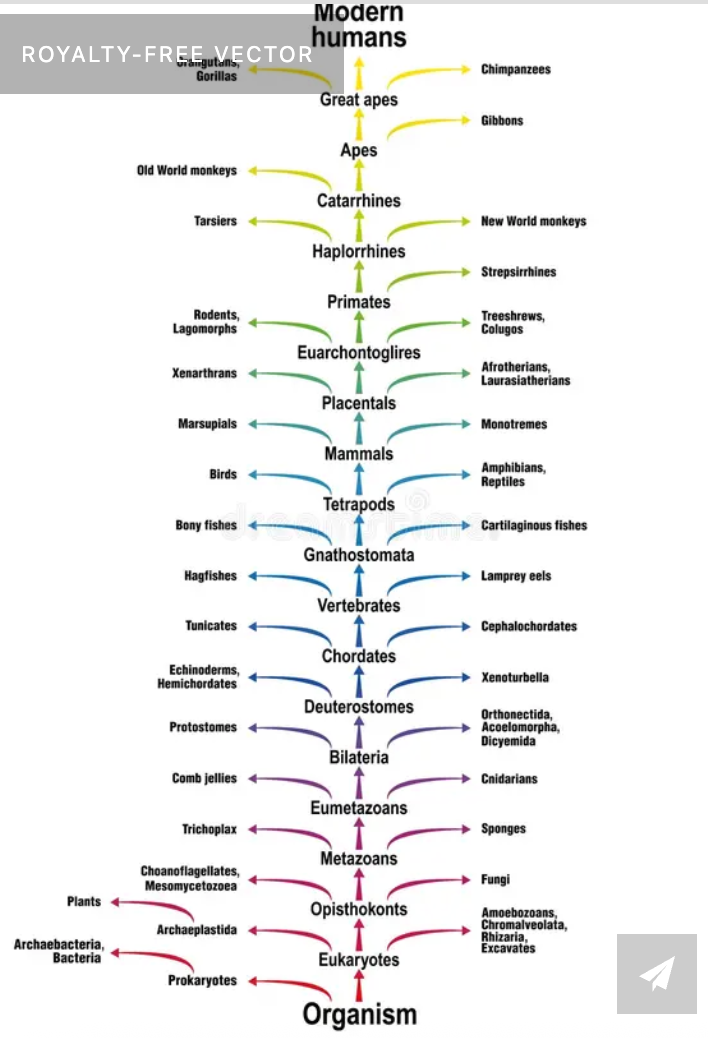
- Tree Of Life Human Evolution Biology Species Classification. Tree of life of all living beings. Phylogenetic tree of biological science with trunk orders/suborders and branches related life forms. Classification from simple organisms to modern humans. (Source: https://www.dreamstime.com/tree-life-human-evolution-biology-species-classification-tree-life-all-living-beings-phylogenetic-tree-biological-image131543711)
- Phylogenetic history of the Hominidaedliving apes and people (Source: https://www.researchgate.net/figure/Phylogenetic-history-of-the-Hominidaedliving-apes-and-people-Dates-are-based-on-genomic_fig1_317314464)

1.3 Evidence Used to Build Phylogenetic Trees
Phylogenetic relationships are reconstructed using multiple types of evidence, including:
- morphological traits (body structure and form),
- fossil records,
- genetic and molecular data,
- developmental and behavioral characteristics.
To support understanding of how these different data sources are combined, students may explore a short educational video (see below) that visually explains how scientists build phylogenetic trees using real evidence. This multimedia resource helps clarify abstract concepts and prepares learners for the practical construction of evolutionary relationships in the Execute phase.
Combining these data sources allows scientists to build more accurate and reliable evolutionary models.
After observing how scientists use evidence to construct phylogenetic trees, students apply the same principles by analyzing traits and building their own evolutionary models using Augmented Reality.
1.4 Homologous vs. Analogous Traits
Not all similarities between organisms indicate close evolutionary relationships. Some traits may look similar on the surface but have very different evolutionary origins. For this reason, scientists distinguish between homologous and analogous traits when building phylogenetic trees.
Homologous traits are characteristics inherited from a common ancestor, even if they serve different functions today. For example, the forelimbs of humans, bats, and whales have different shapes and uses, but they share the same underlying bone structure. These similarities provide strong evidence of shared ancestry and are therefore highly valuable for reconstructing evolutionary relationships.
Analogous traits, on the other hand, perform similar functions but evolved independently in different evolutionary lineages. For example, the wings of birds and insects both enable flight, but they developed from different ancestral structures. Analogous traits often arise due to similar environmental pressures rather than close genetic relationships.
Understanding the difference between homologous and analogous traits is essential for correctly interpreting phylogenetic trees. Mistaking analogous traits for homologous ones can lead to incorrect conclusions about relatedness. By carefully analyzing which traits reflect shared ancestry, scientists are able to construct more accurate models of evolution and better understand how different forms of life are connected.
1.5 How to Read a Phylogenetic Tree
Phylogenetic trees show evolutionary relationships through branching patterns that represent how species diverged from common ancestors over time. Each branching point, or node, represents a common ancestor shared by the organisms that branch from it. Species that share a more recent common ancestor are considered more closely related than those whose common ancestor lies deeper in the tree.
The length or position of branches does not indicate that one organism is more advanced or “better evolved” than another. Instead, branches reflect patterns of evolutionary divergence and shared history. All living species at the tips of the branches have been evolving for the same amount of time.
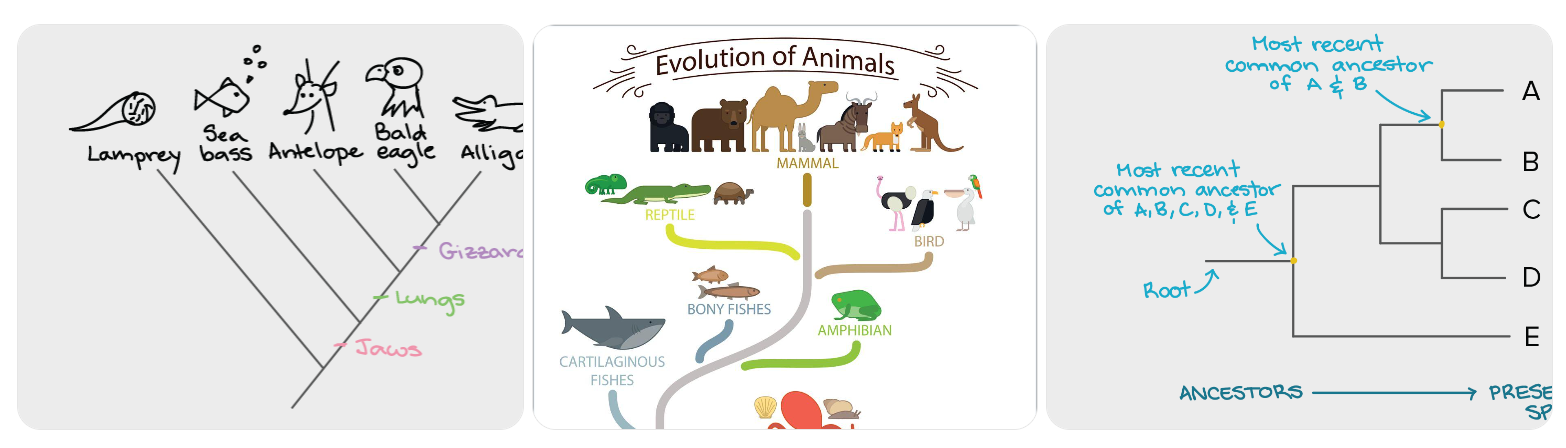
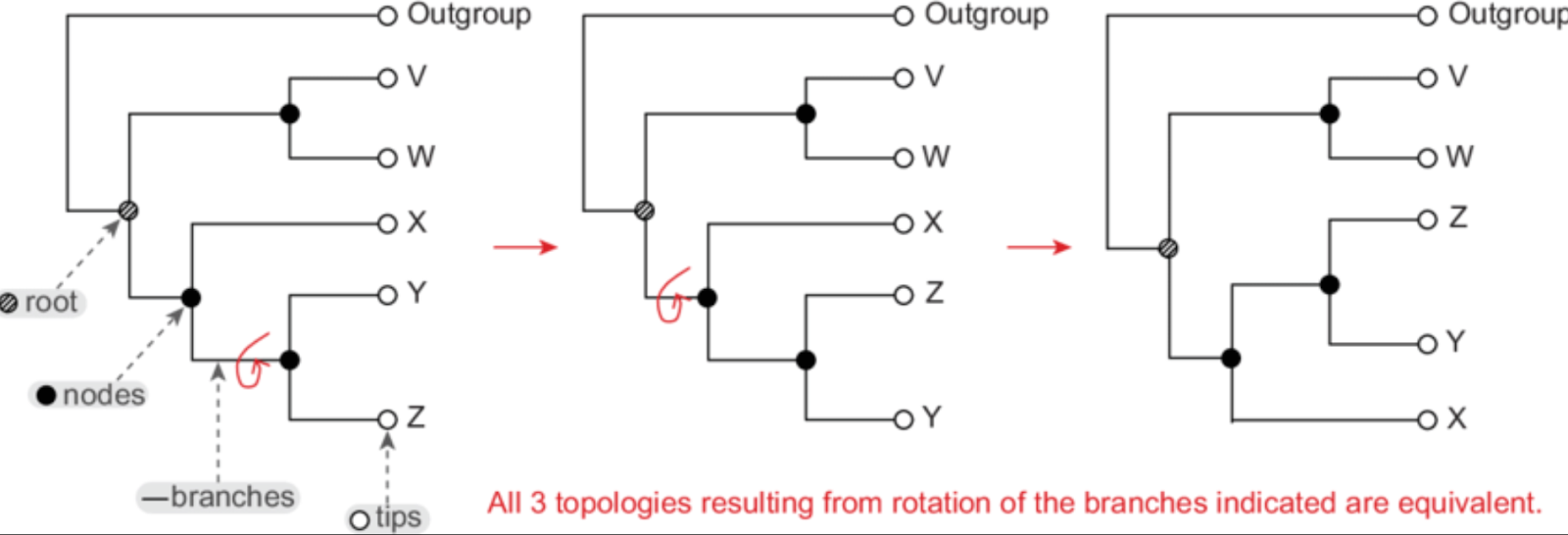
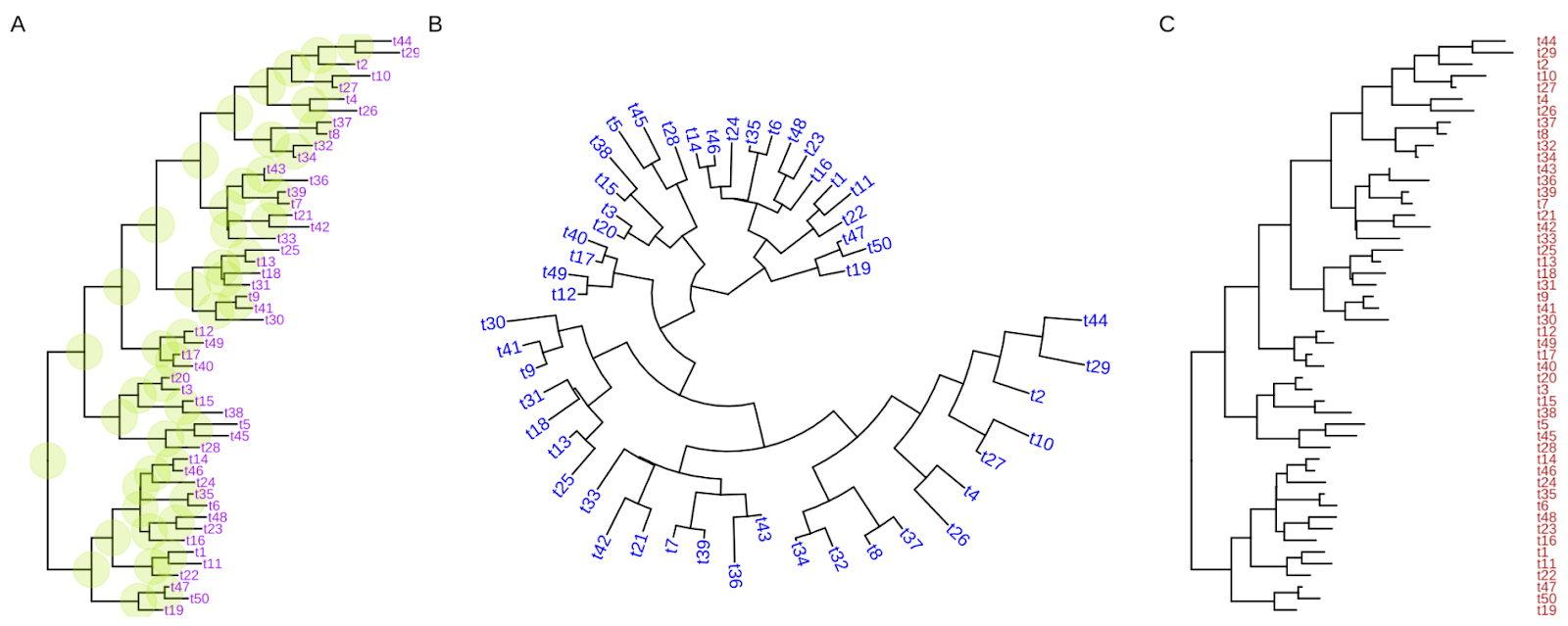
Phylogenetic trees can be displayed in different formats—horizontal, vertical, or radial—without changing the underlying relationships. Rotating or rearranging branches does not alter the evolutionary meaning of the tree, as long as the branching order remains the same. Understanding how to read these trees correctly is essential for interpreting evolutionary relationships and for constructing accurate phylogenetic models.
Below are visual examples of phylogenetic trees that illustrate how evolutionary relationships are represented across different groups of organisms:
- Example 1: Which species are more closely related?
(Source: https://www.khanacademy.org/science/ap-biology/natural-selection/phylogeny/a/building-an-evolutionary-tree;
https://www.istockphoto.com/vector/biological-evolution-animals-scheme-gm500509454-80808691;
https://www.khanacademy.org/science/ap-biology/natural-selection/phylogeny/a/phylogenetic-trees)
In this phylogenetic tree, Species A and Species B share a more recent common ancestor than either does with Species C. This means that A and B are more closely related to each other, even if Species C may look similar or live in a similar environment.
Closeness is determined by shared ancestors, not by appearance or position on the page. - Same relationships, different tree shapes
(Source: https://www.researchgate.net/figure/The-different-parts-of-a-rooted-phylogenetic-tree-showing-the-root-branches-nodes-and_fig1_43022487;
https://yulab-smu.top/treedata-book/chapter4.html; https://users.ugent.be/~avierstr/principles/phylogeny.html)
These trees look different (horizontal, vertical, or radial), but they represent the same evolutionary relationships. Rotating branches or the layout does not alter the meaning of the tree, as long as the branching order remains unchanged.
Tree shape does not change evolutionary relationships. - Misconception – evolution is not a ladder
(Source: https://www.researchgate.net/figure/Tree-format-translations-for-the-ladders-shown-in-Figs-1a-b-along-with-the-associated_fig3_226685940)
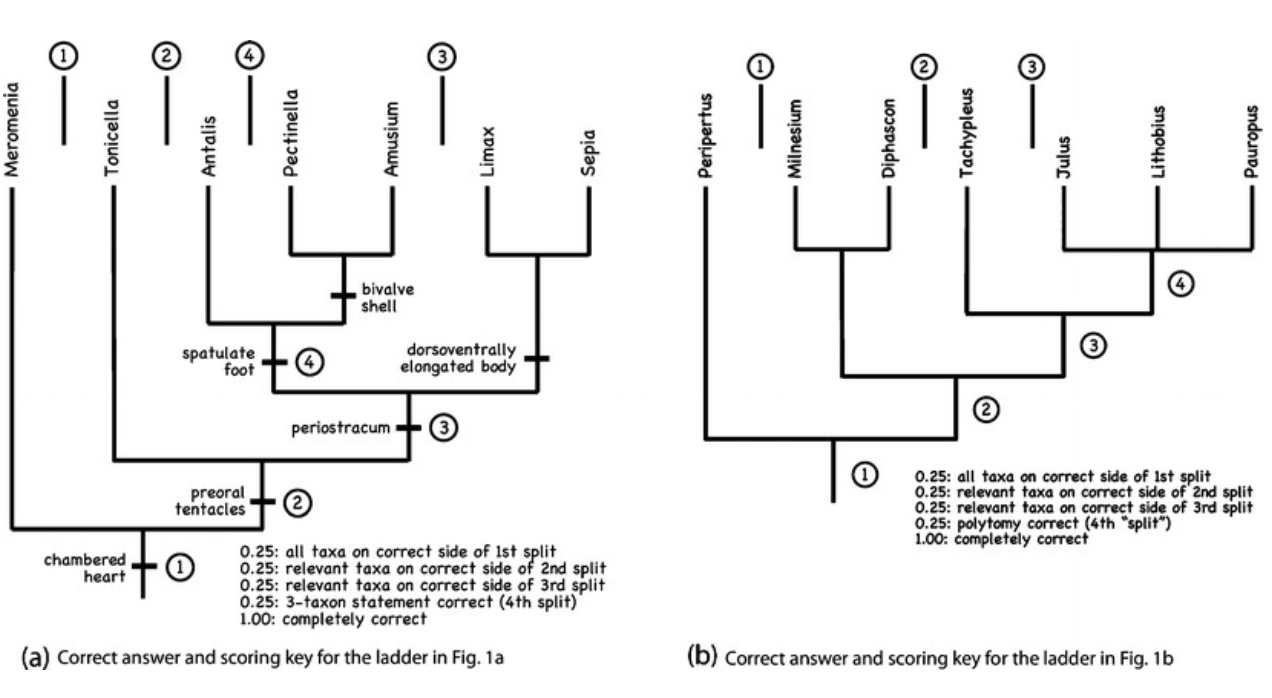
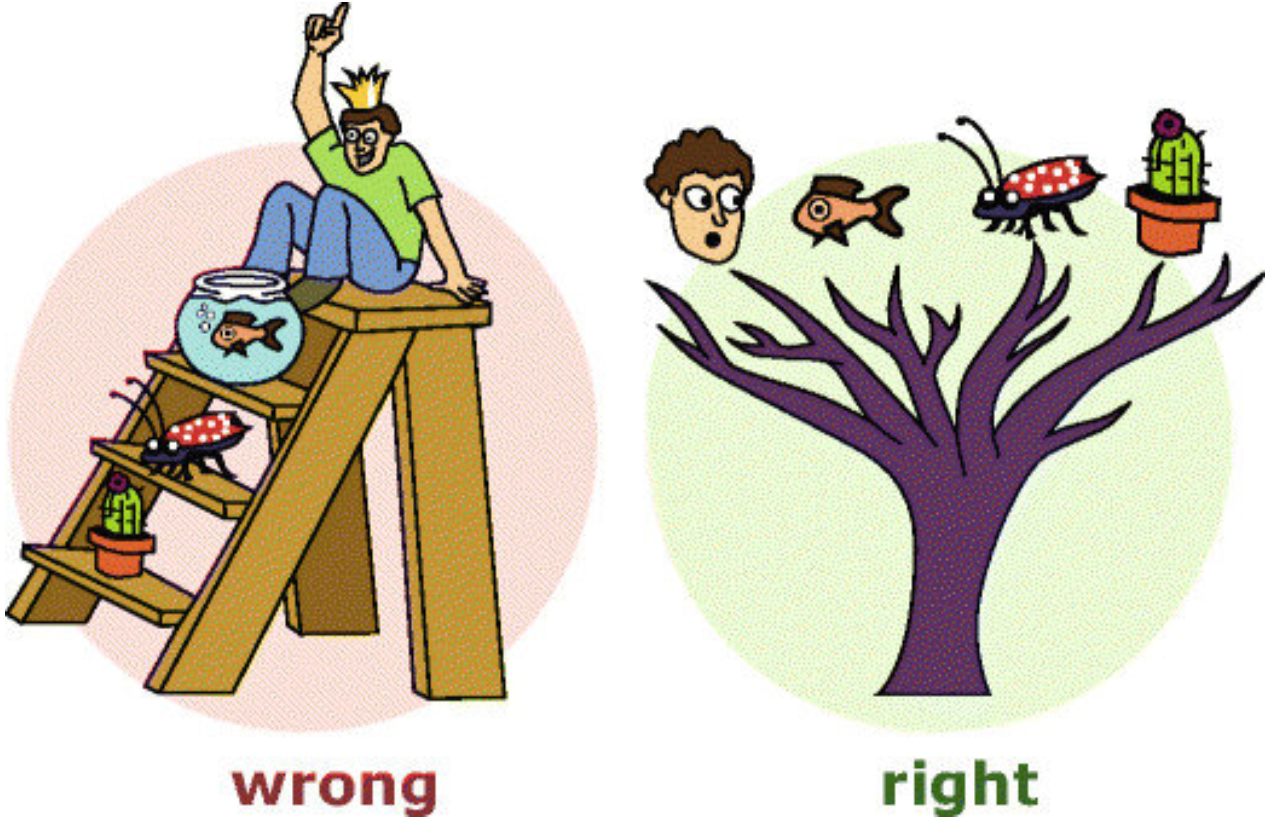
This comparison highlights a common misunderstanding. Evolution is often incorrectly shown as a ladder or linear progression. In reality, evolution works through branching, where multiple lineages evolve simultaneously from common ancestors.
All species at the tips of the tree are equally evolved.
1.6 Why Phylogenetic Trees Matter
Phylogenetic trees help scientists:
- understand biodiversity and evolution,
- track the origins of diseases,
- support conservation efforts,
- inspire bio-inspired solutions in science and technology.