1. Explore
| Site: | Bios4You |
| Course: | (10) What is the Human Genome Project? |
| Book: | 1. Explore |
| Printed by: | Guest user |
| Date: | Tuesday, 25 August 2026, 6:11 AM |
Why Study the Human Genome?
Every living organism has a genome — a complete set of DNA instructions. The human genome can be compared to a very large instruction book that explains how our bodies are built and how they work. It tells cells how to grow, develop, and react to the environment.
In the early 1990s, scientists already had advanced microscopes and genetic tools, but they had never read the full human genome as one complete sequence. This is why the Human Genome Project (HGP) was so important — its main goal was to sequence all human DNA for the first time (NHGRI, 2024).
By studying the human genome, scientists can better understand why some people develop diseases such as cancer, diabetes, or inherited genetic disorders. This knowledge also helps researchers improve treatments and develop new medicines. In addition, genome research helps explain human evolution and why every person is genetically unique (Green & Guyer, 2015).
Big Goals, Big Teamwork
The Human Genome Project officially started in 1990 and had five main goals:
- Identify all the genes in human DNA
- Determine the sequence of approximately 3 billion DNA base pairs
- Store genetic information in public databases
- Improve tools for analyzing genetic data
- Address ethical, legal, and social issues (ELSI) related to genome research (Collins et al., 2003)
The project was a global collaboration. Scientists from the United States, the United Kingdom, France, Germany, Japan, and China worked together. More than 20 research institutions participated, forming the International Human Genome Sequencing Consortium. This large-scale cooperation showed how international teamwork can accelerate scientific progress.

Figure 2. President Bill Clinton and Dr. Francis Collins at the White House in 2000 announcing the human genome draft. Source: NHGRI Photo Archive.
How Did They Sequence DNA?
DNA sequencing can be compared to reading the letters of a very long book. During the Human Genome Project, scientists mainly used a method called Sanger sequencing. This technique works by copying small DNA fragments many times. Special chemicals were added so that each DNA base — A, T, C, or G — produced a signal that could be detected by lasers. Computers then read these signals and reconstructed the DNA sequence (Collins et al., 2003).
Although Sanger sequencing was slow compared to today’s methods, scientists managed to sequence more than 90% of the human genome by 2003. Today, thanks to new technologies, the same task can be completed in just a few hours and at a much lower cost — often under $1,000 per genome (T2T Consortium, 2022).
Where Did the DNA Come From?
To create a human genome “reference,” researchers used anonymous DNA samples. Most of the DNA came from volunteers living in Buffalo, New York. Around 70% of the final sequence came from one donor, while the remaining data came from 19 other individuals. All samples were anonymized to protect donor privacy and prevent misuse of personal genetic information (NHGRI, 2024).
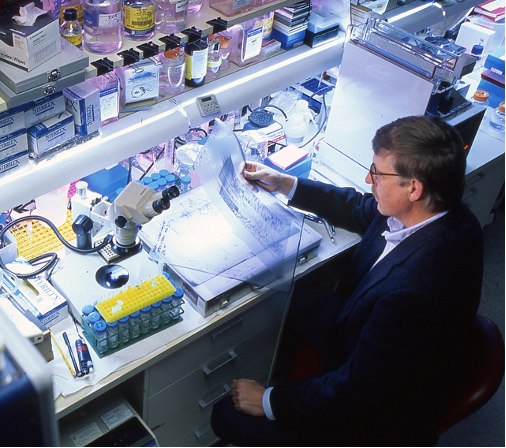
Figure 3. DNA sequencing lab setup at the time of the Human Genome Project. Source: NHGRI Photo Archive.
Ethical Considerations
From the beginning, scientists involved in the Human Genome Project understood that genome information could raise serious ethical questions. For example, could genetic data be used to discriminate against people at work or in health insurance? Should genetic testing be allowed for unborn children?
To address these concerns, the HGP created the ELSI program (Ethical, Legal, and Social Implications) and dedicated about 5% of the project’s total budget to ethical research. This was one of the first large scientific projects to include ethics as a core component of its work (Green & Guyer, 2015).
Lasting Legacy
The Human Genome Project did not end in 2003. Its results opened the door to personalized medicine, genetic testing, ancestry research, and many modern biomedical technologies. The project also promoted open science through policies such as the Bermuda Principles, which encouraged scientists to share genetic data quickly and freely instead of keeping it private until publication (Collins et al., 2003).
In 2022, researchers completed the first truly complete human genome sequence using advanced sequencing technologies. This achievement filled in regions that could not be read during the original HGP and demonstrated how far genomic science has progressed since 2003 (T2T Consortium, 2022).