5. Real-World Examples of AR in Environmental or Biorelated Fields
| Site: | Bios4You |
| Course: | (6) From Lab to Field: How Scientists Test Microbial Clean‑Up in Real Ecosystems |
| Book: | 5. Real-World Examples of AR in Environmental or Biorelated Fields |
| Printed by: | Guest user |
| Date: | Tuesday, 25 August 2026, 6:01 AM |
Table of contents
- 5. Real-World Examples of AR in Environmental or Biorelated Fields
- 5.1. AR for In-Situ Environmental Monitoring and Data Visualization
- 5.2. Affluent Effluent: AR Modeling of Microbial and Chemical Dynamics
- 5.3. AR for Urban and Industrial Pollution Awareness
- 5.4. AR for Interactive Field Planning in Water and Soil Projects
- 5.5. Clean-AR: AR for Risk Mapping and Contamination Control
- 5.6. Emerging Research: AR + Multi-Omics for Field Bioinformatics
5. Real-World Examples of AR in Environmental or Biorelated Fields
Augmented Reality (AR) has rapidly advanced from a tool for visual engagement to a functional interface for complex scientific monitoring and decision-making. In environmental science and biotechnology, AR is beginning to bridge physical landscapes with real-time data, enabling researchers, engineers, and decision-makers to interact with invisible biological or chemical processes at the site of interest.
While direct applications of AR in microbial bioremediation are still developing, a growing body of real-world examples in environmental monitoring, pollution control, data visualization, and risk assessment demonstrates AR’s powerful potential for enhancing "lab-to-field" processes. Below are key examples with implications for microbial clean-up in real ecosystems.
5.1. AR for In-Situ Environmental Monitoring and Data Visualization
Environmental monitoring at field sites typically involves deploying sensors, collecting samples, and conducting off-site analysis, methods that often delay response time and limit spatial context. In the case of microbial bioremediation, this becomes especially problematic, as microbial activity, redox conditions, or contaminant concentration gradients are largely invisible and highly dynamic. Augmented Reality (AR) addresses these issues by enabling real-time, spatially anchored visualization of field data, allowing scientists to interact with environmental information in the very place it is most relevant (Wang et al., 2022; Pokrić et al., 2012).
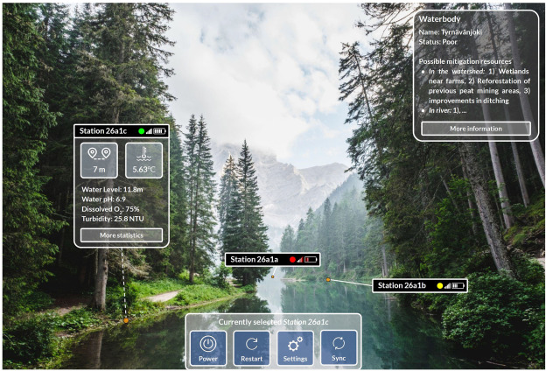
AR systems can fuse:
- · Environmental sensor data (e.g., pH, dissolved oxygen, temperature),
- · GIS-based site layouts (e.g., pollutant source zones),
- · Predictive models (e.g., COMSOL/MODFLOW),
- · Microbial activity patterns (e.g., eDNA-based abundance or gene expression profiles).
This allows researchers, environmental engineers, or site managers to "see" chemical and biological processes overlaid in the actual field, facilitating timely and evidence-based interventions (Zhang et al., 2023).
In microbial remediation projects, AR can:
- · Display real-time concentrations of contaminants like uranium, hydrocarbons, or nitrates directly on a field surface;
- · Overlay microbial colonization zones (based on qPCR, eDNA, or omics data) on physical sampling locations;
- · Show bioavailability zones, where pollutants are accessible or inaccessible to microbial degradation based on soil porosity or binding state (Guo et al., 2023);
- · Visually represent injection well influence, e.g., showing how acetate spreads underground to stimulate Geobacter populations (Lovley et al., 2003; Zhang et al., 2023).
These applications shift bioremediation monitoring from reactive to proactive: potential failures can be identified early, and scientists gain a real-time map of microbial activity and pollutant behavior.
ekoNET: AR-Enabled Environmental Monitoring Platform
Developed as an IoT-based pollution tracking system, ekoNET integrates mobile AR with environmental sensors to visualize real-time air and water quality on-site (Pokrić et al., 2012). Users scan the environment using mobile devices to view levels of pollutants such as CO₂, NO₂, and turbidity.
Implications for Bioremediation: In microbial field trials, a similar setup could be configured to display maps of:
- · Subsurface contaminant plumes,
- · Nutrient diffusion zones,
- · Reactive barriers enhanced with microbial consortia.
Zhang et al. (2023) developed an AR tool for visualizing groundwater flow, pollutant dispersion, and remediation infrastructure using georeferenced 3D models. This system allowed users to understand the spatial relationships between contaminant sources, clean zones, and microbial activity zones in real-world industrial sites.
Application to Field Testing: AR could assist in microbial remediation pilot sites by showing how pollutant concentrations change spatially after microbial inoculation or nutrient injection, directly on-site, without needing to consult GIS platforms or wait for lab results.
AR has growing potential to support multi-omics-based field interpretation. Wang et al. (2022) demonstrated AR integration with metagenomics, allowing users to overlay functional gene expression (e.g., cydA, alkB, narG) onto specific GPS-tagged sites, producing spatial views of microbial functions.
Relevance to Microbial Field Trials:
- · Field teams could visualize microbial activity linked to pollutant degradation in real time.
- · Omics data could be used to verify whether microbes are actively reducing contaminants or merely surviving.
Simulation tools like COMSOL or MODFLOW can be used to forecast nutrient dispersion or microbial transport. When paired with AR, these models can project expected outcomes directly onto the site, aiding the planning of injection schemes and monitoring stations (Silva & Gültekin, 2021).
Benefits in Bioremediation Practice
1. Real-time Decision-Making
By combining on-site visualizations with live data, field teams can adjust bioremediation strategies quickly (e.g., shift nutrient injection, change sampling plans).
2. Improved Spatial Awareness
Visualizing chemical gradients or microbial abundance zones directly in the field helps target remediation more accurately.
3. Enhanced Communication
Stakeholders (e.g., landowners, regulators) can better understand invisible processes, building trust and enabling clearer risk communication.
4. Safety and Containment Monitoring
AR can flag zones where microbial overgrowth or secondary pollutants may emerge, supporting biosafety in cases involving genetically engineered organisms (Schmidt et al., 2021).
5.2. Affluent Effluent: AR Modeling of Microbial and Chemical Dynamics
Developed by Silva & Gültekin (2021), Affluent Effluent is an AR app that simulates environmental interactions between pollutants and microbial populations. The model incorporates:
- · Nutrient dynamics,
- · Microbial growth phases,
- · Pollutant degradation rates.
Definition:
Nutrient dynamics refers to the movement, transformation, availability, and uptake of essential nutrients (e.g., carbon, nitrogen, phosphorus, oxygen, or electron donors like acetate) that support microbial life and influence their activity in polluted environments.
In the Bioremediation Context:
- · Microorganisms used in field clean-up rely on available nutrients to grow and metabolize pollutants.
- · Sometimes, nutrients are naturally present, but in many cases, they must be added artificially (biostimulation) to encourage microbial degradation.
- · For example, in uranium-contaminated aquifers, acetate is injected to stimulate Geobacter species, which use it as an electron donor to reduce soluble U(VI) into insoluble U(IV) (Lovley et al., 2003).
In AR Modeling:
- · Nutrient dynamics are visualized as spreading zones or concentration gradients that change over time.
- · Students or researchers can see how nutrient-rich areas enable more microbial growth and pollutant breakdown.
- · The simulation may also show competition for nutrients, influencing which microbes dominate.
Definition:
Microbial growth phases describe the four-stage cycle that microbial populations typically follow when introduced into a new environment or substrate:
1. Lag Phase – Adjustment period where microbes adapt to new conditions (no growth).
2. Log (Exponential) Phase – Rapid reproduction due to abundant nutrients.
3. Stationary Phase – Growth slows as nutrients deplete and waste accumulates.
4. Death Phase – Microbes die off due to lack of resources or accumulation of toxic byproducts.
In Bioremediation Context:
- · Understanding growth phases is key to timing field interventions like re-inoculation or nutrient reapplication.
- · For example, if a microbial population is in the stationary phase, pollutant degradation will plateau without further action.
In AR Modeling:
- · These phases are represented visually, such as bubbles of microbial colonies expanding and stabilizing, or changing color as they enter different phases.
- · Users can adjust conditions (e.g., temperature, nutrient input) and observe how the growth phase shifts, helping them understand the delicate balance needed for successful field-scale bioremediation.
Definition:
Pollutant degradation rate is the speed at which a specific pollutant is broken down or transformed into less harmful substances by microbial or chemical processes.
In Bioremediation Context:
· Microbes may degrade pollutants through:
o Aerobic degradation (with oxygen) – e.g., hydrocarbons by Pseudomonas spp.
o Anaerobic degradation (without oxygen) – e.g., uranium or nitrate by Geobacter spp.
· Factors influencing degradation rate include:
o Microbial strain efficiency,
o Temperature and pH,
o Pollutant concentration and chemical form,
o Nutrient availability and redox conditions.
In AR Modeling:
· Degradation rates are represented through visual decay curves, color changes in the pollutant plume, or timed animations showing how much pollutant remains over time.
· Users can observe how changing environmental conditions (e.g., injecting more nutrients or shifting pH) affect the degradation timeline.
These three processes, nutrient availability, microbial growth, and pollutant degradation, form a dynamic feedback loop in bioremediation:
1. Nutrient availability affects...
2. Microbial growth, which drives...
3. Pollutant degradation, which may consume nutrients and produce byproducts, affecting microbial health.
Modeling this system in AR allows users to see these interdependencies in action, offering deeper understanding for environmental scientists, students, or field technicians.
Key Features:
- · Visualizes changes in chemical concentration over time;
- · Simulates microbial responses under different environmental stressors;
- · Runs on mobile AR platforms (e.g., smartphones, tablets).
Relevance to Bioremediation:
This app represents an early but practical approach to model-based AR for simulating remediation processes, helping researchers or students predict outcomes under field conditions. In real remediation projects, such tools can support planning of injection schemes or nutrient amendments by showing expected microbial behavior over time and space.
5.3. AR for Urban and Industrial Pollution Awareness
Researchers in Italy have implemented an AR system to enhance public awareness of air pollution. The system overlays Air Quality Index (AQI) metrics and pollutant sources onto physical locations using GIS and mobile AR.
Case Study:
- Marche Region, Italy (Sanità et al., 2024): The system integrated satellite data, urban sensors, and AQI models, allowing users to "walk through" polluted zones and visualize levels of NO₂, PM2.5, and ozone in real time.
Relevance to Bioremediation:
Though developed for urban air pollution, this use case illustrates the visual power of AR in showing invisible environmental threats. Similarly, AR can be adapted to microbial field sites to show underground plumes of heavy metals or oil, microbial activity hotspots, or evolving redox zones that affect pollutant bioavailability.
5.4. AR for Interactive Field Planning in Water and Soil Projects
In industrial remediation, managing multiple inputs, sampling wells, injection points, and native species zones is logistically complex. AR can support:
- Overlaying of infrastructure elements on-site;
- Tracking of progress (e.g., zones cleaned, microbial abundance);
- Simulation of injection plumes and degradation front movement.
Example:
- Mobile Augmented Reality for Environmental Monitoring (Stojanovic et al., 2012): Demonstrated the use of mobile AR platforms to visualize environmental simulations tied to georeferenced data.
Relevance to Bioremediation:
This model can directly enhance field logistics and communication in microbial cleanup, allowing real-time inspection of which zones need microbial re-inoculation, where pollutant levels are declining, or how microbial communities shift after treatment.
5.5. Clean-AR: AR for Risk Mapping and Contamination Control
Originally developed for hospitals to manage airborne disease risks, Clean-AR uses AR glasses and 3D modeling to:
- Identify contamination pathways.
- Highlight high-risk surfaces.
- Track pathogen spread in real time (Schmidt et al., 2021).
Relevance to Bioremediation:
In field-scale microbial applications, especially with genetically modified microbes, tracking ecological containment zones is essential. AR could similarly be used to:
- Mark boundaries where introduced microbes should not spread.
- Identify biofilm overgrowth zones.
- Alert researchers to unintended microbial migration beyond treatment zones.
This ensures biosafety compliance and transparent documentation, particularly in regulatory-sensitive contexts.
5.6. Emerging Research: AR + Multi-Omics for Field Bioinformatics
Recent work suggests that AR can integrate with omics platforms (metagenomics, metabolomics, transcriptomics) to present microbial functional data in space.
Example:
- Wang et al. (2022) developed an AR visualization engine that integrates environmental DNA (eDNA) data with GPS coordinates to produce spatially accurate overlays of microbial diversity and functional traits in real landscapes.
Relevance to Bioremediation:
This has direct utility in field studies where researchers must evaluate whether microbes are actively degrading pollutants, expressing specific genes (e.g., alkB, pahR, cydA), or forming consortia. With AR, such data could be visualized on-site for immediate ecological interpretation.
These real-world examples demonstrate how AR is being used across environmental sectors to visualize contamination, simulate remediation dynamics, monitor ecological risk, and interpret microbiological data. Each example offers a translatable method for microbial bioremediation efforts, particularly during field-scale trials where spatial awareness, real-time monitoring, and safety are critical.