1. EXPLORE – Understanding the Context and Key Concepts
| Site: | Bios4You |
| Course: | (20) Reimagining Cities: Designing Biophilic Urban Spaces with AR for STEM Learners (14–18) |
| Book: | 1. EXPLORE – Understanding the Context and Key Concepts |
| Printed by: | Guest user |
| Date: | Tuesday, 25 August 2026, 6:10 AM |
What is Biophilic Design?
Biophilia can be defined as a love of life or living systems. It is theorized that humans have an inherent need to affiliate with the world around us and are naturally inclined to do so. This inclination is inborn, and as much as we gravitate toward it, we can also be averse to it. For instance, we might naturally want to be outside in the sunlight and warmth of a summer day, but we also do not want to find ourselves near a poisonous snake. Biophilic design helps us discover how the built environment could and should, be radically re-conceptualized around the fundamental workings of the human mind (Vagal, 2020).
How Does Biophilic Design Benefit Humans?
Over the past 5,000 years, the rise of large-scale agriculture, manufacturing, technology, industrial production, engineering, and modern urban life represents only a brief chapter in human history. Despite these advancements, they have not replaced the benefits of living in harmony with the natural environment. Much of our emotional well-being, problem-solving, critical thinking, and creative abilities still stem from skills and instincts developed through deep connections with natural systems. These connections continue to play a vital role in our health, development, and productivity (Kellert, 2015).
Biophilic design offers measurable benefits by reconnecting humans with the natural patterns and sensory experiences that shaped our evolution over millennia. Rooted in our biological affinity for nature, a concept known as biophilia (Wilson, 1984), this design approach recognizes that our cognitive, emotional, and physiological systems are best attuned to environments resembling those in which humans evolved, such as forests, savannahs, and other natural settings (Kellert et al., 2008).
Scientific studies have shown that even minimal exposure to natural elements, such as access to daylight, views of greenery, fresh air, or tactile interaction with organic materials, can significantly enhance psychological well-being. These benefits include reduced stress levels, improved mood, greater creativity, and heightened cognitive performance (Ulrich et al., 1991; Kaplan & Kaplan, 1989). Contact with nature has also been associated with faster recovery rates in healthcare settings, improved concentration in educational environments, and increased workplace job satisfaction (Terrapin Bright Green, 2012).
From a physical health perspective, biophilic environments promote better air quality through natural ventilation, reduce noise pollution by integrating plants and natural materials, and encourage physical movement through well-designed green spaces. Exposure to natural light, particularly when aligned with circadian rhythms, improves sleep quality and overall vitality (Van den Berg et al., 2010).
In addition to individual benefits, biophilic design supports social health by fostering a sense of belonging and community. Spaces with natural elements like courtyards, promenades, and public gardens are more inviting and inclusive, encouraging interaction, collaboration, and shared experiences (Beatley, 2011). These environments can nurture stronger community bonds and contribute to more resilient, socially cohesive urban settings.
Six Elements of Biophilic Design
Biophilic design is an evidence-based approach integrating natural elements into built environments to enhance human well-being. Rooted in the concept of biophilia, the innate human affinity for nature, this design philosophy has evolved to encompass various frameworks that guide its application in architecture and urban planning.
One of the foundational frameworks, developed by Stephen R. Kellert, outlines six core elements of biophilic design:
Environmental Features: Incorporation of natural elements like light, air, water, plants, and natural materials.
- Natural Shapes and Forms: Using biomorphic forms, fractals, and natural patterns.
- Natural Patterns and Processes: Integration of features that reflect nature’s rhythms, changes, and sensory variability.
- Light and Space: Designing with natural light, dynamic illumination, and spatial variability to evoke natural experiences.
- Place-Based Relationships: Creating spaces that reflect local ecology, culture, and a sense of belonging.
- Evolved Human-Nature Relationships: Acknowledgment of psychological connections to prospect-refuge theory, fear and awe, and the restorative benefits of nature.
Recent studies have expanded upon these elements, emphasizing their relevance in contemporary design practices. For instance, a 2023 review by Wijesooriya et al. highlights the integration of biophilic design frameworks with sustainable design criteria, underscoring the importance of aligning biophilic principles with environmental performance standards.
Furthermore, Al Sayyed and Al-Azhari (2025) research demonstrates the physiological benefits of biophilic design elements, such as natural light and ventilation, in reducing stress and enhancing comfort in residential settings.
These findings reinforce the significance of incorporating biophilic elements to promote health and well-being in built environments.
By understanding and applying these six elements, designers and educators can create spaces that foster human-nature connections and support cognitive function, emotional well-being, and overall health.
Biophilic and well-being:
The affiliation with nature as an inherited human inclination is the theory of biophilia; Wilson popularized this term in (1984). Kellert and Calabrese (2015) advocated the practice of biophilic design. They defined it as a process that offers a sustainable design strategy that seeks to interconnect people and nature based on three experiences and twenty-four design attributes. Strengthening this connection with nature reduces stress and improves health and well-being.
Since people usually spend more time inside buildings than in exterior environments, implementing a biophilic interior design approach is particularly important. However, this subject is still being researched, and the related literature is somewhat limited. Admittedly, principles and design processes are open to multiple interpretations that lead to ambiguity. “While the goal of the biophilic design is clear, understanding it and its application is less so” (Vagal, 2020).
Biophilic design considers other life forms (Beatley, 2017) and works efficiently in different contexts (Orman, 2017). It consists of direct, indirect, and symbolic experiences that aid human-nature connections (Bewza, 2012). Characteristics include access to diverse space types with different spatial qualities (Mangone et al., 2017), varied surface textures, glass, natural view, natural materials, warm colors (Spivack and Rogelberg, 2010), plants, natural sunlight, ventilation, open spaces and windows (Gray and Birrell, 2014).
Biophilic design example:
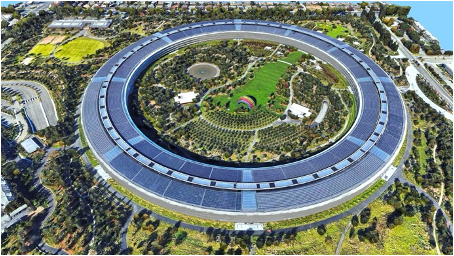
1- Apple Park, California, USA
Apple’s new campus is widely regarded as one of the leading examples of biophilic design. The doughnut-shaped structure copies the natural curves found in nature and brings light into the offices from every angle. A new, 9,000-tree woodland also surrounds the campus.
2- Bosco Verticale, Milan, Italy
Finding nature in a high-rise apartment seems quixotic, but it may be just the biophilic injection dense cities need. After centuries of practice distinguishing the urbane from wilderness, a pair of residential high rises in Milan, Italy, has flipped the paradigm by proposing a new social ecology within its building façade and is providing an option for ultra-urban access to nature.
Bosco Verticale, designed by architect Stefano Boeri, opened in 2014 to provide residents with an alternative to suburban single-family neighborhoods. Boeri envisioned public exchange with neighbors through a terrace-scape on the building’s exterior façade. In this space, residents would have views of nature, direct access to vegetation, and the opportunity for neighborly exchange about the pleasantries of gardening, plants, and wildlife. Relying on a compact intimacy of the gardening tradition, Bosco Verticale expands Milan’s cultural habits of terrace gardening into a community-level asset that occurs as a forest on a building within the city.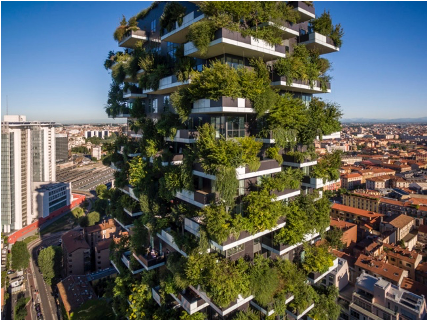
3- Kampung Admiralty
Kampung Admiralty offers a case study on how nature can be a primary element of these residential buildings. It, too, provides residents with rooftop agriculture and gardens throughout. The multitiered levels of the building progressively treat stormwater that flows through the site. The building has flourished within the three years since it opened to residents. 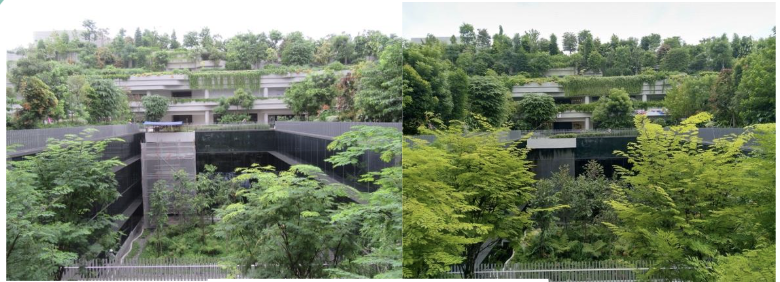
Figure … source: Jana Soderlund
STEM Concepts Involved
Biophilic design is inherently multidisciplinary, drawing from nature’s processes and forms to enhance the built environment in ways that support human health, ecological balance, and aesthetic richness. Integrating STEM education, science, Technology, Engineering, and Mathematics into biophilic design allows students to explore and apply real-world skills while engaging with sustainability challenges and environmental awareness.
Each STEM discipline offers a unique perspective for understanding and applying nature-inspired solutions:
- Biology deepens our understanding of natural systems, ecosystems, and biodiversity, which is essential for designing environments that interact harmoniously with living organisms.
- Physics helps us explore the behavior of natural forces like light, airflow, and energy transfer, all of which influence environmental comfort and efficiency.
- Mathematics provides the tools to recognize and apply natural patterns, such as symmetry, fractals, and the Fibonacci sequence, that often guide form and proportion in nature-based design.
- Technology empowers learners to experiment with innovative materials and digital tools, such as augmented reality (AR), to prototype and visualize sustainable, nature-integrated spaces.
Students gain practical experience in scientific observation, critical thinking, spatial reasoning, and ecological literacy through this approach. These connections support technical skill development and a deeper appreciation of nature's role in solving human-centered design challenges, bridging education, innovation, and sustainability.
Recent studies emphasize the power of nature-based STEM learning to foster creativity, well-being, and environmental responsibility among young learners (e.g., Wijesooriya et al., 2023; Al Sayyed & Al-Azhari, 2025). These experiences become even more immersive and impactful when supported by interactive technologies like AR.
Natural systems and ecosystems (Biology)
Biophilic design integrates natural systems and ecosystems into urban environments to enhance human well-being and ecological balance. Urban spaces can mimic natural habitats by incorporating green roofs, vertical gardens, and biodiversity corridors, promoting environmental balance and psychological benefits.
Recent research highlights the importance of biodiversity in urban settings. For instance, the study "Biophilic Design Integration: Enhancing Sustainability and Human Well-Being in Modern Architecture" discusses how integrating natural elements into architectural design can improve mental health and environmental sustainability.
Moreover, urban areas can host a surprising level of biodiversity and provide unique ecosystems at various scales. Urban nature offers the potential to create needed ecological connectivity across fragmented landscapes, lessen per capita environmental footprints, and nurture climate-resilient ecosystems (https://www.nlc.org/article/2025/04/09/catalyzing-biodiversity-on-buildings/?utm_source=chatgpt.com ).
Implementing biophilic design, especially in urbanized areas, can sometimes lead to unintended negative consequences for natural ecosystems. Therefore, careful planning and consideration are essential to ensure that integrating natural elements into urban design supports and enhances existing ecosystems rather than disrupting them ( Szewrańskiet al., 2024).
Incorporating natural systems into urban design benefits the environment and supports human health. Studies have shown that exposure to natural environments can reduce stress, improve cognitive functioning, and increase workplace productivity ( Senthil & Jayalakshmi, 2025).
Students can appreciate the interconnectedness of human and ecological health by understanding and applying the principles of natural systems and ecosystems in urban design. This knowledge empowers them to create urban spaces that are not only sustainable but also conducive to the well-being of all inhabitants.
Light and ventilation (Physics)
Light and ventilation are fundamental physical elements in biophilic design, directly influencing human comfort, health, and productivity. Understanding the physics behind natural light and airflow enables the creation of built environments that harmonize with natural processes, enhancing occupant well-being and environmental sustainability.
Natural Light
Natural light, or daylighting, plays a crucial role in regulating human circadian rhythms, which are essential for maintaining sleep patterns, hormonal balance, and overall health. The strategic use of daylight in architecture involves considering building orientation, window placement, and reflective surfaces to maximize light penetration while minimizing glare and heat gain.
Recent research highlights the benefits of incorporating natural light into building design. For instance, a study published in Frontiers in Virtual Reality demonstrated that environments with biophilic elements, including natural light, significantly reduced physiological stress indicators compared to non-biophilic environments ( Al Sayyed & Al-Azhari, 2025).
Moreover, daylight-responsive lighting control systems can reduce reliance on artificial lighting, saving energy and reducing greenhouse gas emissions. Integrating such systems requires understanding the physics of light, including its intensity, direction, and spectral qualities. For STEM learners aged 14–18, exploring the physics of natural light offers hands-on opportunities to understand concepts like light reflection, refraction, and energy efficiency.
Geometry and patterns in nature (Mathematics)
Geometry and mathematical patterns are fundamental to understanding the natural world and play a crucial role in biophilic design. By studying these patterns, students can gain insights into the underlying principles that govern natural forms and apply this knowledge to create harmonious and sustainable urban spaces.
Fractals and Self-Similarity
Fractals are complex geometric shapes that exhibit self-similarity, meaning they look similar at different scales. These patterns are prevalent in snowflakes, coastlines, and tree branches. Fractal analysis has been used to understand the complexity of natural systems and has applications in fields ranging from ecology to medicine.
Fibonacci Sequence and the Golden Ratio
The Fibonacci sequence and the associated golden ratio are mathematical concepts frequently occurring in nature. They can be observed in the arrangement of leaves on a stem, the pattern of seeds in a sunflower, and the spiral shells of mollusks. Understanding these patterns helps students appreciate the mathematical order underlying natural forms.
Symmetry and Tessellations
Symmetry is a common feature in natural organisms, contributing to their structural stability and aesthetic appeal. Tessellations, or tiling patterns, are also found in nature, such as in the honeycomb structures of beehives. Studying these patterns allows students to explore concepts of balance and repetition in design.
Applications in Biophilic Design
Incorporating natural geometric patterns into urban design can enhance inhabitants' aesthetic and psychological well-being. For example, fractal patterns in architectural elements can reduce stress and improve cognitive function. Understanding and applying these mathematical principles enable students to create designs that resonate with natural forms and promote sustainability.
What Are Sustainable Materials?
Sustainable materials are eco-friendly. They either grow back quickly, are recyclable, or use less energy to produce. When used in biophilic design, these materials also support health and well-being.
Here are some exciting examples being explored and used today:
- Bamboo, cork, and hempcrete are plant-based materials that grow quickly and naturally absorb carbon dioxide. They require less processing than traditional materials like concrete or plastic. These bio-based materials can reduce the carbon footprint of buildings significantly (Mnasri et al., 2021).
- Mycelium is the root structure of mushrooms. It can be grown into building blocks or panels. This material is lightweight, fully compostable, and doesn’t need chemical processing. It’s often used in green architecture (Alaneme & Anaele, 2023).
- Bioconcrete is a special kind of concrete that heals its cracks using bacteria. These bacteria produce a natural substance that seals the crack when moisture enters. This innovation reduces maintenance needs and extends the life of buildings (Aytekin et al., 2024).
- Low-emissivity (Low-E) glass reflects heat but lets in natural light. This glass helps reduce energy use for heating and cooling while still providing access to daylight, which is vital in biophilic spaces (Elverici, 2024).
Using these materials makes cities more sustainable and supports biophilic design’s biggest goal: improving our connection to nature while protecting the environment.
What Is Design Thinking?
Design thinking is a creative process that helps people devise solutions to complex problems. It's not just about making things look good; it's about meeting real needs in smart, effective ways.
It includes five steps:
- Empathize – Understand what people need.
- Define – Identify the core problem.
- Ideate – Brainstorm creative solutions.
- Prototype – Build a model or test version.
- Test – Try it out and improve based on feedback.
In biophilic design, you might use design thinking to create:
- A park bench made from local wood and mycelium foam.
- A school courtyard with natural light, trees, and seating shaped like leaves.
- A small rooftop greenhouse that collects rainwater.
Research shows that using design thinking in sustainability projects helps people collaborate better and create real-world solutions. It’s already being used to tackle significant challenges like climate change, green transportation, and eco-friendly housing (Leal Filho et al., 2024).