1. Explore
| Sito: | Bios4You |
| Corso: | (28) Photobiomodulation – How Low-Level Light Helps the Body Heal |
| Libro: | 1. Explore |
| Stampato da: | Επισκέπτης (Guest user) |
| Data: | martedì, 25 agosto 2026, 06:42 |
Understanding Light and Its Powers
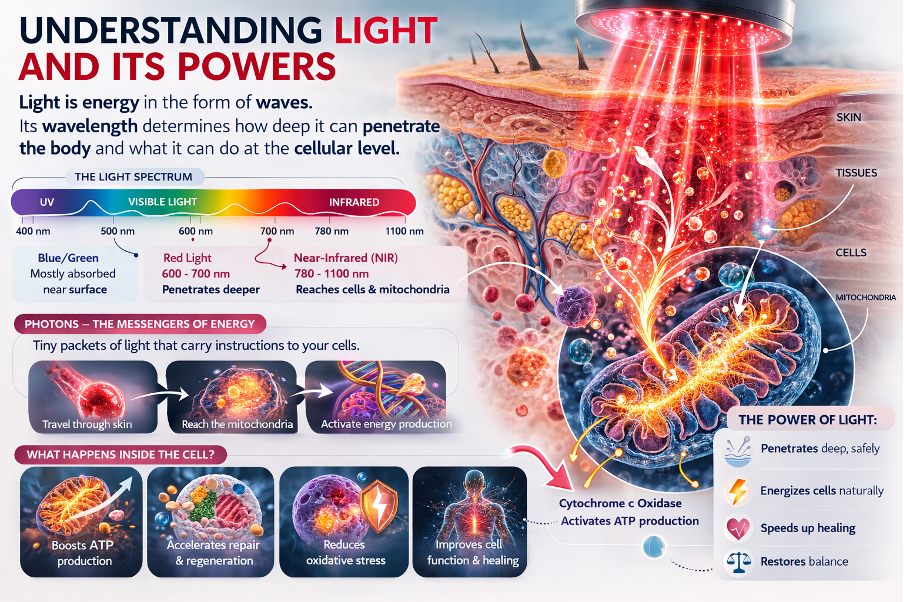
Light is not just something we see; it is a form of energy that travels in waves, each wave carrying a specific amount of energy determined by its wavelength. The wavelength of light determines its color and, crucially, how deeply it can penetrate matter. Shorter wavelengths, like blue and violet, are energetic but tend to scatter or get absorbed near the surface. Longer wavelengths, like red (600–700 nm) and near-infrared (NIR, 780–1100 nm), can travel deeper, reaching the hidden layers of tissues where they perform their therapeutic magic.
Light as a Forest of Colors
Imagine walking in a dense forest at noon. Sunlight pours down from above, but not all colors of light reach the forest floor. Blue and green light are mostly absorbed or scattered by the leaves, barely touching the plants below. Red and orange light, however, filter through the canopy, reaching the forest understory and nourishing the plants there.
In your body, the situation is similar. The “canopy” is made of skin, fat, and other tissues. Red and NIR light act like the filtered sunlight that can penetrate this canopy, reaching the “understory” — the mitochondria within your cells — without causing any harm.
Visual metaphor / schematic idea
Sunlight (full spectrum)
↓
Canopy (skin & tissue)
┌──────────────┐
│ Blue/Green │ → mostly absorbed
│ Red/NIR │ → penetrates deeper
└──────────────┘
↓
Forest floor → mitochondria inside cells
Photons: Tiny Messengers
Light consists of photons — the smallest packets of energy. You can think of photons as tiny messengers, each carrying an “instruction” to the cells. When red or NIR photons reach mitochondria, they deliver this message:
Produce more energy!
Light’s Role in Healing
By enhancing ATP production, red and NIR light accelerate the body’s natural repair mechanisms:
- Cells fix damage faster.
- Oxidative stress is reduced.
- Overall cellular function improves.
In essence, light is more than illumination — it is a biological messenger, capable of influencing life at the molecular level. Like sunlight nurturing the hidden forest floor, it energizes the deepest layers of the body, promoting healing and vitality from within.
Diving into Cells and Mitochondria
Cells are the building blocks of all living things, and mitochondria are their powerhouses. Think of a mitochondrion as a tiny factory inside the cell, where fuel is converted into energy in the form of ATP (adenosine triphosphate). Every movement, every heartbeat, every repair process in your body requires ATP.
PBM provides an extra energy boost by stimulating mitochondria with light. This extra energy is crucial for repairing damaged tissues, reducing inflammation, and speeding up recovery. It’s like providing extra workers and machinery in a factory to finish an important project faster.
Why Red and NIR Light Work Best
Inside mitochondria, a molecule called cytochrome c oxidase - a molecule that acts like a gatekeeper for cellular energy production- absorbs photons from red and NIR light. This triggers a series of chemical reactions, which leads to more ATP — the molecule that powers almost all cellular functions- production and less oxidative stress. The result is healthier, more active cells that can respond to injury or strain more efficiently.
By targeting the correct wavelength and dose, PBM safely stimulates healing without overheating tissues, unlike high-power surgical lasers. This makes PBM a safe, repeatable treatment for various conditions.
Exploring PBM in Everyday Life
PBM is not just a lab phenomenon; it’s used in real-world applications across medicine and sports. Clinics use it to heal wounds faster, reduce inflammation, and accelerate recovery from muscle injuries. Athletes use PBM for post-training recovery to reduce fatigue and soreness. Even dental clinics employ PBM to reduce swelling and discomfort after procedures.
Imagine a soccer player with a sprained ankle. Normally, it might take two weeks to regain full function. With PBM, the ankle heals faster because the cells have more energy to repair tissues. Even minor injuries or post-workout soreness can be alleviated more quickly.
Discuss in small groups: If you could use PBM on an injury or after a tough workout, how would it help your recovery? What precautions would you take?
Try to find other Videos about “PBM in Action: Real-World Healing Examples” showing scenarios such as muscle recovery, wound healing, and reduction of inflammation.
The Science Behind Healing
It’s fascinating to see how light, something we take for granted, can have such profound effects at a microscopic level. PBM reminds us that our bodies are finely tuned systems that respond to energy in very precise ways. By understanding the science behind PBM, we gain insight into cellular processes, energy production, and the potential for non-invasive therapies to improve health.
This section encourages students to think critically and imagine applications in daily life, sports, and medical settings. Students can ask: How might PBM help an athlete vs. a patient with a chronic wound? Why is wavelength important? What could happen if the light intensity is too high or too low?