
Plant-Inspired Innovations in Solar Energy Collection and Transformation
Plant-Inspired Innovations in Solar Energy Collection and Transformation
Photovoltaic Leaf (PV-Leaf)
Over billions of years of evolution, natural organisms have developed highly efficient methods for collecting solar energy and storing it as hydrocarbons, such as sugar and starch, to sustain growth and survival. Research has shown that plant leaves contain light-harvesting antenna structures, known as chloroplasts, which enable the absorption of a broad spectrum of sunlight. These structures also function as long-range channels that transfer excitons from the excited electronic states of chlorophyll, following photon absorption, to the reaction centers where photosynthesis takes place(Mirkovic et al., 2017).
Within a natural leaf, interconnected three-dimensional porous and channel networks are present, optimizing light absorption and facilitating the movement of essential substances. Inspired by these structures and the mechanisms of natural photosynthesis, researchers have extensively developed artificial solar-to-fuel conversion processes, enabling the transformation of carbon dioxide into multi-carbon products, as well as solar-driven hydrogen generation (Liu et al., 2021).
By replicating the structure of chlorophyll and the functional processes of photosynthesis in plant leaves, artificial leaves have been developed to enable bioinspired solar energy harvesting and conversion ( Van Noorden, 2021, Reece et al., 2011, Nguyen et al., 2017).
To enhance gas diffusion and light-harvesting efficiency, three-dimensional artificial photosynthetic systems are often designed with a hierarchical electrode structure similar to that of a natural leaf. For instance, artificial leaves have been developed using synthetic nanomaterials embedded within plant-derived frameworks, forming bio-hybrid systems (Zhou, 2013) .
The PV-leaf mimics the transpiration process in plant leaves to cool solar cells, improving their efficiency. This design incorporates a biomimetic transpiration layer made of bamboo fibers and hydrogel cells that passively move water from a reservoir to cool the solar panel surface. By reducing operating temperatures by up to 26°C, the PV-leaf enhances electrical efficiency and can simultaneously generate electricity, heat, and clean water.
During the synthesis process, the leaf's natural architecture and venation systems were directly replicated and incorporated into the artificial photosynthetic system, creating a three-dimensional hierarchical macropore network. These artificial leaves, constructed with man-made catalysts, effectively capture light and facilitate carbon dioxide photoreduction, mimicking natural photochemical processes to convert carbon dioxide and water into high-value hydrocarbons under natural or simulated sunlight. Beyond bioinspired devices for carbon dioxide capture and conversion, research over the past decade has explored solar water splitting using leaf-inspired structures. As a clean energy source with no carbon emissions, hydrogen is expected to play a crucial role in future energy systems, particularly when generated through water-splitting reactions. The concept of hydrogen production through water splitting has also been influenced by the natural mechanisms of photosynthesis (Velasco-Garcia and Casadevall, 2023).
The structure of a typical plant leaf consists of photosynthetic cells, vascular bundles (veins), sponge cells, stomata, the cuticle, and the epidermis, as shown in Figure 1a. Water transport within the plant occurs through a process driven by capillary forces and osmotic pressure, enabling the movement of liquid water from the soil to the leaves. The vascular bundles contain microchannels that efficiently distribute water throughout the leaf, which then evaporates from cell surfaces during transpiration.
Inspired by the efficiency of transpiration and the structural design of natural leaves, a biomimetic transpiration structure has been developed for the PV-leaf, as depicted in Figure 1b. This design integrates a biomimetic transpiration (BT) layer attached to the back of a solar PV cell, enhancing heat dissipation. The function of vascular bundles is replicated using natural bamboo fiber bundles, ensuring effective water transport and distribution. Meanwhile, hydrogel cells with a high specific surface area and superior water absorption properties serve as a substitute for sponge cells, promoting efficient evaporation.
A detailed configuration of the PV-leaf transpiration structure is shown in Figure 1c, comprising a BT layer (~1 mm thick), a supporting mesh (0.5 mm thick), and a PV cell layer (~150 μm thick), covering an effective area of 10 × 10 cm². Embedded within the BT layer are approximately 30 branches of bamboo fiber bundles, uniformly distributed within a potassium polyacrylate (PAAK) superabsorbent polymer (SAP) hydrogel, which facilitates even water distribution across the layer. The fiber branch ends are gathered and submerged in water, maintaining continuous hydration.
The step-by-step fabrication process for the PV-leaf transpiration structure is presented in Supplementary Figure 1, while Supplementary Figure 2 provides a circuit diagram detailing the electrical measurement system used for performance evaluation (Huang et al., 2023).
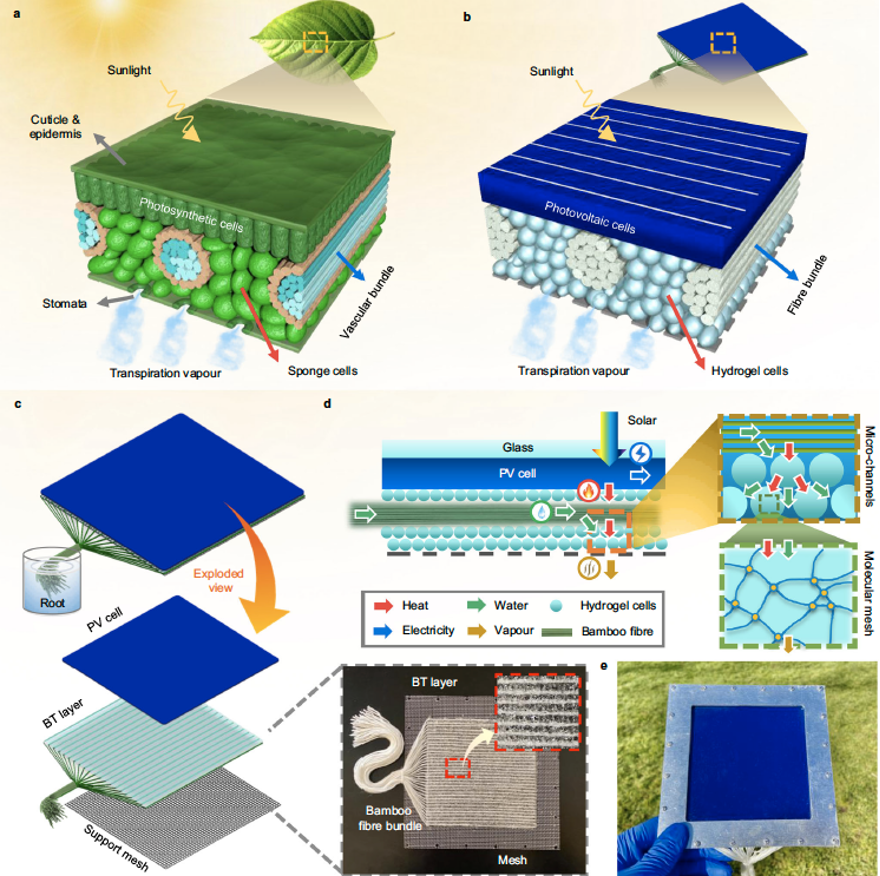
Figure 4. Structure and Function of the Bio-Inspired PV-Leaf, a. A natural leaf has vascular bundles that evenly distribute water across its surface, allowing for cooling through transpiration, which protects photosynthesis. b. The bio-inspired PV-leaf mimics this process using hydrophilic fiber bundles and hydrogel cells to replicate the water transport and storage functions of a real leaf. c. The biomimetic transpiration (BT) layer is made of bamboo fiber bundles and hydrogel cells, with the fiber roots placed in water for continuous moisture supply. d. Water moves from the fiber roots to the hydrogel cells through capillary action and osmosis. As water evaporates, it removes heat from the PV cell, keeping it cool. e. A real-life photograph of the PV-leaf prototype shows how this bio-inspired structure is applied to a working solar cell (Huang et al., 2023).
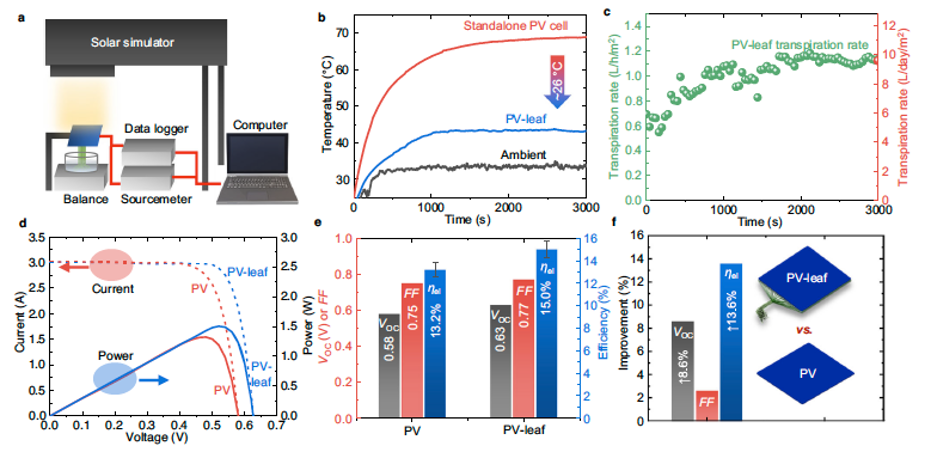
Figure 5. How the PV-Leaf Improves Solar Panel Performance, a. To test how well the PV-leaf works, a special setup was created using a solar simulator that produces light similar to sunlight. This setup helps measure the cooling effect and energy efficiency of the PV-leaf compared to a regular solar panel. b. The PV-leaf stays much cooler than a conventional solar panel. Tests showed that the biomimetic transpiration layer helps lower its temperature significantly, preventing overheating and improving performance. c. The PV-leaf releases water through transpiration, just like a real leaf. This process helps remove heat from the solar panel, making it more efficient. The amount of water evaporated over time shows how well the cooling system works. d. The PV-leaf produces more energy than a standard solar panel. The improved cooling system helps the solar cells generate higher power output, making them more effective in capturing and using sunlight. e. Key measurements show that the PV-leaf performs better in terms of energy production and efficiency compared to a regular solar panel. f. Overall, the PV-leaf improves solar energy conversion by keeping the panel cool and ensuring higher efficiency throughout the day. This bio-inspired design can help make solar panels more effective and sustainable in the future (Huang et al., 2023).