Project Examples Using AR Tools for Biomimicry Education
Technologies and Mechanisms in the nature
Automatically controlling the operation of system is limited if a simple software with only predetermined options is used. Increasingly, systems are being made brilliant using artificial intelligence, where the control algorithms mimic nature. Making these systems bright involves using artificial intelligence algorithms that provide critical control capabilities such as knowledge capture, representation and rezoning under uncertainly, planning, vision, face and feature tracking, language processing, mapping and navigation, natural language processing, and machine learning. Generally, artificial intelligence is a branch of computer science that studies the computational requirements for such tasks as perception, rezoning, and learning to allow the development of systems that perform these capabilities. Improving the understanding of human cognition is increasingly enabling scientists to understand the requirements for intelligence in general and allowing the development of intelligent devices, autonomous agents, and systems that cooperate with humans to enhance their abilities.
Numerous examples of mechanisms were inspired by observing biology; several examples are given herein.
● Inchworm linear motors
The biological inchworm is a caterpillar of a group of moths called Geometridae, which has six front legs and four rear legs. Emulating the mobility mechanism of this larva, or caterpillar, led to the development of motors and linear actuators known as inchworms. These commercially available motors are driven by piezoelectric actuators (made by companies such as Burleigh Instruments). They can move at a speed of about 2 mm s−1 with a resolution of nanometers while providing hundreds of millimeters of traveling. The forces produced by these motors can reach over 30 N with zero backlash and high stability. Their non-magnetic content offers advantages for applications in test instruments such as magnetic resonance imagers (MRI). Compared to biological muscles, the piezoelectric actuated inchworms have zero-power dissipation when holding position.
Inchworm mechanisms have many configurations where the unifying drive principle uses two brakes and an extender. These motors perform cyclic steps where the rear brake clamps onto a shaft, and an extender pushes the front brake forward. Then, the front brake clamps the shaft, releasing the rear brake and retracting the extender to move one step forward and this step can be as small as 1 nm.
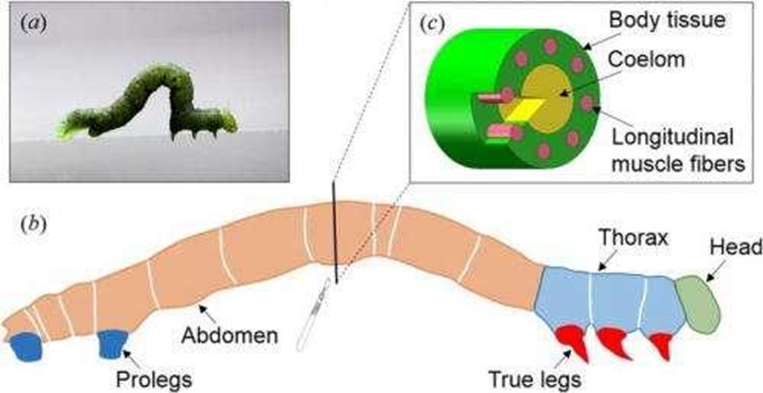
Figure 6. (a) A real inchworm, (b) side view sketch of an inchworm and (c) sketch of its main muscular structures. Credit: Wang, et al. ©2014 IOP Publishing
In fact, as a project for students, they explore how the inchworm’s movement inspired piezoelectric motors, understanding its principles of mobility, efficiency, and practical applications in devices like MRI systems.
Enhanced Focus with AR
Using AR, students can:
- Visualize the biomechanics of the inchworm's movement in 3D.
- Simulate how piezoelectric actuators replicate this movement in linear motors.
- Prototype bio-inspired motor designs virtually, testing their functionality and efficiency.
New Learning Outcomes
- Biomechanical Understanding: Students gain a deeper understanding of the inchworm’s movement and how it inspired innovative engineering solutions.
- Systems Thinking: AR fosters an integrated view of biological principles and engineering applications.
- Design and Experimentation: Students develop and test bio-inspired designs in a virtual, risk-free environment, encouraging creativity and iterative learning.
- Real-World Relevance: AR demonstrates the impact of biomimicry in practical contexts, making the learning experience more meaningful
- Pumping mechanisms
Pumping mechanisms in nature offer a great model for fluid and gas pumping devices. Nature uses various pumping mechanisms that are also used in mechanical pumps. The lungs pump air in and out (tidal pumping) via the use of the diaphragm that enables our breathing with the support of the inter-rib muscles. Peristaltic pumping is one of the most common forms of pumping in biological systems, where liquids are squeezed in the required direction. Such pumping is common in the digestive system. Pumping via valves and chambers that change volume is found in human and animal hearts, with expansion and contraction of chambers. The use of one-way valves is the key to the blood flow inside the veins, where the pressure is lower.
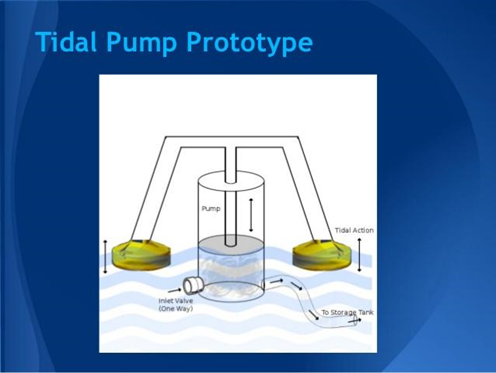
Figure 7. Tidal pump, https://www.slideshare.net
By concidering this mechanism as a student’s project, Students explore natural pumping mechanisms like the human heart or peristalsis in the digestive system.
Enhanced with AR:
- Use AR tools like Merge Cube to create interactive 3D models of biological pumps, enabling students to explore their anatomy and functionality.
- Simulations can demonstrate fluid dynamics, illustrating how one-way valves and pressure differences enable efficient fluid transport.
- Students can design virtual prototypes of bio-inspired pumps for applications like medical devices or irrigation systems.
● Controlled adhesion
Controlled wet or dry adhesion is achieved by many organisms. Using a highly fibrillated microstructure, the Hemisphaerota cyanea (a beetle) uses wet adhesion that is based on capillary interaction. On the other hand, the gecko exhibits remarkable dry adhesion using van der Waals forces. Even though these forces provide low intrinsic energy (∼50 m J m-2), their effective localized application allow for the remarkable capability (Autumn et al 2002). Using this adhesion mechanism, the gecko can run on polished glass at a speed of about 1 m s−1 and attach its body to the wall using a single toe to support its body weight. This capability motivated efforts to mimic the gecko’s adhesion mechanism and some limited success was reported. Such research was conducted by Autumn and Peattie (2003) who developed an artificial foot-hair tip model for a dry, self-cleaning adhesive that works under water and in vacuum.
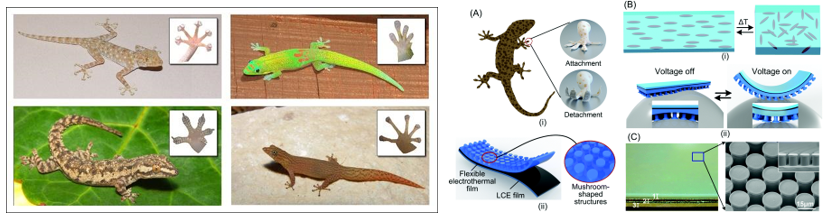
Figure 8. Gecko’s adhesion specification, ( Hongmiao Tian&all,2020)
As a project for students, this example can be examined by students to know how geckos adhere to surfaces and brainstorm ways to mimic this function.
Enhanced with AR:
- Utilize Reality Composer or similar tools to let students visualize gecko foot structures at a microscopic scale in AR.
- Interactive simulations can show how van der Waals forces enable adhesion, even on smooth surfaces.
- Students can test and adjust virtual designs inspired by gecko adhesion, such as robotics or medical devices.
- Honeycomb
The honeycomb is made by bees in total darkness and it consists of a perfect hexagonal cellular structure that offers an optimal packing shape. For honeybees, the geometry meets their need for making a structure that provides the maximum amount of stable containment (honey, larvae) using the minimum amount of material. For the same reasons, the honeycomb is an ideal structure for the construction of control surfaces of an aircraft and it can be found in the wing, elevators, tail, the floor, and many other parts that need strength and large dimensions while maintaining low weight.
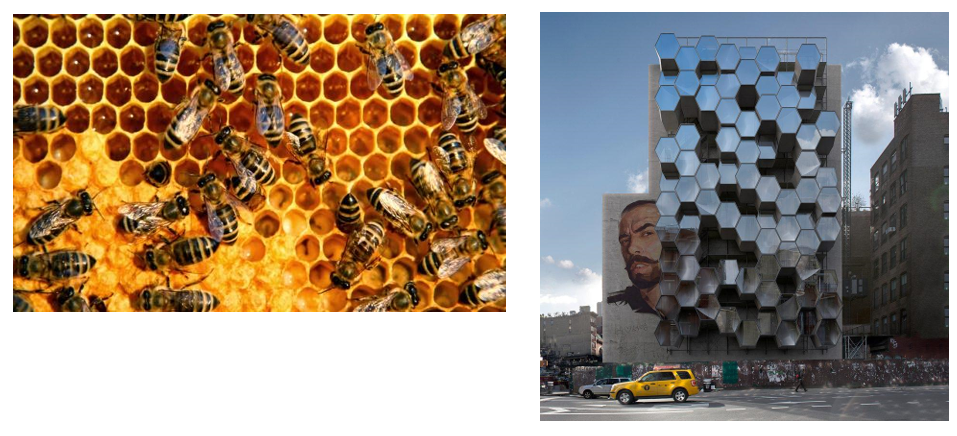
Figure 10. 3D Printed 'Homed' by Framlab Offers Shelter for New York's Homeless according to honeycomb.https://www.dezeen.com
By interpreting this idea as a students’ project, students study honeycomb geometry to understand its strength and material efficiency.
Enhanced with AR:
- Use AR tools like Sketchfab to provide immersive experiences of honeycomb structures, allowing students to analyze how their geometry optimizes space and material use.
- To demonstrate the direct utility of these principles, simulate real-world applications, such as honeycomb-inspired architectural designs or airplane components, in AR.
Consideration of biomimetics for planetary application:
For future space exploration applications, biomimetics offers a pool of concepts that can potentially be used to enable new technologies and enhance the available capabilities. To take advantage of the potential benefits to future NASA missions that can be harvested from mimicking from nature. As a potential application of these materials, one can envision that availability of strong and robust artificial muscles based on EAP materials may enable us in coming years to produce biomimetic legged robots that can run as fast as a cheetah, carry mass like a horse, climb steep cliffs like a gecko, reconfigure their body like an octopus, fly like a bird and dig tunnels like a gopher. This is an incredible vision for robots that can potentially be used to explore planets in the universe, and it may lead to future
planetary mission plans that are based on a script for the robot’s operation following science fiction ideas. Some of the tasks that such robots may need to perform include autonomously operate to detect water, various resources, and possibly biological indicators in the search for past or present life or even construct facilities for future human habitats. Once such robots are made sufficiently reliable to operate in the harsh environment of space, they will be able to act as human surrogates in executing tasks that require human’s capabilities without subjecting real persons to any unnecessary hazards.
Space applications are among the most demanding in terms of the harshness of the operating conditions, requiring a high level of robustness and durability. Making biomimetic capability using electroactive material will potentially allow NASA to conduct missions on other planets using robots that emulate human operation ahead of the landing of humans. Generally, the requirements and challenges associated with making hardware based on the emerging technology for space flight are very difficult to overcome.
However, since such applications usually involve producing only small batches, they can provide an important avenue for introducing and experimenting with new actuators and devices. This is in contrast to commercial applications, for which issues of mass production, consumer demand and cost per unit can be critical to the transfer of technology to practical use. Generally, making biologically inspired robots that are driven by EAP actuators may have capabilities that are superior to natural creatures since these robots are not constrained by evolution and survival needs that are critical to biological creatures. Bar-Cohen and his co-investigators constructed a miniature robotic arm that was lifted by an EAP actuator that is based on rolled dielectric elastomer and operated as a linear actuator. Telepresence combined with virtual reality using haptic interfacing offers another important potential for space applications particularly for avoiding the direct contact of humans with hazardous conditions.
A novel design was conceived by Bar-Cohen and his research team, where a minimally invasive robotic arm as a surgical tool can be constructed in an octopus configuration with multiple degrees of freedom tentacles equipped with various tools. To implement such a possibility, a combination of EAP as actuators and electrorheological fluids (ERFs) was considered where the rigidity of such a flexible robotic arm can be controlled, and it can be operated as a haptic interface.
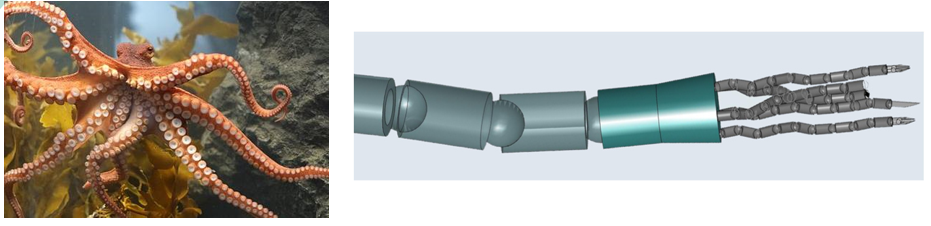
Figure 17.A graphic view of an octopus-configured catheter for surgical applications. (Bar-Cohen,2006)
The Consideration of Biomimetics for Planetary Application project, which envisions biomimetic robots for space exploration, can also be significantly enhanced with AR tools. By integrating AR, students and researchers can simulate, visualize, and experiment with bio-inspired robotic concepts, improving their understanding and creativity in designing solutions for harsh planetary environments.
The project explores biomimetic concepts, such as artificial muscles, gecko-like climbing, and octopus-like reconfiguration, to create robots that can operate in harsh planetary conditions.
Enhanced Focus with AR:
Using AR, students can:
- Visualize the movement and adaptability of biomimetic designs in extreme environments.
- Simulate tasks such as resource detection or habitat construction on other planets.
- Prototype and test bio-inspired robots in virtual simulations of planetary conditions.