The Biomimicry theorical framework
Principles of Biomimicry
The biomimicry principles focus exclusively on nature's attributes; thereby implying that humans have much to learn from the billions of years of the natural world's evolutionary experience.
|
a- Nature uses only the energy it needs b- Nature fits form to function c- Nature recycles everything d- Nature banks on diversity e- Nature demands local expertise. |
 |
Bio Design activities:
Bio-inspired design methods support different activities:
|
 |
Planning a bio-inspired design project and other technical product development projects or planning biological research projects are different from each other. The interdisciplinary nature of bio-inspired design poses a challenge for the design procedure, and there can be different starting points for the project. Moreover, if biologists and engineers collaborate, the integration of their work has to be taken into account. Also, Abstraction is an important part of bio-inspired design. In fact, designers have to conduct abstraction over and over again throughout a bio-inspired design project: they must abstract a technical task or enable searching for biological inspiration. They must abstract technical and biological systems to make them comparable. They must abstract again to formulate analogies for transfer… and so on. Search, in particular the search for biological inspiration is addressed by numerous methods for bio-inspired design. It is a key activity when a bio-inspired design project is started from a purely technical viewpoint (technical task, looking for a biological inspiration) or from a purely biological viewpoint (interesting biological solution, looking for a technical application).
In fact, designers have to analyze and compare both technical and biological systems carefully to apply bio-inspired design successfully. There are numerous examples where bio-inspired designs failed at the prototype stage, because the biological solution could not be applied in a technical environment. An example from the authors’ experience is the attempt of a student’s project to mimic the flagella movement of bacteria on a much larger scale. Due to the different influence of fluid forces, the rotational flagella movement could not be used to effectively move liquids. Finally, the transfer of bio-inspired analogies is the core activity of bio-inspired design. All bio-inspired design projects aim at transferring more or less abstract analogies to develop a technical solution.
That said, bio-inspired design projects include of course many other activities. However, these activities are not particular to bio-inspired design, as they are also present in other technical product development projects or in biological research projects.

Figure 1. Bio-inspired design: specific and other activities, (Hashemi Farzaneh ,2019)
Even though the majority of bio-inspired design projects and classes focus on the technology pull approach. Some researchers claim that the biology push approach is more innovative. In the case of a technology pull approach, designers start with a technical task. This entails a predefined set of requirements and desired functions. They stick to these boundary conditions, but are relatively free in considering different biological systems. Therefore, they can be more open to transfer several analogies from different biological systems. If a biology push approach is adopted, designers start with a predefined biological system. They might analyze this system in detail, and they are more likely to restrict their analysis to this system instead of searching for other biological systems. However, they are probably more open to searching for multiple technical applications. Moreover, multifunctional biological systems can inspire multifunctional technical systems.

Figure 2. Bio-inspired design approaches: technology pull and biology push, (Hashemi Farzane,2019)
There are three levels of biomimicry have to be applied also to design problems. From the biomimetic technologies and techniques, it is obvious and well noticed that there are three levels of mimicry: the organism level, behavior level and ecosystem level. The organism level illustrates the mimicking of certain organism or the mimicry of a part from the whole organism, buildings on the organism level mimic a specific organism. The second level is the mimicry of behavior of which every organism behaves, buildings mimic how an organism behaves or relates to its larger context. The third level is the mimicking of the whole ecosystem and this level is considered the hardest level as it focuses on a functionally very hard issue to mimic, a building mimics the natural process and cycle of the greater environment. Through each level there are five dimension which determine at which extent the mimicry exists. The design is listed as biomimicry in the way it looks like (form), what it is made of (material), how it is made (construction), how it works (process) and what its capability (function). These levels are very important and they complete the biomimicry approaches.
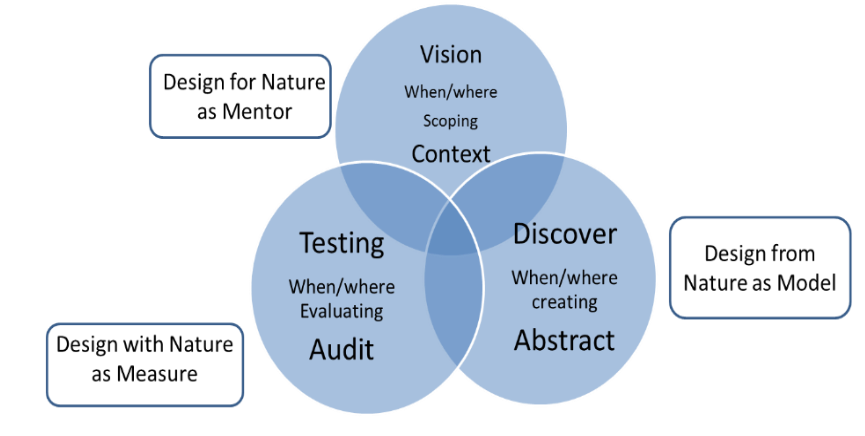
If we want to consciously emulate nature's genius, we need to look at nature differently. In biomimicry, we look at nature as model, measure, and mentor.

Biomimicry is a new science that studies nature’s models and then emulates these forms, process, systems, and strategies to solve human problems – sustainably. The Biomimicry Guild and its collaborators have developed a practical design tool, called the Biomimicry.
Biomimicry uses an ecological standard to judge the sustainability of our innovations. After 3.8 billion years of evolution, nature has learned what works and what lasts. Nature as measure is captured in Life's Principles and is embedded in the evaluate step of the Biomimicry-Design-Spiral.
Biomimicry is a new way of viewing and valuing nature. It introduces an era based not on what we can extract from the natural world, but what we can learn from it.