Conclusion
Integrating biomimicry into educational practices offers students a unique opportunity to explore the intersection of biology, engineering, and design, fostering creativity and innovation. Incorporating Augmented Reality (AR) tools makes learning more immersive, interactive, and engaging. These tools enable students to visualize complex biological systems, simulate real-world applications, and prototype bio-inspired solutions in dynamic virtual environments.
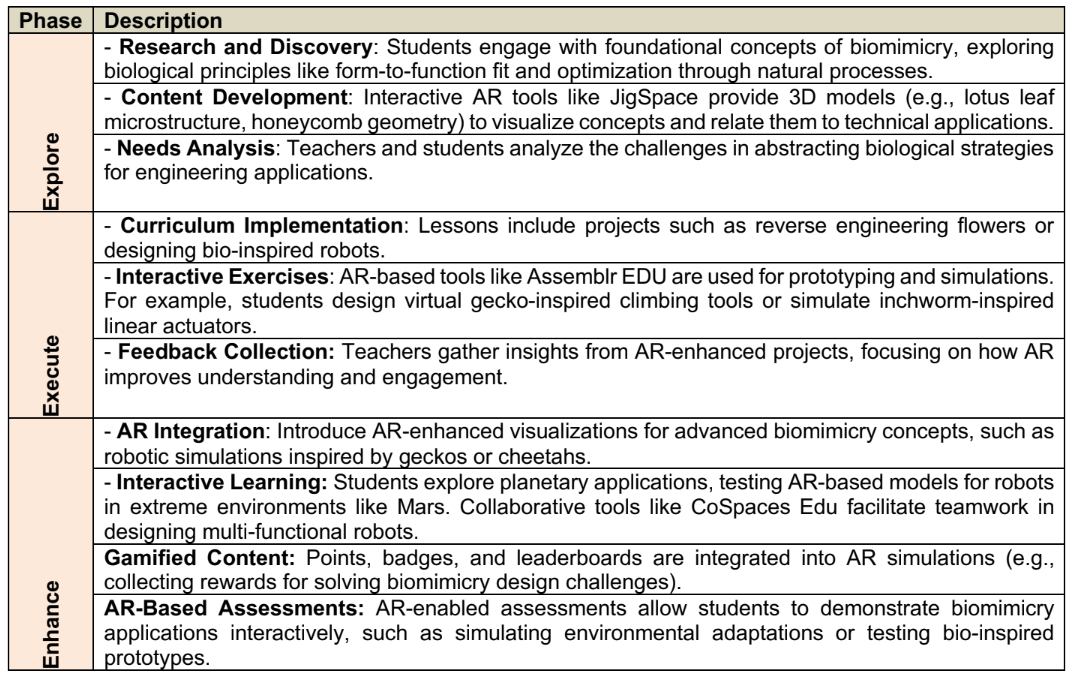
This training unit has been structured to guide learners through the phases of Explore, Execute, and Enhance phases, ensuring a comprehensive approach to understanding and applying biomimicry principles. In the Explore phase, students build foundational knowledge of bio-inspired concepts and utilize AR to visualize biological models. The Execute phase emphasizes hands-on projects, collaborative problem-solving, and real-time feedback through AR simulations. Finally, the Enhance phase introduces advanced learning strategies, such as gamification and AR-based assessments, to deepen understanding and encourage innovation.
The following table summarizes the core elements of each phase, detailing how AR tools are integrated to support the learning objectives. By embedding this table in the training unit, educators and learners can easily reference the framework and appreciate the transformative role of AR in biomimicry education.