Chemistry, bioenergy and biomaterials
Once the matter around us is well-known, scientists should be able to develop technologies to take advantage of and improve citizens’ lifestyles.
Chemistry is considered the "central science", being involved in studying the composition of matter and of its interactions.
For several years, though, chemistry industries were considered the most damaging place of the planet; nowadays, thanks to environmental sensitivity and law restriction, every chemical company is moving in “a green direction” as a consequence of the fact that guarantee the planet’s health is a common aim.
In this contest bio-energy and biomaterials are becoming common words that play a key role in sustainability and are related to the essential global need to keep living reducing the impact on the planet in terms of carbon emissions and environmental pollution.
The IEA (International Energy Agency) defines bioenergy as the most important source of renewable energy today, made from biomass and biofuel. Biomass is any organic material that has absorbed sunlight and stored it in terms of chemical energy through the photosynthesis process. Since biomass technically can be used as a fuel source directly, it denotes the raw material of which biofuel is made of. IEA also argues that the current rate of bioenergy deployment is well below the levels required in low carbon scenarios, and that accelerated deployment is urgently needed.
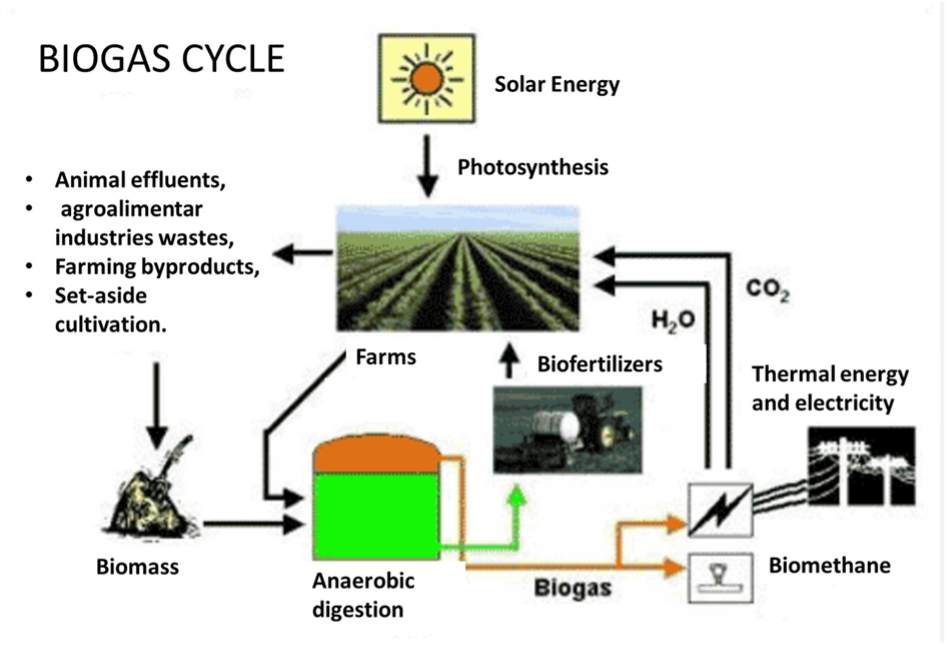
Scheme of a Biogas Cycle process
Anaerobic digestion is a complex biological process that allows the conversion of organic compounds into biogas, a blend of methane (CH4) and carbon dioxide (CO2), without requiring the use of oxygen that, even is quite common in the environment, its use is not generally convenient in the industries. The process stems from all the things included in a farm. The most important initial issue when considering the application of anaerobic digestion systems is the feedstock to the process. Almost any organic material can be processed with anaerobic digestion. Poultry’s effluents are considered the most efficient one thanks to their moisture content and nitrogen high content. However, chicken manure contains inert substances that tend to sediment and cause operative problems and force the use of small-volume reactors. Other feedstock could be depuration’s mud, included what is accumulated downstream urban and industrial solid wastes. During this process, a lot of microorganisms are involved in converting the organic compound into an intermediate compound, like acetic acid, and finally, convert the latter one into methane. Anaerobic microorganisms present a low growth rate and low kinetics reaction rate, so they require the most optimized operative conditions, consequently, the timing of the process is longer than other biological processes.
The edge of this process is that the green feedstock allows the production of biofuel with a significantly high heat of combustion. Thus, the only environmental impact is caused by process machinery employed or energy (and costs) required for transportation and compression of biomethane for commercial use. So, this green concept of energy is optimized when fermenters or reactors (and all the others treatment processes related to them) are energetically fed with renewable energy, such as hydropower, solar collector, photovoltaic system, wind power, and so on.
The biogas-biomethane chain provides a double advantage as it simultaneously produces energy and recovers residues, reducing the amount of material destined for the landfill. Thus, is totally in line with sustainability and circular economy concept.
Enhance Module
(Project Examples Using AR Tools for circular processes with sustainability concept)
Augmented Reality (AR) tools bring new dimensions to sustainability and circular economy education by offering students an immersive, interactive way to engage with eco-cities principles and translate them into innovative design solutions. Below are examples of how previously used projects can be adapted and enhanced using AR tools.
Use tools like 3D Bear to provide 3D AR models of bio energy that can be produced, enabling students to virtually explore nature and understand their form-to-function relationships.
- Simulate how to interact with environmental elements, such as water or wind and sunlight to attract bio energy.
- Enable virtual models, allowing students to observe key structural components like solar panels, wind turbine or ecological vehicles, fostering deeper ecological understanding of how solar panel, wind turbine works.
New Learning Outcome: Students gain insight into applying ecological resources to real-world engineering challenges, such as new kind or shapes of surfaces or new sustainable materials.