2. What form do the data take?
- Vaata
Although it is now possible to exchange any format of data (e.g. photos, videos, documents, etc.) via digital means, it is not reflected that these are originally encoded through the binary system formed by the numbers zero and one. This system is based on a type of positional numbering, i.e. in which the position that the two numbers assume has its own importance and value; furthermore, since there are only two numbers used for encoding, the system is said to have base two. For all these reasons, the writing of a value in the binary system will have this form:
(001011)₂
The subscript ₂ testifies to the fact that it is a binary system, while the round brackets serve to contain the value. It is first possible to attempt to translate values in the binary system into values pertaining to the decimal system: to do this, it is necessary to order the values (the first will be the one at the far right and the last will be the one at the far left) and multiply them by two raised to progressive powers. For example:
1. We order the values from right to left
|
1 |
1° |
|
1 |
2° |
|
0 |
3° |
|
1 |
4° |
|
0 |
5° |
|
0 |
6° |
1. Multiply each value by 2 to a progressively increasing power
|
1 |
2⁰ |
|
1 |
2¹ |
|
0 |
2² |
|
1 |
2³ |
|
0 |
2⁴ |
|
0 |
2⁵ |
1. We add up the results obtained from the individual multiplications
|
1*1 |
1 |
|
1*2 |
2 |
|
0*4 |
0 |
|
1*8 |
8 |
|
0*16 |
0 |
|
0*32 |
0 |
|
TOTALE |
11 |
Ultimately, the value (001011)₂ in the binary system takes on a value of 11 in the decimal system.
If, on the other hand, we wish to try the reverse operation, i.e. to transpose a number in the decimal system into one in the binary system, we need only divide the number progressively by 2 and take into account the remainder:
96
|
96/2 = 48 |
0 |
|
48/2 = 24 |
0 |
|
24/2 = 12 |
0 |
|
12/2 = 6 |
0 |
|
6/2 = 3 |
0 |
|
3/2 = 1 |
1 |
|
1/2 = 0 |
1 |
The number 96 in the binary system will therefore be:
(1100000)₂
We can check that this calculated value is correct.
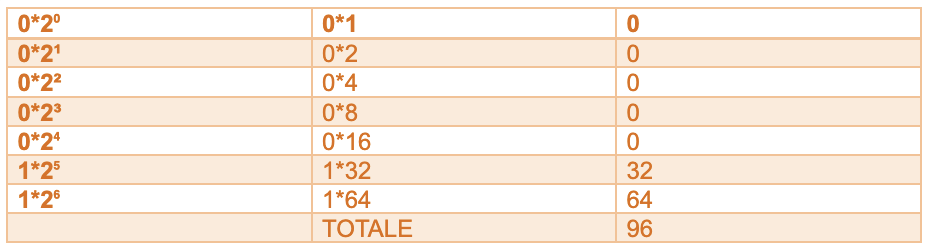
The individual binary values contained within brackets are called bits and eight bits correspond to one byte. In the above case, for example, the sequence consists of seven bits.
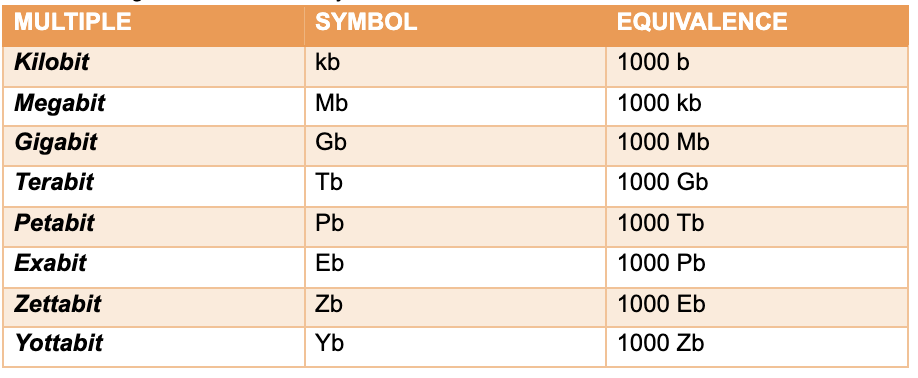
The bit is a unit of measurement and therefore, like all others, has a scale of equivalence defined through the international system: