
3. Where Big Data comes from?
- Visualizzare
Going back to the definition of the concept, it emerges how this type of data stands in contrast to traditionally processed data: first of all, the feature that most distinguishes big data from the rest is the complexity provided and the vastness of information it provides and, potentially, can produce. Big data, therefore, marks the overcoming of the storage and processing of data through relational databases.
|
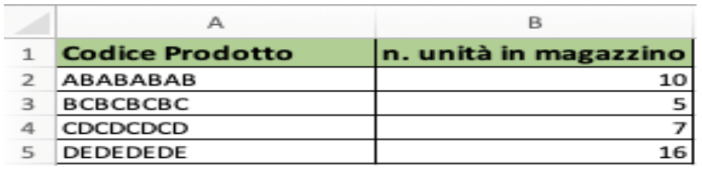
DATABASE RELAZIONALI Cells 1A and 1B contain the data fields which, in this case, correspond to the identification code of each product and the units in the warehouse; cells 2A, 3A, 4A, 5A and 2B, 3B, 4B, 5B contain the records. Supposing you have another table containing, instead, the product code and the units already on the supermarket's shelves, you can join this one with the previous table to obtain a third table containing all the data available to the supermarket: in this case, the join field between the two would be the product code.
|
I big data vengono raccolti attraverso una moltitudine di strumenti ed essi vengono prodotti a partire da azioni compiute su base quotidiana, come ad esempio la navigazione su browser, l’acquisto di beni e servizi on-line oppure l’accesso ai canali di e-banking. Una fonte di dati di questo tipo può essere individuata, a titolo esemplificativo, nei cookies autorizzati per la cessione a terze parti.
La definizione condivisa sul significato e sulla funzione dei cookies prevede che essi siano dei piccoli frammenti di dati che l’utente cede al sito web consultato per ottenere una migliore esperienza di navigazione, fornendo al fornitore di servizi la possibilità di memorizzare alcune informazioni sull’utilizzo del sito web, sulle preferenze di acquisto, etc. La funzione primaria dei cookies è, in ogni caso, quella di identificare l’utente e di ricordare quali siano le motivazioni della sua visita: a fronte di ciò, essi sono diventati oggetto di preoccupazione da parte di alcuni consumatori. Tramite la Direttiva 2002/58/CE del Parlamento Europeo e del Consiglio, relativa al trattamento dei dati personali e alla tutela della vita privata nel settore delle comunicazioni elettroniche, alla sezione delle considerazioni si spiega il senso dell’utilizzo dei cookies, sottolineando l’utilità di questo strumento e al contempo ammonendo i fornitori di servizi web, richiedendo di adottare criteri di trasparenza fornendo agli utenti informazione sulla tipologia di dati raccolti e sulle finalità d’uso. Successivamente, è entrato in vigore un regolamento sulla tutela della privacy, il General Data Protection Regulation (GDPR), con il quale è stato introdotto – tra le varie misure – l’obbligo per il fornitore di servizi di non posizionare alcuno strumento di raccolta dati al primo ingresso da parte dell’utente, al quale viene poi richiesto il consenso per alcune finalità di utilizzo dei cookies (tecnici, cessione a terze parti, etc.).

Figure 2 - Banner for consent to the use of cookies, source: https://www.neting.it/blog/cookie-law.html
In addition to cookies, various types of data can be obtained through social networks or through the use of sensors contained within devices belonging to the Internet of Things (IoT) world. Especially for the latter category, it is possible to access a multitude of data concerning the most diverse variables.
According to an AGCOM estimate, in 2018 alone, 28 Zettabytes of data were produced, the equivalent of 250,000,000 DVDs. Assuming that this amount of data were to be stored on memory disks with a capacity of one Terabyte each, approximately 3,006 477 ×10 ¹ ⁰ memory disks would be needed, which is an extremely large number even to imagine. According to another estimate, by 2020 each inhabitant of the Earth will generate an average of 1.7 MegaBytes of data per second, resulting in a total flow of 2.5 quintillion bytes of data per day.
These magnitudes are even more surprising if we consider, for example, the amount of data that is produced in a single minute by some of the digital tools we most commonly use. To this end, it is useful to refer to the infographic in (Fig.3):

Figura 3 - Dati prodotti in un minuto, fonte: https://www.go-globe.com/things-that-happen-every-60-seconds/
However, although these quantities may already be particularly complicated to understand and imagine, it should be emphasised that the amount of data in ZettaBytes produced for each year is growing, as this graph produced by AGCOM shows:

Figure 4 - Estimated amount of data in Zettabytes per year, source: https://www.agcm.it/dotcmsdoc/allegati-news/IC_Big%20data_imp.pdf