
Introduction. The Photovoltaic Journey: Capturing the Sun
Energy conversion in solar cells; from photons to electrons; physics of photovoltaic systems
Solar energy conversion arises from the intersection of quantum physics and materials engineering. Sunlight, composed of photons carrying discrete packets of energy, strikes the surface of a photovoltaic cell and interacts with semiconductor materials.
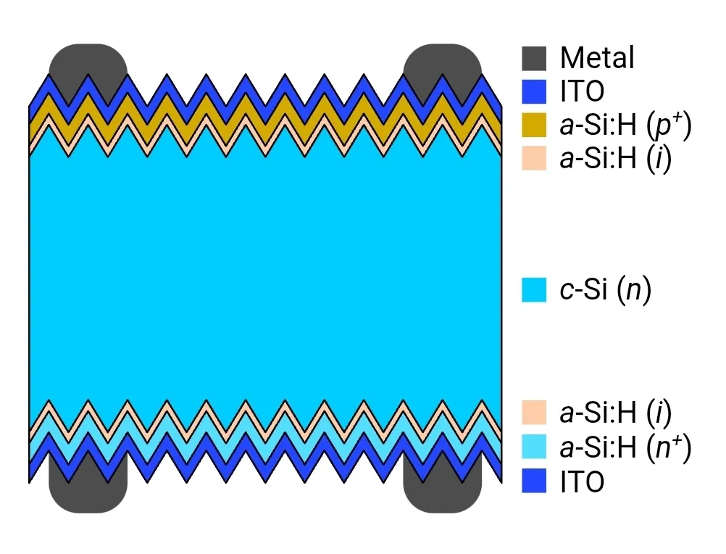
Figure 1. Cross-sectional structure of a silicon heterojunction solar cell showing layered architecture. The n-type crystalline silicon (c-Si) forms the main absorber layer, with thin amorphous silicon (a-Si:H) passivation layers and transparent ITO contacts. (Source: Wikimedia Commons, CC BY-SA 4.0)
Here, photons are absorbed, generating electron-hole pairs that, under the influence of an internal electric field, separate and flow through an external circuit. Harnessing solar energy does not mean passively collecting heat, but actively converting light into usable electrical current through precisely engineered atomic-scale structures.
The efficiency of energy conversion depends on the material properties and the architecture of the solar cell. Silicon, the most commonly used semiconductor, is "doped" with impurities to create two distinct regions: an N-type layer (electron-rich) and a P-type layer (hole-rich). At the interface between these layers-the P-N junction-an electric field forms naturally. This field is essential: it provides the driving force that separates photo-generated electrons and holes, preventing them from recombining and ensuring that charge carriers flow in a specific direction to produce current.
The photovoltaic effect begins when a photon with sufficient energy strikes the semiconductor material. If the photon's energy exceeds the bandgap-the minimum energy required to free an electron from its atomic bond-the electron is promoted from the valence band to the conduction band, leaving behind a positively charged "hole." This electron-hole pair represents the fundamental unit of solar energy conversion: light energy transformed into charge separation at the atomic level.
The P-N junction acts as a one-way gate for charge carriers. The built-in electric field sweeps electrons toward the N-type region and holes toward the P-type region. When metallic contacts are attached to both sides and connected through an external circuit, electrons flow from the N-side through the circuit to the P-side, generating electric current. The voltage produced by a single silicon cell is approximately 0.5–0.6 volts; multiple cells are connected in series to achieve higher voltages suitable for practical applications.
Energy output and efficiency are influenced by several factors: the intensity and spectrum of incoming light, the quality of semiconductor materials, the temperature of the cell, and the design of anti-reflective coatings that maximize photon absorption. Modern silicon solar cells achieve efficiencies of 15–22%, meaning that only a fraction of incident solar energy is converted into electricity. Advanced materials such as perovskites and multi-junction cells push efficiencies higher, but trade-offs in cost, stability, and manufacturing complexity remain active areas of research.
From an educational perspective, it is crucial to clarify the sequential chain of events: (1) photons arrive and penetrate the cell surface; (2) photons with adequate energy generate electron-hole pairs in the semiconductor; (3) the electric field at the P-N junction separates these charge carriers; (4) electrons flow through an external circuit, producing electrical current; (5) energy is delivered to a load (lamp, battery, grid). Presenting these steps in an ordered manner helps students connect quantum-scale phenomena with macroscopic energy generation.
The targeted use of digital and augmented reality tools makes it possible to visualize otherwise invisible processes, such as photon absorption at the atomic level, the formation of the depletion region in the P-N junction, and the directional flow of electrons through the circuit. Scene-by-scene visualization facilitates the understanding of relationships between microscopic physics and large-scale renewable energy systems.
Why can't we extract electrical energy from sunlight without semiconductors? How does the P-N junction transform random photon absorption into directed electron flow? What role does the bandgap energy play in determining which wavelengths of light can be converted into electricity? These questions help link observable solar energy phenomena to the underlying quantum and electrical mechanisms.