
Introduction
Beyond the Petri Dish – Testing Microbial Clean-Up in the Real World
https://www.theguardian.com/environment/2023/sep/28/plastic-eating-bacteria-enzyme-recycling-waste
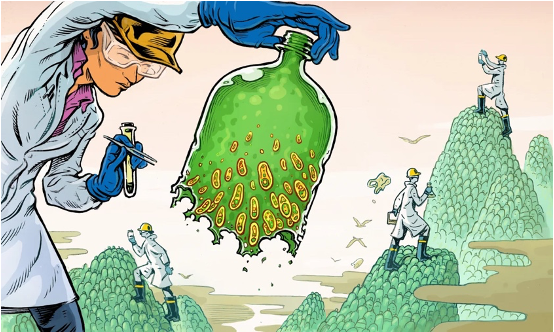
When we think of science in action, we often imagine white lab coats, microscopes, and petri dishes, clean, controlled environments where discoveries are made under perfect conditions. And while that’s an important part of the scientific process, solving real-world problems like pollution requires more than just success in a laboratory. That’s where field testing comes in, taking what works in the lab and seeing if it survives and succeeds in nature.
One of the most exciting tools in environmental science today is bioremediation, a process where tiny living organisms like bacteria and fungi are used to clean up polluted environments. These microbes can "eat" harmful substances, such as oil, heavy metals, or toxic chemicals, and turn them into harmless materials. In the lab, researchers have discovered hundreds of microbial species that can digest a wide range of substances, including diesel fuel, chromium, and uranium compounds (Lovley et al., 2022). But can these same microbes survive in a polluted river, a contaminated forest, or a toxic waste site? That’s the big question.
Nature is unpredictable. Conditions like temperature, sunlight, water flow, and the presence of other organisms all affect how microbes behave outside the lab. Even if a microbe is great at breaking down pollutants in a petri dish, it might not work at all when released into a lake or soil. For example, Alcanivorax borkumensis, a naturally occurring marine bacterium, thrives in oil-contaminated seawater and helps degrade hydrocarbons, but only under specific temperature and nutrient conditions (Yakimov et al., 2007). That’s why scientists need to test bioremediation strategies in real ecosystems, through small-scale experiments called pilot studies or field trials.
These trials help researchers understand if the chosen microbes are effective, safe, and able to survive in natural conditions. For instance, researchers have conducted field experiments in Rifle, Colorado, using Geobacter species to reduce uranium contamination in groundwater by injecting them with simple nutrients like acetate (Anderson et al., 2003). In another project in Italy, scientists created a "bio-barrier" in an aquifer to test the reduction of hexavalent chromium (Cr VI) in groundwater using naturally occurring microbes (Beccari et al., 2010). These real-world experiments provide valuable insights into how bioremediation can be applied safely and effectively on a larger scale.
In this unit, you’ll discover how scientists take microbes from the lab bench to the field, and how they carefully prepare, test, and monitor microbial cleanup efforts. You’ll also explore real-life case studies where bioremediation has helped restore polluted areas, and learn about the challenges researchers face when dealing with complex natural environments. Most importantly, you’ll see how this work is shaping a cleaner, more sustainable future, and how science is moving beyond the lab to meet the needs of our planet (Singh et al., 2023).