
Efficient Urban Planning and Flow
In natural systems, the branching structures of trees, root networks, and vascular systems are optimized to distribute resources such as water, nutrients, and energy with minimal resistance. Urban planners and infrastructure designers have increasingly turned to these natural patterns to inform the design of transportation networks, pedestrian pathways, and utility systems. These biomimetic designs enhance connectivity, reduce congestion, and allow decentralized energy and water distribution, improving resilience and efficiency. As Badarnah (2017) emphasizes, biomimetic principles derived from ecological branching systems offer practical strategies for adapting cities to complex environmental and social demands while maintaining harmony with the natural landscape.
Biomimicry can be applied at three levels: form, process, and system-level. The form level involves emulating the function derived from the specific form of an organism, a part of it, or its production. This level focuses on the morphology found in nature. The process level of biomimicry mimics the behavior or production processes of organisms or groups of organisms. Lastly, the system-level biomimicry emulates ecosystems' functioning, principles, and strategies (Jain et al., 2023). In the context of cities, complex systems comprising humans, infrastructures, environmental context, and
relationships, ecosystems serve as the most relevant and fitting level of inspiration. Ecosystems consist of biotic elements, analogous to the built components of a human city, and abiotic elements, which can be compared to the urban environment and context. Additionally, ecosystems encompass interactions among these elements.
Madmar et al. (2023) proposed a parallel between an ecosystem’s composition and an urban system’s composition and functioning in Figure 1. While ecosystem-level biomimicry can incorporate form and process-level biomimicry, it systematically considers the larger-scale benefits. This approach provides more comprehensive and attuned solutions to cities' systematic challenges. Past analogies between the human organism and current works on urban metabolism are limited and primarily address the issue of urban flow (Dicks et al., 2021).
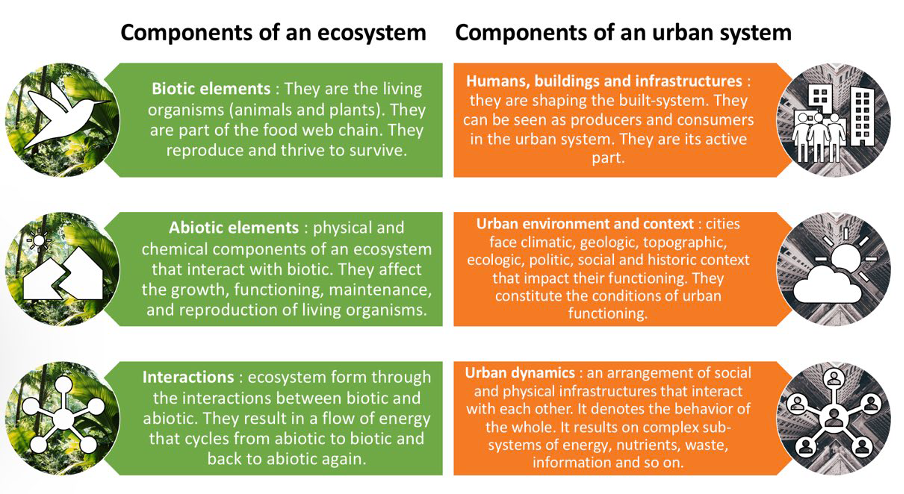
Fig 1. Parallel between ecosystem and urban system composition and functioning, Source: Dicks et al., 2021