
Namib Desert Beetle: Water Harvesting from Air
The Namib Desert beetle (Stenocara gracilipes) thrives in one of the driest places on Earth by harvesting water from fog. Its elytra (hardened wing covers) are textured with hydrophilic bumps surrounded by hydrophobic valleys, allowing it to capture and direct atmospheric moisture toward its mouth. As Nørgaard et al. (2012) explain, the beetle uses a distinct fog-basking behavior, orienting its body into the breeze during early morning fogs to maximize water collection. This passive system enables the beetle to survive without any active energy expenditure, making it an ideal model for sustainable water technologies.
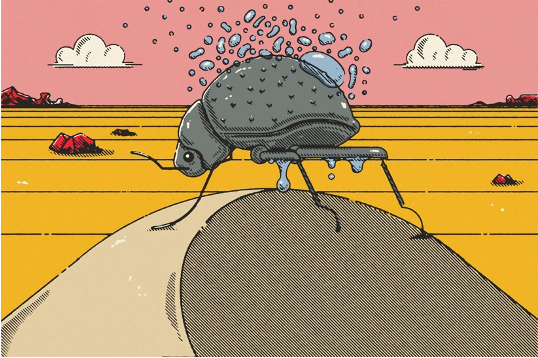
Fig 6. Namib Desert beetle and harvesting water, source: https://www.atlasobscura.com/articles/fogstand-beetles-namib-desert
The beetle’s microstructural surface and behavioral strategy have inspired the development of biomimetic materials and surfaces that mimic its water collection method. Engineers have created synthetic surfaces with patterned wettability to condense and funnel water from fog, dew, or humid air. These have been used in fog nets, façade panels, and rooftop systems, especially in water-scarce regions like Chile, Ethiopia, and the UAE. These systems offer a passive and sustainable solution to freshwater scarcity in remote or drought-prone areas by replicating the beetle's efficiency.
Architectural applications continue to evolve, integrating these materials into building envelopes that shelter and function as water-harvesting tools, reducing reliance on centralized infrastructure and promoting environmental resilience.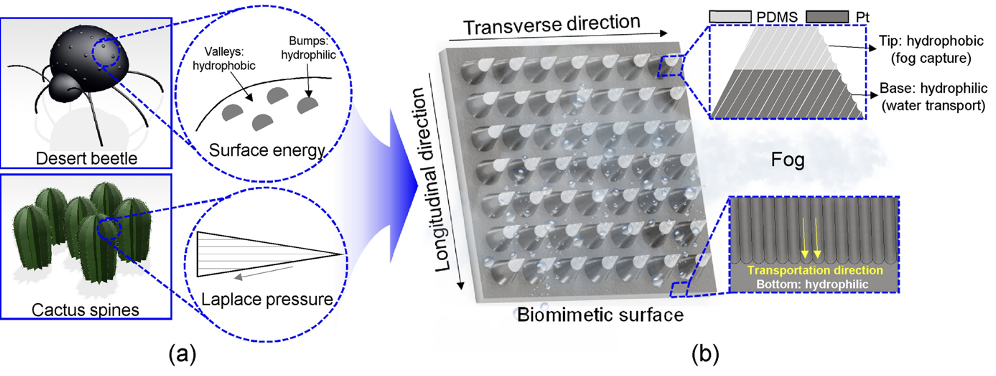
Fig 7. (a) Illustration of the characteristics of both elytra of the Namib Desert beetle and cactus spines; (b) schematic of the hierarchically structured biomimetic surfaces inspired by the elytra of the Namib Desert beetle and cactus spines. Source: https://www.nature.com/articles/s41598-023-37461-x/figures/1