Execute: Harnessing Augmented Reality to Explore Nature-Inspired Design in STEM Education
In the evolving STEM education landscape, integrating bio-inspiration and drawing design principles from nature offers a highly engaging pathway to connect students with real-world sustainability challenges. Augmented Reality (AR)emerges as a transformative tool in this context, bridging the gap between abstract biological concepts and tangible architectural applications for high school students aged 14 to 18.
Recent research emphasizes that AR technologies significantly enhance student engagement and deepen understanding. Through AR, students can interact with three-dimensional models of biological structures, such as the microstructure of lotus leaves or the ventilation system of termite mounds, projected into their physical environment. This immersive experience helps learners to visualize, manipulate, and better comprehend complex STEM concepts (BestColleges, 2024).
Moreover, AR supports visualizing intricate natural systems that might be difficult to capture through traditional teaching methods. In bio-inspired design education, AR enables students to dynamically explore how natural adaptations, like the water-collection mechanisms of desert beetles or the self-shading properties of cactus skins, can inspire architectural innovation. Studies have shown that AR in STEM contexts can foster critical thinking, creativity, and spatial reasoning, crucial skills for future engineers and designers (Frontiers in Education, 2024).
In addition, AR technologies offer flexibility and inclusiveness by catering to different learning paces and styles. Students can engage individually or collaboratively, constructing knowledge to suit their learning preferences. Such flexibility contributes to greater accessibility and student satisfaction in STEM education environments.
Finally, integrating AR into bio-inspiration education allows students to engage with theoretical knowledge and authentic problem-solving experiences. Designing a biomimetic facade to reduce urban overheating or conceptualizing a shading system based on plant behavior provides students with interdisciplinary skills at the intersection of biology, technology, and architecture. This holistic approach nurtures innovation, sustainability thinking, and real-world readiness.
In summary, integrating AR tools into bio-inspiration-focused STEM education creates dynamic, inclusive, and future-oriented learning experiences that empower students to innovate by learning from nature.
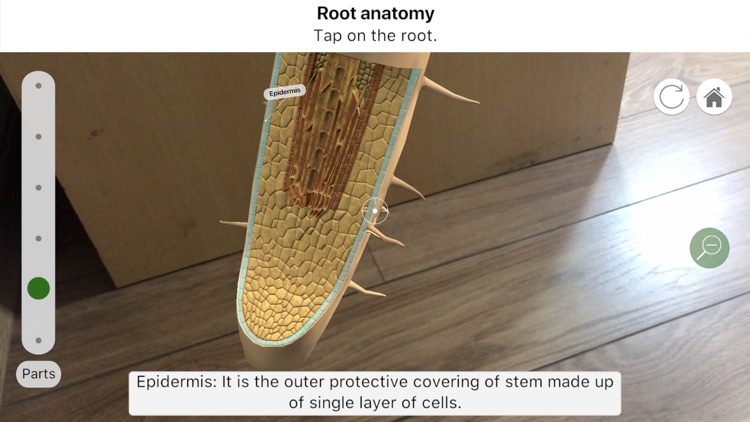
Plantale App
As augmented reality (AR) technology continues to gain momentum in education, various schools and educational initiatives have already demonstrated its potential to enhance STEM learning through bio-inspiration. These projects showcase how AR can immerse students aged 14 to 18 in observing biological phenomena, understanding natural principles, and creatively applying them to engineering and design challenges. The following examples illustrate how AR has been successfully integrated into bio-inspired STEM education environments to foster deeper engagement, conceptual understanding, and innovation skills.