Card of the learning path
Card of the learning path
|
General topic of the learning path
|
Bio-photonics |
|---|---|
|
Specific name of the learning unit
|
Light and Matter – How they interact |
|
Age of the target users
|
15-17 years |
| Requirements for the learner | Students participating in this learning unit should have a basic understanding of physics concepts, particularly the nature of light and matter. They should be able to perform simple measurements, record observations, and work collaboratively in groups. Curiosity, critical thinking, and willingness to engage in hands-on experiments are essential. Learners must be comfortable using digital devices and exploring AR applications to manipulate virtual experiments. Basic skills in interpreting diagrams, tables, and graphs are required. No prior advanced knowledge of optics is necessary, but motivation to explore scientific phenomena, analyze results, and connect theory with practical observation is expected. |
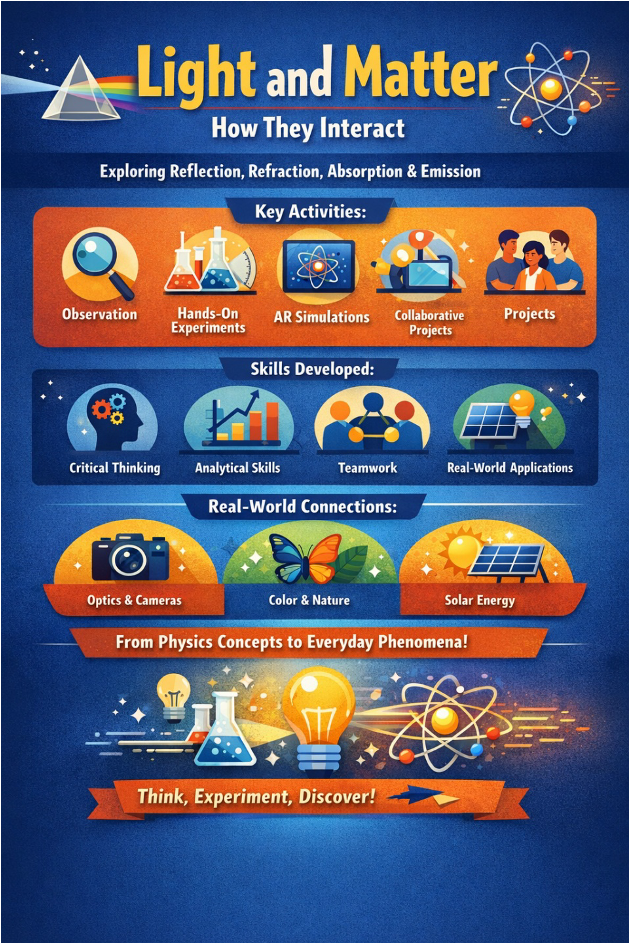
| Description of the learning unit | This learning unit explores how light interacts with matter through reflection, refraction, absorption, and emission. Students engage in observation, hands-on experiments, and AR simulations to develop conceptual understanding, analytical skills, and collaboration. The unit fosters curiosity, critical thinking, and real-world connections between physics concepts and everyday phenomena. |
| Subject: Parties involved | Physics, Chemistry |
| Keywords | Optics Light-matter interaction, Reflection and refraction Absorption and emission |
| Key qualifications, skills and knowledge that can be acquired |
Conceptual Understanding: Knowledge of light properties and interactions with different materials (reflection, refraction, absorption, emission). Experimental Skills: Ability to design, conduct, and analyze hands-on physics experiments. Data Analysis: Competence in recording observations, creating tables, graphs, and interpreting results. Digital Literacy: Experience using AR tools to simulate and manipulate light-matter interactions. Transversal Skills: Development of critical thinking, problem-solving, teamwork, and scientific communication. Real-World Application: Understanding the practical relevance of light phenomena in technology and everyday life. |
| Resources and didactic aids used |
Laboratory Equipment: Flashlights, mirrors, prisms, lenses, colored paper, glass containers, and safe laser pointers. Digital Tools: Computers or tablets for AR applications, such as Delightex Edu, Merge EDU, or Physics Toolbox AR. Visual Materials: Images, videos, and diagrams illustrating light-matter interactions. Data Recording Tools: Worksheets, tables, and graph templates for measurements and observations. Collaborative Aids: Whiteboards, posters, or shared digital platforms (e.g., Google Drive) for group discussions and reporting. Instructional Guides: Teacher-led instructions, step-by-step experimental protocols, and AR user guides. |
| Assessment criteria and evaluation |
Active Participation: Engagement in all phases (Explore, Execute, Enhance) and contribution to group discussions. Accuracy of Observations: Correct recording and interpretation of experimental results and AR simulations. Data Analysis Skills: Ability to organize data in tables, graphs, and diagrams, and draw evidence-based conclusions. Connection to Theory: Linking experimental and AR observations to underlying physics concepts of light-matter interaction. Collaboration and Communication: Effective teamwork, clear presentation of findings, and contribution to group reports or presentations. Reflective Thinking: Demonstrating critical reflection on learning outcomes, challenges, and practical applications. |