
1. Explore - Understanding Evolutionary Relationships and Common Ancestry
1.5 How to Read a Phylogenetic Tree
Phylogenetic trees show evolutionary relationships through branching patterns that represent how species diverged from common ancestors over time. Each branching point, or node, represents a common ancestor shared by the organisms that branch from it. Species that share a more recent common ancestor are considered more closely related than those whose common ancestor lies deeper in the tree.
The length or position of branches does not indicate that one organism is more advanced or “better evolved” than another. Instead, branches reflect patterns of evolutionary divergence and shared history. All living species at the tips of the branches have been evolving for the same amount of time.
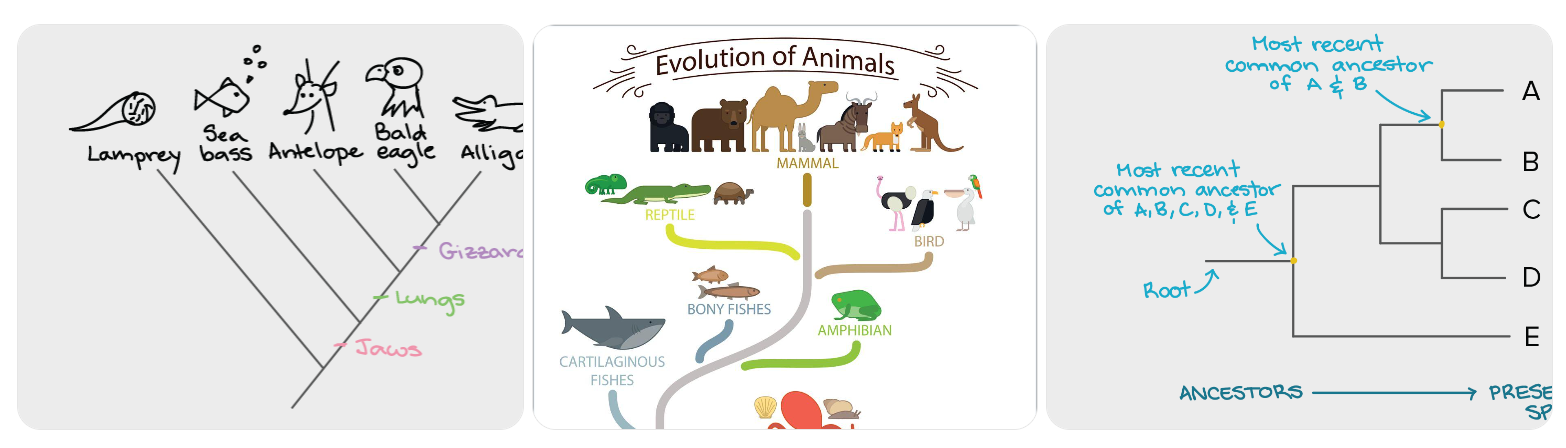
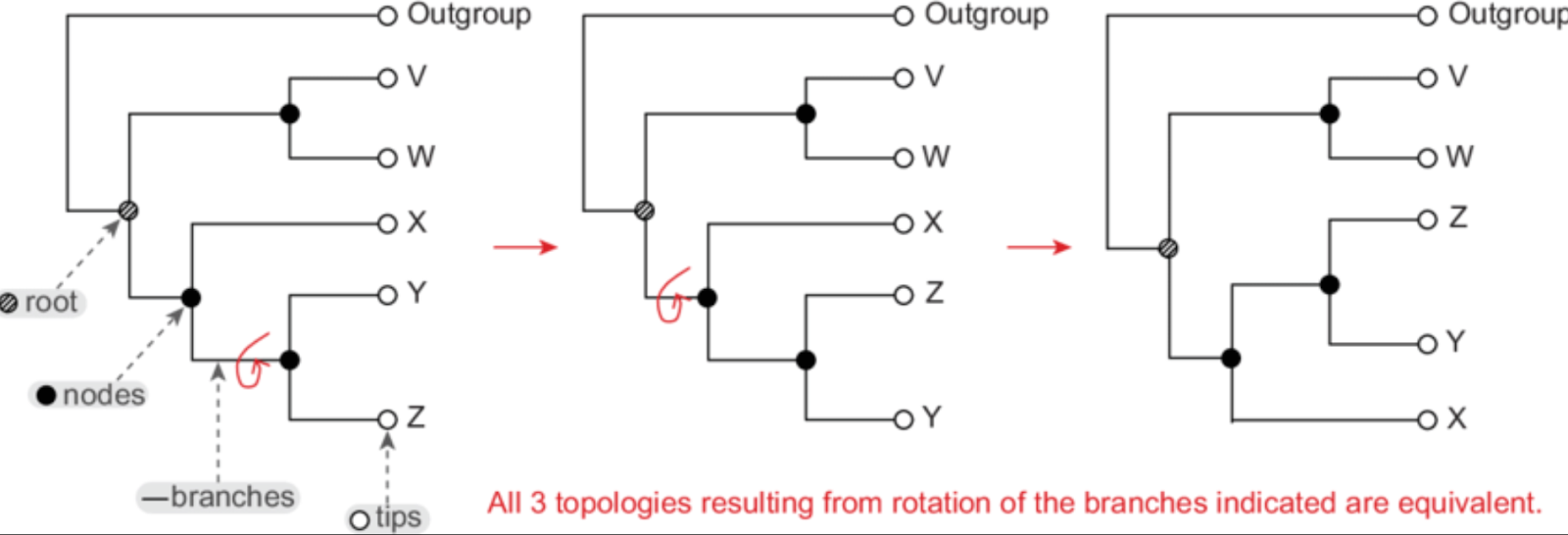
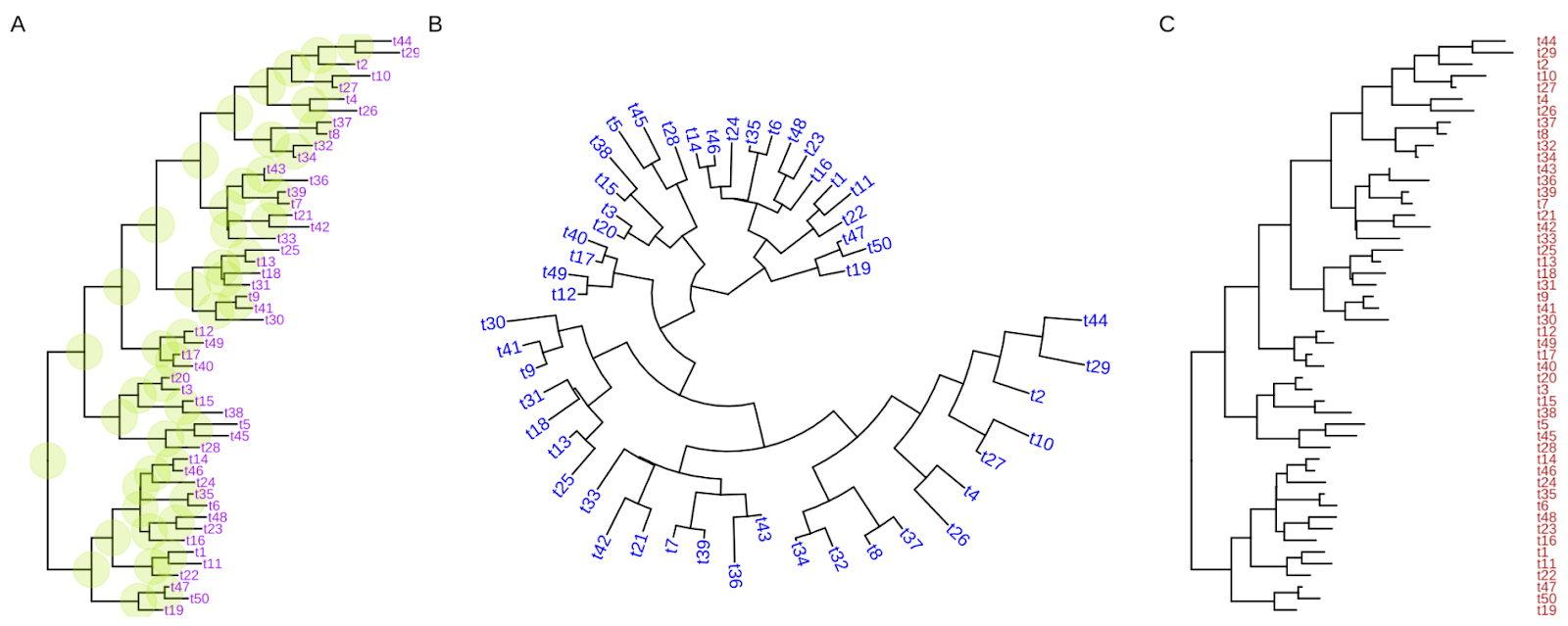
Phylogenetic trees can be displayed in different formats—horizontal, vertical, or radial—without changing the underlying relationships. Rotating or rearranging branches does not alter the evolutionary meaning of the tree, as long as the branching order remains the same. Understanding how to read these trees correctly is essential for interpreting evolutionary relationships and for constructing accurate phylogenetic models.
Below are visual examples of phylogenetic trees that illustrate how evolutionary relationships are represented across different groups of organisms:
- Example 1: Which species are more closely related?
(Source: https://www.khanacademy.org/science/ap-biology/natural-selection/phylogeny/a/building-an-evolutionary-tree;
https://www.istockphoto.com/vector/biological-evolution-animals-scheme-gm500509454-80808691;
https://www.khanacademy.org/science/ap-biology/natural-selection/phylogeny/a/phylogenetic-trees)
In this phylogenetic tree, Species A and Species B share a more recent common ancestor than either does with Species C. This means that A and B are more closely related to each other, even if Species C may look similar or live in a similar environment.
Closeness is determined by shared ancestors, not by appearance or position on the page. - Same relationships, different tree shapes
(Source: https://www.researchgate.net/figure/The-different-parts-of-a-rooted-phylogenetic-tree-showing-the-root-branches-nodes-and_fig1_43022487;
https://yulab-smu.top/treedata-book/chapter4.html; https://users.ugent.be/~avierstr/principles/phylogeny.html)
These trees look different (horizontal, vertical, or radial), but they represent the same evolutionary relationships. Rotating branches or the layout does not alter the meaning of the tree, as long as the branching order remains unchanged.
Tree shape does not change evolutionary relationships. - Misconception – evolution is not a ladder
(Source: https://www.researchgate.net/figure/Tree-format-translations-for-the-ladders-shown-in-Figs-1a-b-along-with-the-associated_fig3_226685940)
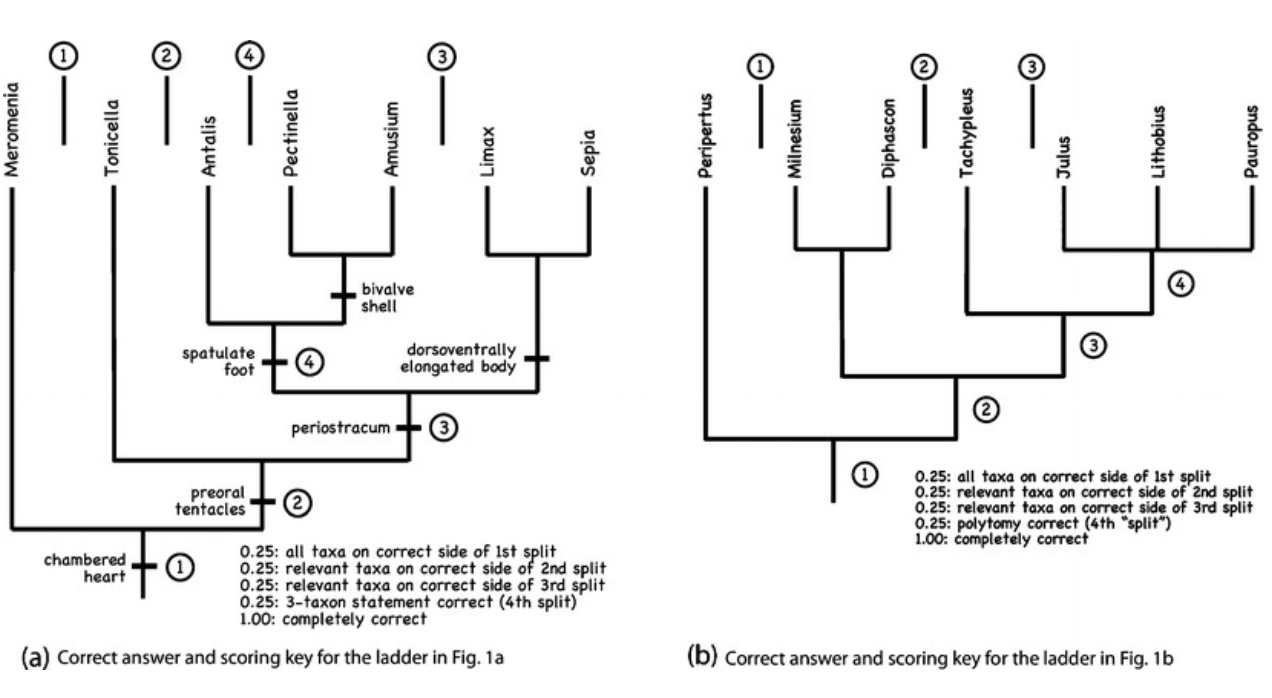
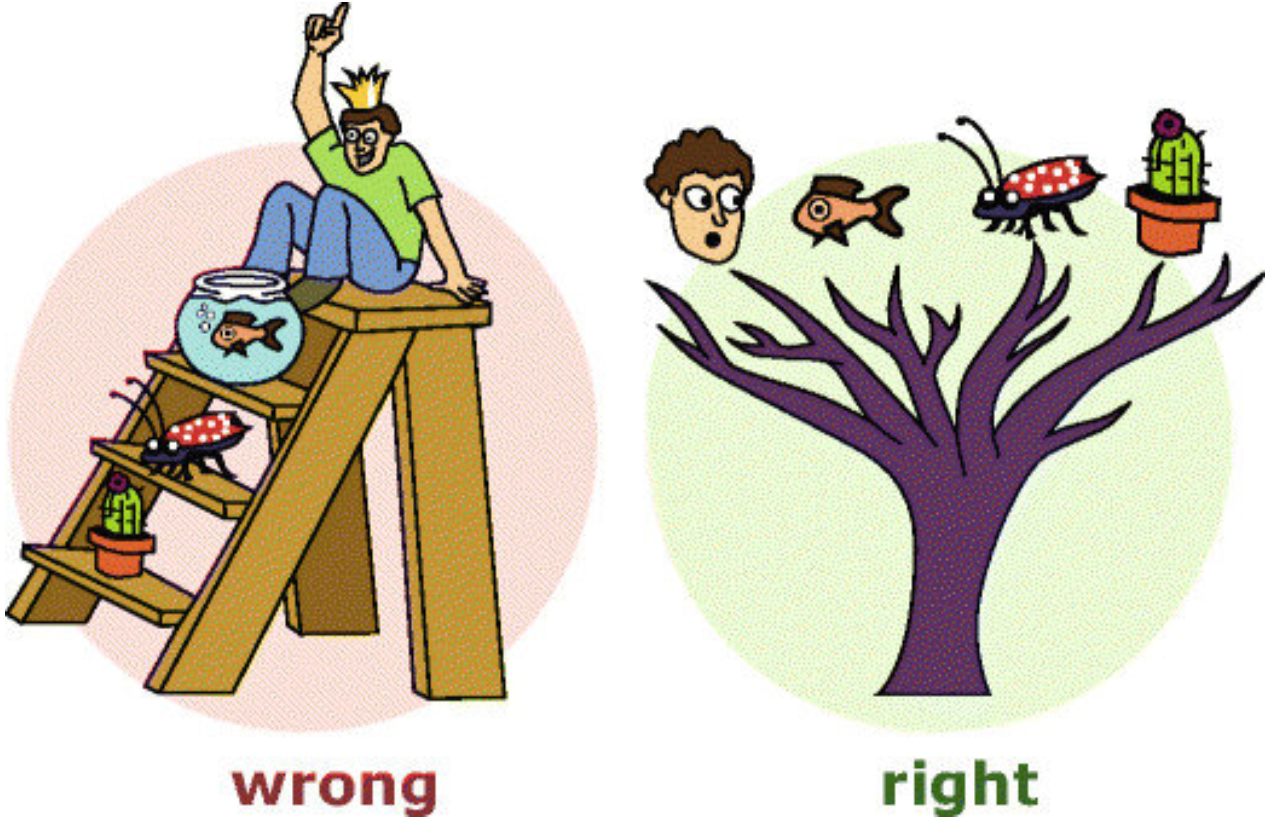
This comparison highlights a common misunderstanding. Evolution is often incorrectly shown as a ladder or linear progression. In reality, evolution works through branching, where multiple lineages evolve simultaneously from common ancestors.
All species at the tips of the tree are equally evolved.