
1. Explore
Insertion Mutations
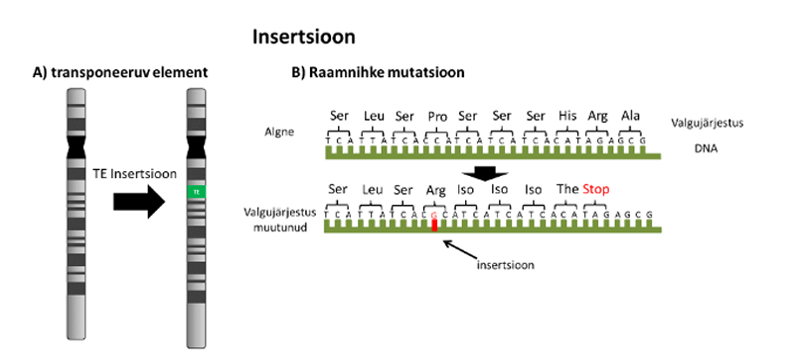
Figure 3. An insertion
An insertion mutation happens when one or more nucleotides are added to the DNA sequence. Insertions can be very small or extremely large, sometimes involving thousands or even millions of nucleotides. Small insertions often occur during DNA replication or DNA repair processes (Alberts et al., 2015).
If nucleotides are inserted into a protein-coding gene and the number of added nucleotides is not divisible by three, the mutation causes a frameshift mutation. This shifts the reading frame of the gene, changing all the codons that follow. As a result, the entire protein sequence is altered, and the protein usually loses its normal function (see Figure 3) (Griffiths et al., 2019).
Frameshift mutations usually affect only one protein because genes are separated by long non-coding regions in the genome. However, the effects on that single protein can be very serious and often lead to disease.
Insertions can also be caused by transposable elements (TEs). These are DNA sequences that can move to different locations within the genome. The most common transposable element in humans is the Alu element, which is about 300 base pairs long and occurs in hundreds of thousands of copies in the human genome (Strachan & Read, 2018).
Transposable elements can move by two main mechanisms:
- “Cut and paste”, where the element is removed from one location and inserted into another.
- “Copy and paste”, where a copy of the element is inserted into a new location while the original remains.
Scientific studies have shown that Alu insertions can disrupt genes and are linked to genetic disorders such as hemophilia and breast cancer (National Human Genome Research Institute [NHGRI], 2023).