
Brainstorming activities in the classroom
Basic Level
Neurons
What is the structure of the neuron?
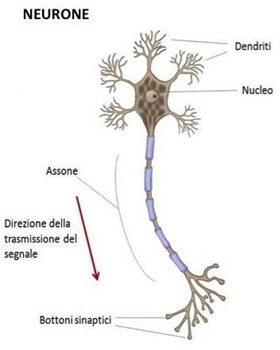
The human brain contains about 100 billion cells, neurons, specialized in the transmission of nerve signals, mainly of an electrical nature. A neuron is made up of several parts, with specific functions: a cell body (or soma), containing the nucleus, dendrites and axon. The nerve signal, coming from other neurons or from the receptor organs is collected and transmitted to the nucleus through the dendrites, short and branched extensions of the nucleus. Inside the cell body, the signal is processed and transmitted to the axon, which is a very long extension with the task of carrying the electrical signal to other cells. Separating the inside of the neuron from the external interstitial fluid is the cytoplasmic membrane. Axons are sometimes enveloped for most of their length by a thick insulating material, the myelin sheath. In its final part, the axon branches into a variable number of endings, the synaptic buttons, where the electrical signal is converted into a chemical signal, through a neurotransmitter.
Source image: Online Medicine
What happens when a neuron is not stimulated? What physicochemical characteristics allow us to describe the behaviour of the neuron?
Neurons have a difference in electrical potential between the inside and outside of the cytoplasmic membrane, mainly due to a different concentration of sodium Na+ and potassium K+ ions on the two sides of the membrane. When the neuron is at rest, i.e. it does not transmit signals, this potential difference, called resting potential, has values between -60 mV and -80 mV. The cytoplasmic membrane has ion channels and pumps that open and close in response to certain stimuli, regulating the passage of ions and consequently changing the electrical potential.
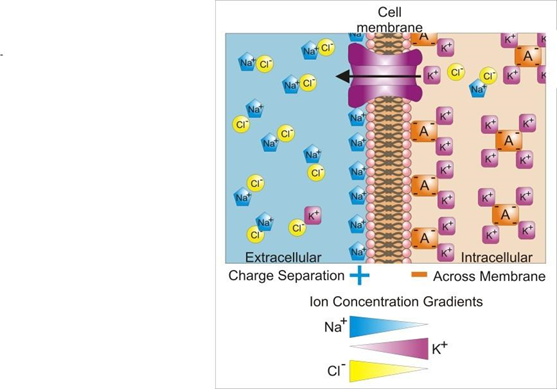
The inside of the cell is rich in K+ ions and negative ions bound to organic macromolecules, while the outside of the cell is rich in Na+ and Cl- ions. The concentration of Na+ ions and K+ ions is regulated by three membrane proteins called ion channels or pumps:
- sodium channels;
- potassium channels;
- the sodium-potassium pump.
The neuron's membrane has many potassium channels: these channels push K+ ions from inside the membrane to the outside, although in this way they increase negativity inside the cell. On the other hand, negative ions inside the cell cannot diffuse outside because they are too large to cross the membrane.
Sodium channels are few and tend to diffuse sodium ions inwards.
The sodium-potassium pump acts against the natural direction of ion flow, pushing Na+ out and K+ inside the cell. When at rest, the membrane is practically impermeable to the ingress of Na+ ions.
 |
Let's think about it together: Neurons are the oldest cells in the body: they are unable to duplicate themselves and in the event of lesions that lead to their death, those around them are unable to replace them. As the years go by, the functionality of the Nervous System becomes less effective: research is therefore interested in finding new methods to enhance the brain's ability to produce new neurons (neurogenesis) to improve learning and memory. What can you do to keep your neurons healthy? How can you keep your mind trained? |