
Brainstorming activities in the classroom
Basic Level
The physical model of signal propagation in a neuron
What physical model can explain the principle of operation of a neuron?
For a quick refresher on capacitance and capacitors: Capacitors and capacitance of a capacitor (youmath.it)
For a quick refresher on resistance and resistors: Resistors, electrical resistance and electrical resistivity (youmath.it)
The axon is similar to a coaxial cable. The inner part of the axon is the central conducting core of the cable.
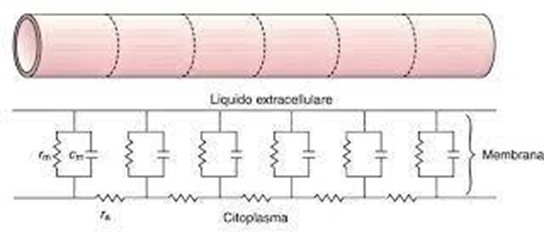
Its strength is high, mainly due to its small cross-section. To describe the electrical properties of the cytoplasm, the resistance per unit length ri is introduced.
The external part of the axon is also a conductor, but the external section is much larger than the internal one and therefore the resistance offered by the interstitial fluid is negligible compared to the internal one. The insulating membrane constitutes a capacitor, since the inside and outside of the axon behave like two conducting plates, storing charges of opposite signs. In parallel with the capacitor, a resistance must be considered, which considers the flow of ions through the membrane itself. To schematize the electrical behaviour of the membrane, two quantities are introduced, the capacitance per unit length cm and the conductivity per unit length of the membrane σμ (φρομ ωηιχη ωε ωιλλ δεριϖε τηε resistance of the membrane per meter rm).
The axon can then be schematized by a circuit consisting of a succession of meshes with resistors and capacitors.
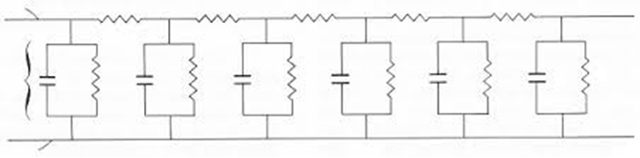
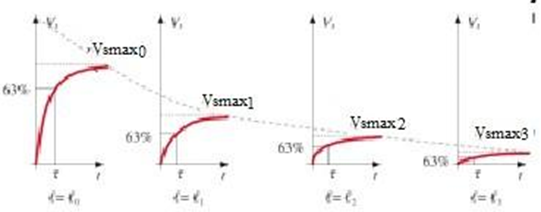
The stimulus potential will depend on the time and location along the axon. In fact, it is characterized by two parameters: the time constant τ and the space constant λ. The mathematical model of the circuit allows us to derive the trend of the potential both as a function of time and as a function of position. In the first case we will have:

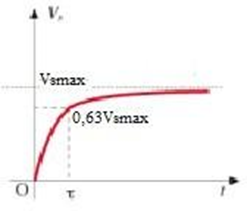
where Vsmax is the maximum value reached by the potential and τ =rmcm.
The time constant τ (on the order of ms) is the time interval it takes for the stimulus potential to reach 63% of its maximum value: it is a measure of how fast the neuron responds.
As we move away from the point where it is generated, the stimulus potential decays with distance due to the combined effects of the ri and rm resistances.
The stimulus potential tends to decrease according to the law:
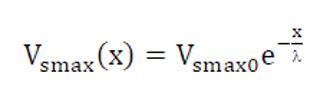
where Vsmax0 is the stimulus potential at the site of origin and λ is the space constant.
The space constant λ (of the order of mm) is the distance at which the initial potential difference decays to 37% of its maximum value.
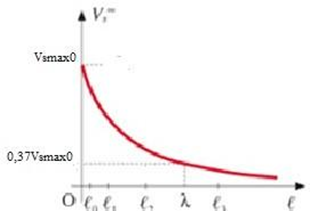
It is a measure of how far the current can flow down the axon before dissipating due to leakage currents.
So after traveling a distance of λ, the signal has reduced to about 1/3 and after 2 λ it is about 1/7 of the original signal and can no longer trigger the action potential. In reality, the stimuli travel considerably longer distances, of the order of a couple of meters, due to the intervention of other mechanisms that we are not considering. Mathematically, the space constant is described as:
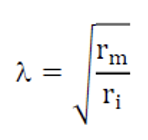
The main factor influencing the internal resistance ri is the radius of the axon: axons of large diameter have a lower resistance to longitudinal current flows and, therefore, a lower axial resistance; consequently, they will have a of the axon ra.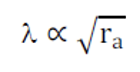
What does the speed of propagation of the nerve impulse depend on?
The knowledge of the two constants allows us to find the speed of propagation of the electrical signal along an axon:
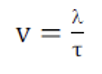 and therefore, to deduce that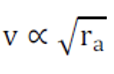
relationship that agrees with the experimental results.
 |
Let's reflect together: The term model is a representation sometimes a simplification of a phenomenon capable of explaining how it works. Using a physical model to interpret and understand a biological phenomenon answers to the need highlighted by several neuroscience scholars of |