
Bio-inspired design process
Nature capabilities
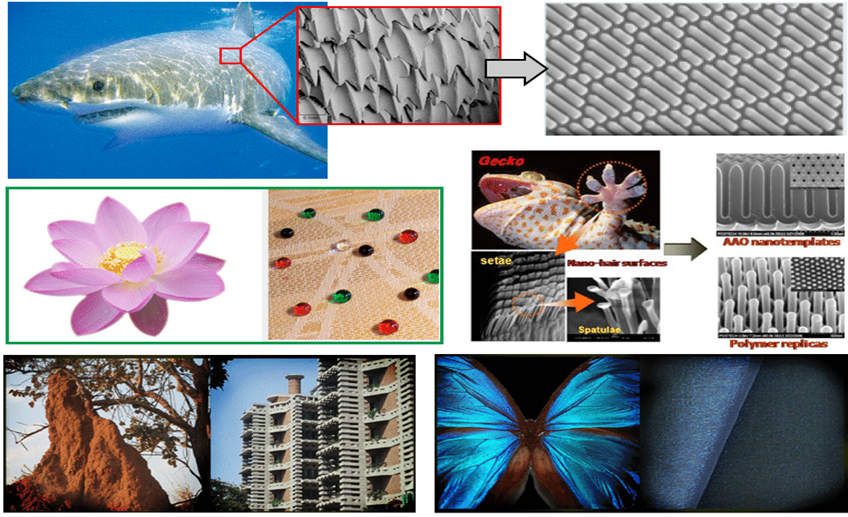
Some of nature’s capabilities can inspire new mechanisms, devices and robots. Examples may include the woodpecker’s ability to impact wood while suppressing the effect from damaging its brain. Another inspiring capability is the ability of numerous creatures to operate with multiple mobility options including flying, digging, swimming, walking, hopping, running, climbing, crawling. Increasingly, biologically inspired capabilities are becoming practical including collision avoidance using whiskers or sonar, controlled camouflage, and materials with self-healing. One of the challenging capabilities will be to create miniature devices that can:
- fly with enormous maneuverability like a dragonfly;
- adhere to smooth and rough walls like a gecko;
- adapt to the texture, patterns and shape of the surrounding environment like a chameleon, or reconfigure their body to travel through very narrow tubes like an octopus;
- process complex three-dimensional (3D) images in real time;
- recycle mobility power for highly efficient operation and locomotion;
- self-replicate, self-grow using resources from the surrounding;
- chemically generate and store energy; and many other capabilities for which biology offers a model for science and engineering inspiration.
While many aspects of biology are still beyond our understanding, significant progress has been made.