Explore Module
Engagement phase
Guiding question. Do we see with our eyes or with our brain?
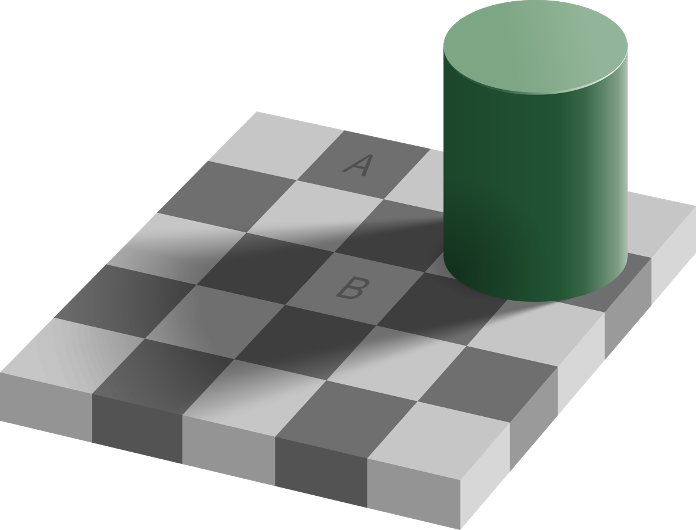
The lesson opens with a brief visual stimulus: a picture in which the same surface appears to have different colors depending on the surrounding context, or a brightness illusion. The purpose is not to “deceive” students, but to introduce the idea that vision is not a mere optical recording—it is an interpretation of physical signals performed by biological structures.

Initial stimuli (videos and short resources)
How the Eyes Work – National Eye Institute (NEI): a clear overview of the main parts of the eye and the light path through the ocular media.
https://www.nei.nih.gov/learn-about-eye-health/healthy-vision/how-eyes-work
Our Eyes – Our Vision – Science Learning Hub: an accessible summary of the neural pathway from retina → optic nerve → brain.
https://www.sciencelearn.org.nz/resources/3006-our-eyes-our-vision
PhET – Geometric Optics (lenses/images): a short interactive exploration about refraction and focusing.
https://phet.colorado.edu/sims/html/geometric-optics/latest/geometric-optics_all.html
Kick-off activity (5–10 min).
A quick projection of an optical illusion or a short video clip invites students to ask, “Why do we see something that isn’t there?”
The goal is to highlight that vision is an interpretative process guided by the brain, not just an optical “input”.
Suggested video: How Vision Works (Academy of Science – Curious)
https://www.science.org.au/curious/video/vision