
1. Explore - Foundations of Viruses, Their Parts and Types
In this section, students build the scientific foundation needed to understand what viruses are and why they are unique biological entities. They explore how viral structure relates to function, how viruses replicate using host cells, and how viruses can be classified into different types. This Explore phase prepares learners for the next stages of the unit, where they will model viruses using 3D tools and visualize them in Augmented Reality (AR), transforming invisible biology into interactive learning objects.
1.1 What is a Virus?
A virus is a microscopic infectious agent that cannot reproduce independently. Unlike living cells, viruses do not have the full machinery needed to produce energy, grow, or divide. Instead, they must enter a host cell and “use” the host’s internal systems to create new virus particles.
Viruses can infect many types of organisms, including animals, plants, fungi, and bacteria. Although simple in structure, viruses can spread efficiently and evolve quickly, which is why they are important in biology, biotechnology, and public health.
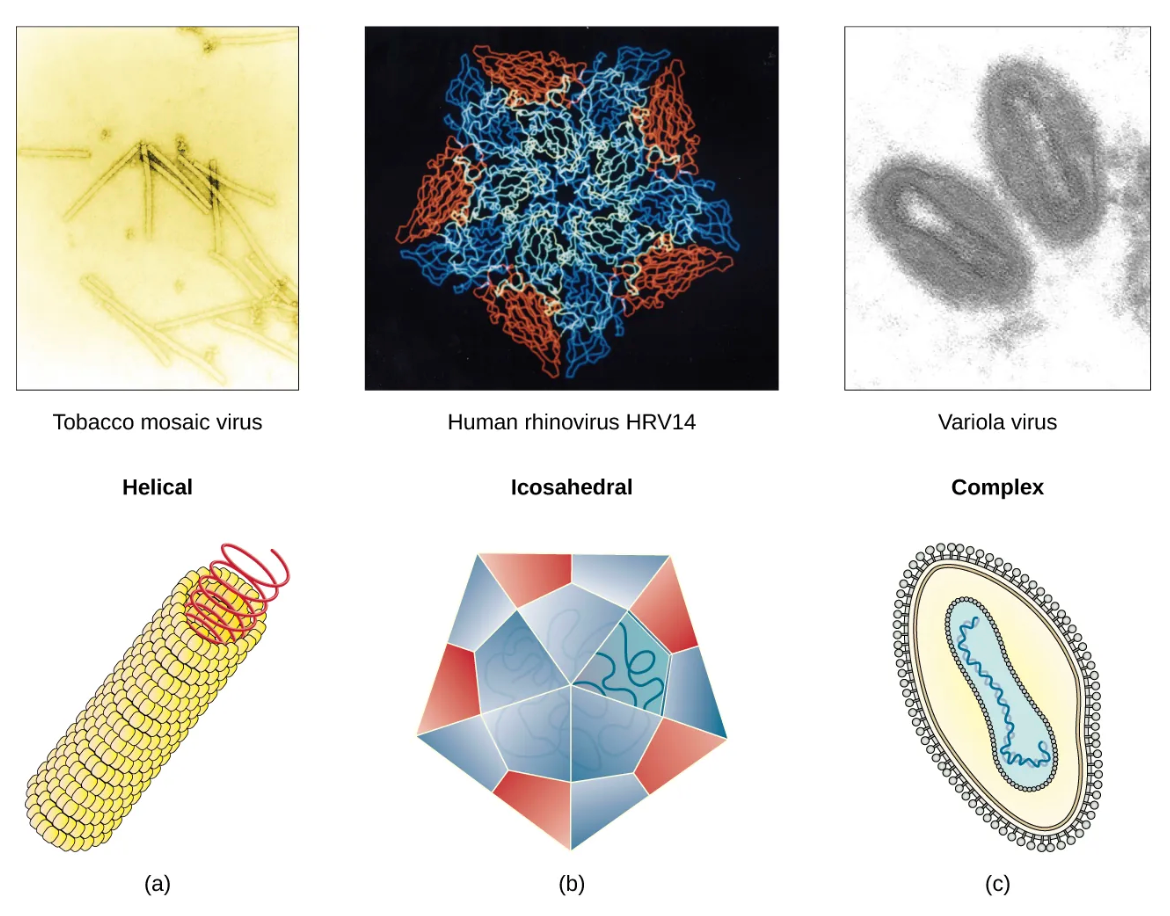
Figure 1. Viruses example. Source:
https://openstax.org/books/biology-2e/pages/21-1-viral-evolution-morphology-and-classification
Example
The influenza virus cannot make proteins on its own. Only after it enters a human cell can it use the cell’s machinery to produce new virus particles. This dependency explains why viruses are inactive outside a host.