
Physics and Chemistry activities
Advanced level
A big debate to reduce human’s environmental impact concerns the chose materials for buildings constructions. As shown in Figure, the building is a process that requires energy during the whole lifetime. Steve Howard, the corporate innovator of IKEA, resumes the compelling needs of sustainability considering that:
“we’re building cities like never before, bringing people out of poverty like never before and changing the climate like never before. Sustainability has gone from a nice-to-do to a must- to do”
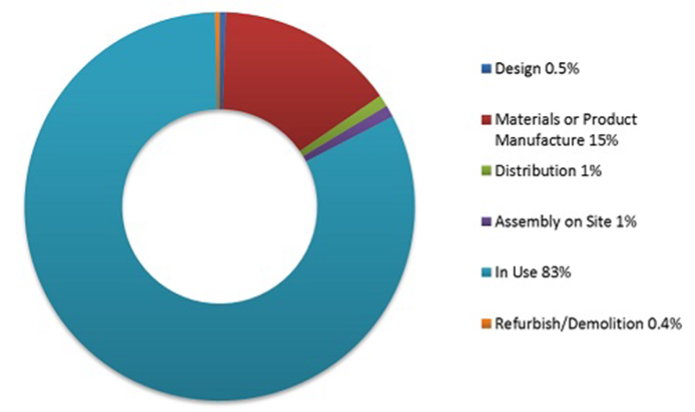
Current energy required for building constructions
In buildings, it is possible to save energy both in the used materials and in the improvement of the life cycle of the buildings.
Recalling the concept of circular economy, building materials that required less energy and come from recycled materials already exist. For example, the use of sedimentary rock or recycled glass particularly appreciated for their high mechanical resistance. But the new frontier of eco-building seems to be the cork.
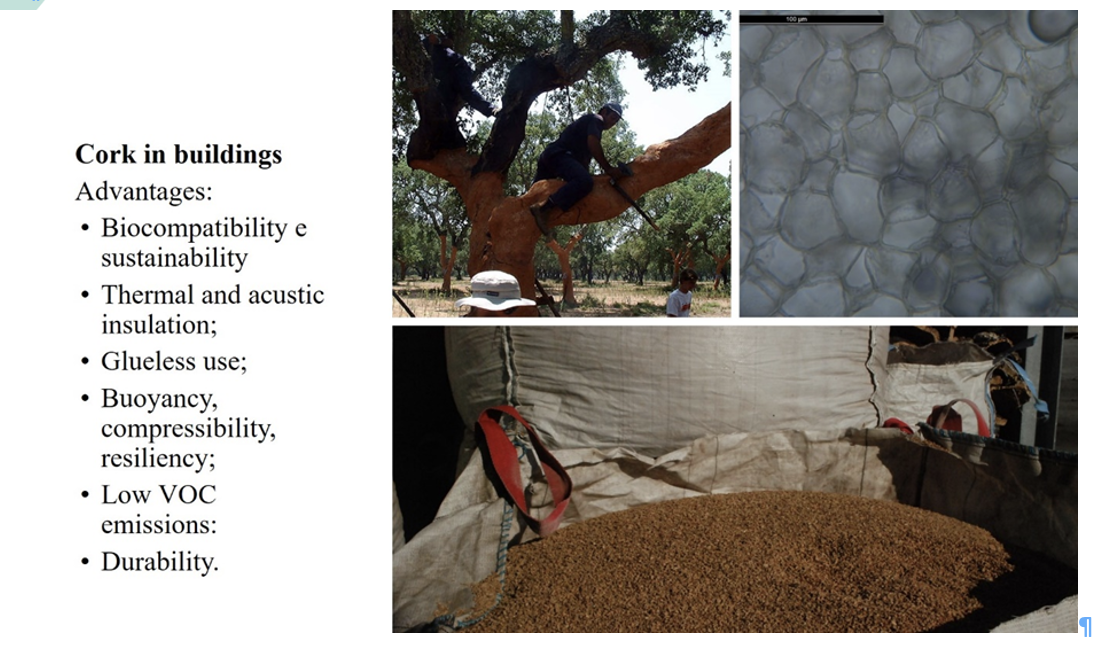
Due to the fact that more than 50% of the cell volume of a cork piece consists of air, cork is one of the lightest solid substances. Because heavy pressure does not break down or destroy the tiny air cells but compresses the air within the cells, the cork begins to spring back when the pressure is removed. A roll or sheet of composition cork can be compressed in one direction without losing its dimensions in the other direction. This is of great importance for many applications of composition cork. Moreover, cork is a highly frictional material, both in its natural form as well as in cork composition. Even when wet or coated with oil or grease, cork retains this quality which surpasses that of leather, rubber, and many other products used for frictional or non-skid purposes. The high degree of stability under varying conditions is paramount to the continuing success and use of cork in the world today.
Cork thermal insulation is primarily made from cork oak and can be produced as both a filler material or as boards. Typical thermal conductivity values for cork are between 40 and 50 mW/mK. Cork insulation products may be perforated and also cut and adjusted at the building site, without any loss of thermal resistance.
Some disadvantages in the use of cork are related to aesthetic issues as the limited color availability and the possibility to punctuate or damage if employed as a flooring surface.
In conclusion, biomaterials is a science about fifty years old. IUPAC's definition of this word is
“a material exploited in contact with living tissues, organisms or microorganisms”.
So, this term includes even the substances that, combined with a suitable polymeric substrate, are able to interact with biological systems and for that reason are employed also for a medical purpose.
From fashion to design, from building to constructions, biomaterials and their application are multiplying, changing the future of our life.
Advantages & Disadvantages Of Cork Flooring | The Flooring Group🔗