
Physics and Chemistry activities
Basic level
By replacing fossil fuels with renewable energy nations could achieve their emissions commitments without encroaching on vital natural land. Low-emission energy sources like wind and solar can have a larger geographical footprint than fossil-fuel plants of equivalent capacity. Even so, the renewable-energy potential of already developed land is more than enough to fulfill pledges made as part of the Paris Agreement and could satisfy the total energy demand projected for 2050. At the 21st Conference of the Parties (COP21) in Paris in 2015, 196 countries agreed to aim to limit warming to less than 2 °C above pre-industrial levels. The rapid cuts in greenhouse-gas emissions imply a large-scale shift away from fossil fuels.
Renewable-energy schemes are not without environmental impact themselves, however, so it’s important to choose locations and generation techniques that cause the least possible harm. Similar to conventional energy sources, we need to think beyond just the direct footprint of the wind turbine or solar panel and consider the associated structures and roads that renewable energy development brings with it.
The first step is the mapping of each country’s potential for wind and solar energy generation. We also should include the potential output from retrofitting existing hydroelectric plants – assuming their efficiency could be slightly improved – and repurposing non-hydroelectric dams to become power-generating.
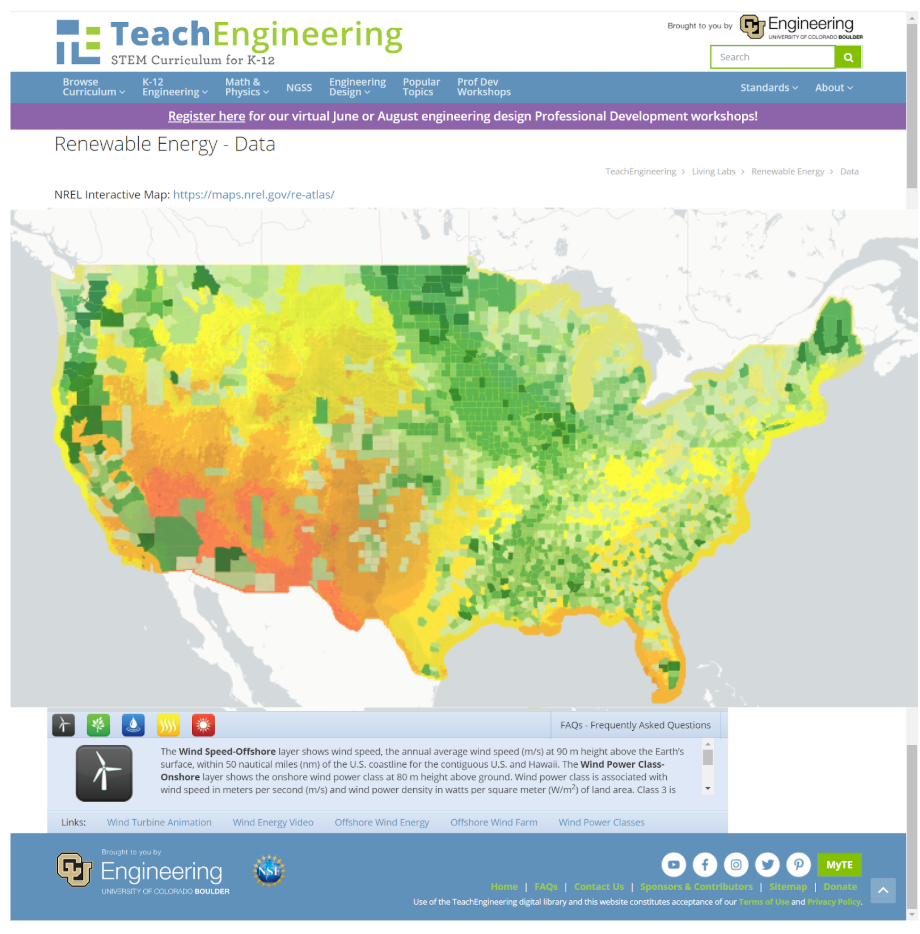
To achieve this task, we can exploit the potentialities of the
- Lab on Renewable Energy powered by Teach Engineering, University of Colorado, Boulder: https://www.teachengineering.org/livinglabs/renewableenergy912🔗
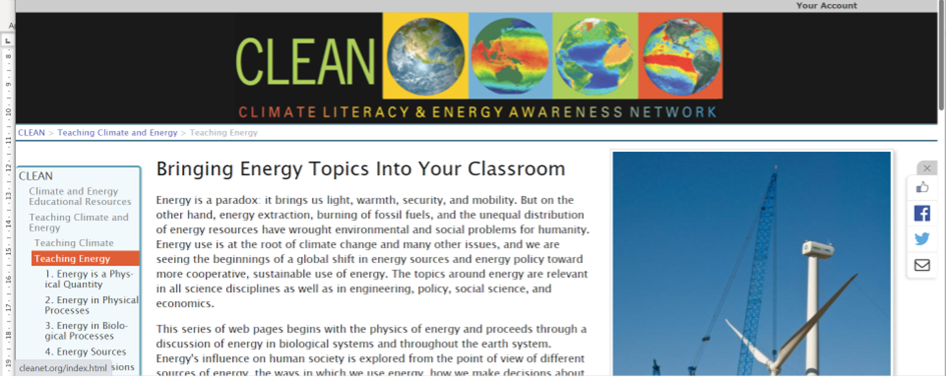
Or exploiting the
- CLEAN Collection of Climate and Energy Educational Resources, a collection of 700+ free, ready-to-use learning resources rigorously reviewed by educators and scientists suitable for secondary through higher education classrooms. https://cleanet.org/index.html🔗
Resources of the National Renewable Energy Laboratory (NREL) https://www.nrel.gov/index.html🔗
- Data and tools: Find NREL-developed data sets, maps, models, and tools used for the analysis of energy and energy efficiency technologies.
- Energy basics: Learn about the basics of research areas—bioenergy, geothermal, hydrogen, solar, transportation, wind, and water.